South Texas Diabetes and Obesity Institute, Department of Human Genetics, School of Medicine, University of Texas Rio Grande Valley, Edinburg, TX, USA.
Department of Food Science, Purdue University, West Lafayette, IN, USA.
Sci Rep. 2021 Jan 13;11(1):871. doi: 10.1038/s41598-020-79387-8.
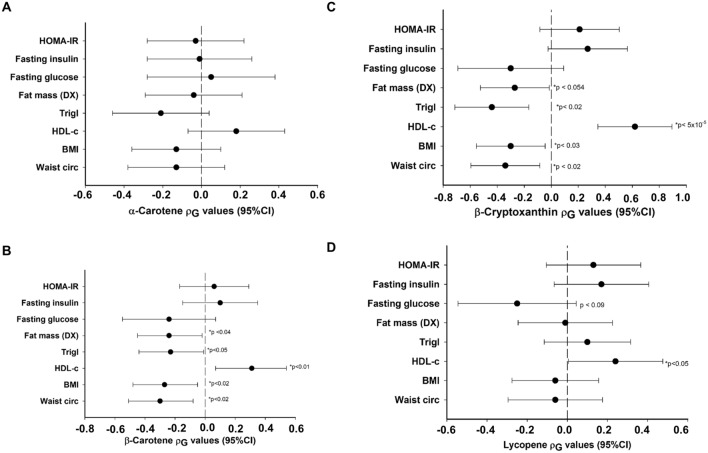
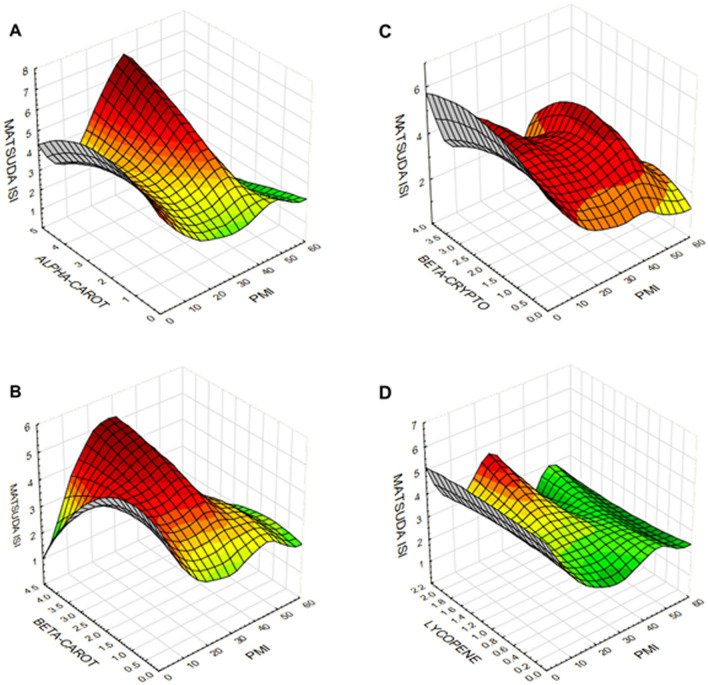
High concentrations of carotenoids are protective against cardiometabolic risk traits (CMTs) in adults and children. We recently showed in non-diabetic Mexican American (MA) children that serum α-carotene and β-carotene are inversely correlated with obesity measures and triglycerides and positively with HDL cholesterol and that they were under strong genetic influences. Additionally, we previously described a Pediatric Metabolic Index (PMI) that helps in the identification of children who are at risk for cardiometabolic diseases. Here, we quantified serum lycopene and β-cryptoxanthin concentrations in approximately 580 children from MA families using an ultraperformance liquid chromatography-photodiode array and determined their heritabilities and correlations with CMTs. Using response surface methodology (RSM), we determined two-way interactions of carotenoids and PMI on Matsuda insulin sensitivity index (ISI). The concentrations of lycopene and β-cryptoxanthin were highly heritable [h = 0.98, P = 7 × 10 and h = 0.58, P = 1 × 10]. We found significant (P ≤ 0.05) negative phenotypic correlations between β-cryptoxanthin and five CMTs: body mass index (- 0.22), waist circumference (- 0.25), triglycerides (- 0.18), fat mass (- 0.23), fasting glucose (- 0.09), and positive correlations with HDL cholesterol (0.29). In contrast, lycopene only showed a significant negative correlation with fasting glucose (- 0.08) and a positive correlation with HDL cholesterol (0.18). Importantly, we found that common genetic influences significantly contributed to the observed phenotypic correlations. RSM showed that increased serum concentrations of α- and β-carotenoids rather than that of β-cryptoxanthin or lycopene had maximal effects on ISI. In summary, our findings suggest that the serum carotenoids are under strong additive genetic influences and may have differential effects on susceptibility to CMTs in children.
类胡萝卜素浓度高可预防成年人和儿童的心脏代谢风险特征(CMTs)。我们最近在非糖尿病的墨西哥裔美国(MA)儿童中表明,血清α-胡萝卜素和β-胡萝卜素与肥胖指标和甘油三酯呈负相关,与 HDL 胆固醇呈正相关,并且它们受到强烈的遗传影响。此外,我们之前描述了一种儿科代谢指数(PMI),有助于识别患有心脏代谢疾病风险的儿童。在这里,我们使用超高效液相色谱-光电二极管阵列在约 580 名 MA 家族的儿童中定量了血清番茄红素和β-隐黄质的浓度,并确定了它们与 CMT 的遗传力和相关性。使用响应面法(RSM),我们确定了类胡萝卜素和 PMI 对 Matsuda 胰岛素敏感性指数(ISI)的双向相互作用。番茄红素和 β-隐黄质的浓度具有高度的遗传力[h = 0.98,P = 7×10 和 h = 0.58,P = 1×10]。我们发现 β-隐黄质与五个 CMT 之间存在显著的(P≤0.05)负表型相关性:体重指数(-0.22),腰围(-0.25),甘油三酯(-0.18),脂肪量(-0.23),空腹血糖(-0.09),与 HDL 胆固醇呈正相关(0.29)。相比之下,番茄红素仅与空腹血糖呈显著负相关(-0.08),与 HDL 胆固醇呈正相关(0.18)。重要的是,我们发现常见的遗传影响对观察到的表型相关性有显著贡献。RSM 显示,血清中α-和β-胡萝卜素浓度的增加而不是β-隐黄质或番茄红素浓度的增加对 ISI 有最大的影响。总之,我们的研究结果表明,血清类胡萝卜素受强烈的加性遗传影响,可能对儿童 CMT 的易感性有不同的影响。