Laboratory of Precision- and Nanomedicine, Institute of Biomedicine and Translational Medicine, University of Tartu, Tartu, 50411 Tartu, Estonia.
Faculty of Medicine, University of Latvia, Riga, LV-1586, Latvia.
Nucleic Acids Res. 2021 Apr 19;49(7):e38. doi: 10.1093/nar/gkaa1279.
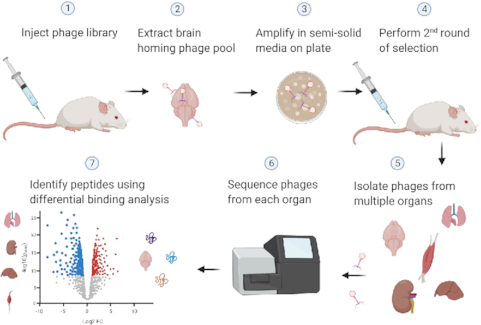
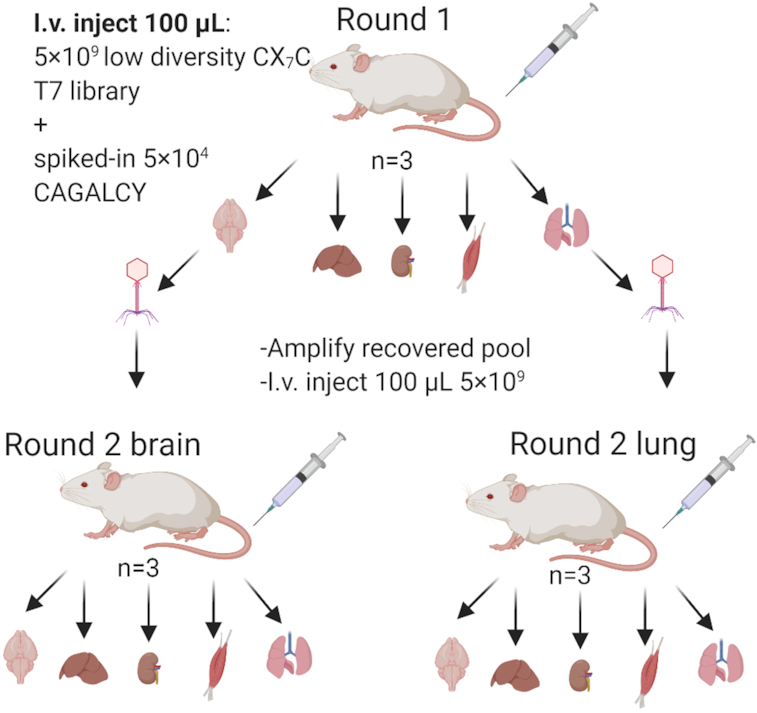
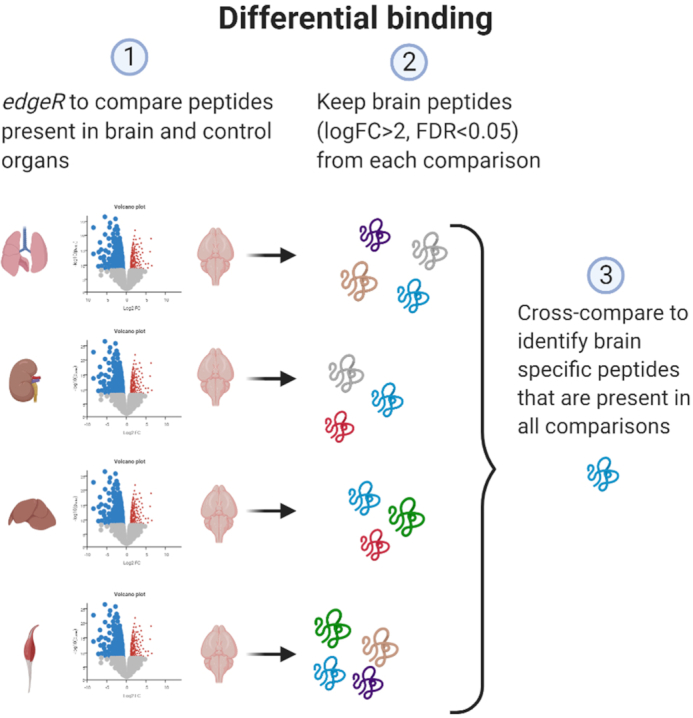
In vivo phage display is widely used for identification of organ- or disease-specific homing peptides. However, the current in vivo phage biopanning approaches fail to assess biodistribution of specific peptide phages across tissues during the screen, thus necessitating laborious and time-consuming post-screening validation studies on individual peptide phages. Here, we adopted bioinformatics tools used for RNA sequencing for analysis of high-throughput sequencing (HTS) data to estimate the representation of individual peptides during biopanning in vivo. The data from in vivo phage screen were analyzed using differential binding-relative representation of each peptide in the target organ versus in a panel of control organs. Application of this approach in a model study using low-diversity peptide T7 phage library with spiked-in brain homing phage demonstrated brain-specific differential binding of brain homing phage and resulted in identification of novel lung- and brain-specific homing peptides. Our study provides a broadly applicable approach to streamline in vivo peptide phage biopanning and to increase its reproducibility and success rate.
体内噬菌体展示被广泛用于鉴定器官或疾病特异性归巢肽。然而,目前的体内噬菌体筛选方法无法在筛选过程中评估特定肽噬菌体在组织中的生物分布,因此需要对单个肽噬菌体进行繁琐和耗时的筛选后验证研究。在这里,我们采用用于 RNA 测序的生物信息学工具来分析高通量测序 (HTS) 数据,以估计体内生物筛选过程中各个肽的代表性。使用体内噬菌体筛选的数据,通过目标器官与一组对照器官中每个肽的差异结合-相对代表性进行分析。该方法在使用掺入脑归巢噬菌体的低多样性肽 T7 噬菌体文库的模型研究中的应用表明,脑归巢噬菌体具有脑特异性差异结合,并导致鉴定出新型肺和脑特异性归巢肽。我们的研究提供了一种广泛适用的方法来简化体内肽噬菌体生物筛选,并提高其重现性和成功率。