School of Nursing, University of Pennsylvania, 418 Curie Blvd, Philadelphia, PA, 19104, USA.
Children's Hospital of Philadelphia, 3401 Civic Center Blvd, Philadelphia, PA, USA.
BMC Palliat Care. 2021 Jan 14;20(1):17. doi: 10.1186/s12904-020-00703-0.
Many children with serious illnesses are receiving palliative and end-of-life care from pediatric palliative and hospice care teams at home (PPHC@Home). Despite the growth in PPHC@Home, no standardized measures exist to evaluate whether PPHC@Home provided in the U.S. meets the needs and priorities of children and their families.
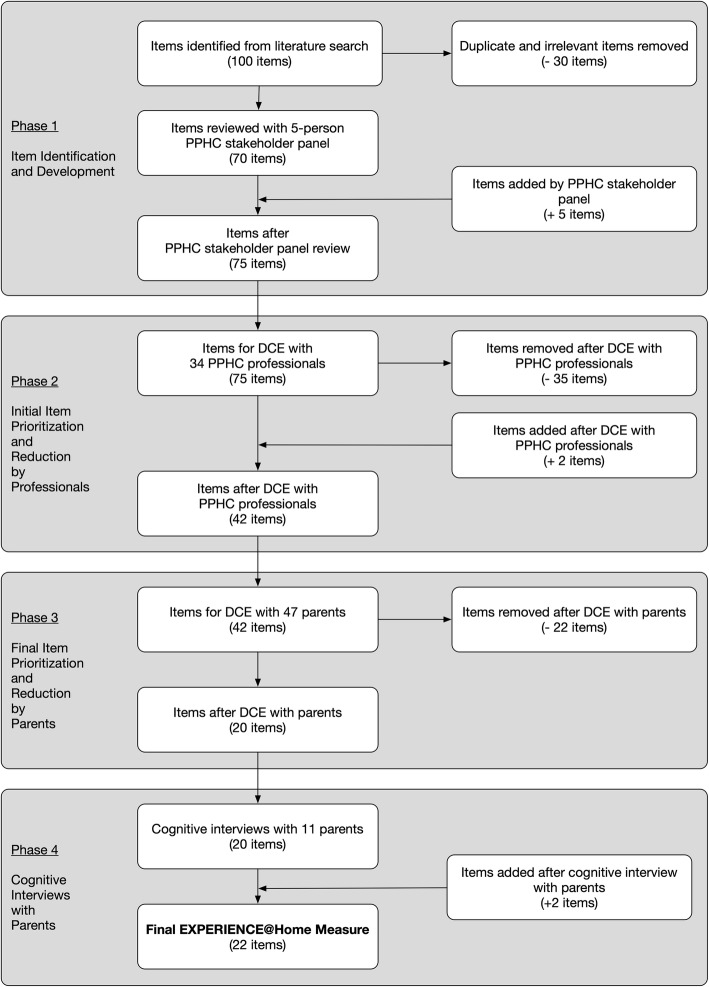
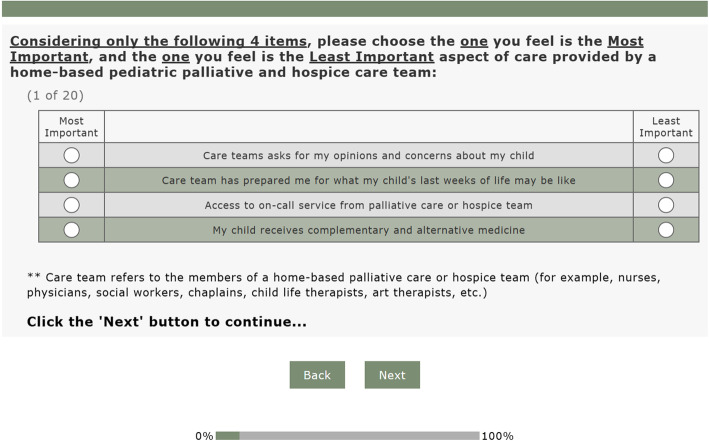
We developed and conducted a preliminary evaluation of a family-reported measure of PPHC@Home experiences using a multi-method, multi-stakeholder approach. Our instrument development process consisted of four phases. Item identification and development (Phase 1) involved a comprehensive literature search of existing instruments, guidelines, standards of practice, and PPHC@Home outcome studies, as well as guidance from a PPHC stakeholder panel. Phase 2 involved the initial item prioiritization and reduction using a discrete choice experiment (DCE) with PPHC professionals and parent advocates. Phase 3 involved a second DCE with bereaved parents and parents currently receiving care for their child to further prioritize and winnow the items to a set of the most highly-valued items. Finally, we conducted cognitive interviews with parents to provide information about the content validity and clarity of the newly-developed instrument (Phase 4).
Items were compiled predominantly from three existing instruments. Phase 2 participants included 34 PPHC providers, researchers, and parent advocates; Phase 3 participants included 47 parents; and Phase 4 participants included 11 parents. At the completion of Phase 4, the Experiences of Palliative and Hospice Care for Children and Caregivers at Home (EXPERIENCE@Home) Measure contains 22 of the most highly-valued items for evaluating PPHC@Home. These items include "The care team treats my child's physical symptoms so that my child has as good a quality of life as possible", "I have regular access to on-call services from our care team", and "The nurses have the knowledge, skills, and experience to support my child's palliative or hospice care at home."
The EXPERIENCE@Home Measure is the first known to specifically measure family-reported experiences with PPHC@Home in the U.S. Future work will include formal psychometric evaluation with a larger sample of parents, as well as evaluation of the clinical utility of the instrument with PPHC@Home teams.
许多患有重病的儿童正在接受儿科姑息治疗和临终关怀团队的姑息治疗和临终关怀,这些团队在家庭中提供服务(PPHC@Home)。尽管 PPHC@Home 的数量在不断增加,但目前仍没有标准化的措施来评估美国提供的 PPHC@Home 是否符合儿童及其家庭的需求和优先事项。
我们采用多方法、多利益相关者的方法,开发并初步评估了一种家庭报告的 PPHC@Home 体验测量工具。我们的仪器开发过程包括四个阶段。项目识别和开发(第 1 阶段)涉及对现有仪器、指南、实践标准和 PPHC@Home 结果研究的全面文献检索,以及 PPHC 利益相关者小组的指导。第 2 阶段涉及使用离散选择实验(DCE)对 PPHC 专业人员和家长倡导者进行初步的项目优先级排序和简化。第 3 阶段涉及与丧亲父母和目前正在为其子女接受护理的父母进行第二次 DCE,以进一步确定和筛选出最有价值的项目。最后,我们对父母进行了认知访谈,以提供有关新开发仪器的内容有效性和清晰度的信息(第 4 阶段)。
项目主要由三个现有仪器汇编而成。第 2 阶段的参与者包括 34 名姑息治疗提供者、研究人员和家长倡导者;第 3 阶段的参与者包括 47 名家长;第 4 阶段的参与者包括 11 名家长。在第 4 阶段完成时,《在家接受姑息治疗和临终关怀的儿童和照顾者体验量表》(EXPERIENCE@Home)包含了 22 项最有价值的评估 PPHC@Home 的项目。这些项目包括“护理团队治疗我孩子的身体症状,以使我孩子的生活质量尽可能好”、“我可以定期获得我们护理团队的随叫随到服务”和“护士具备支持我孩子在家接受姑息治疗或临终关怀的知识、技能和经验”。
EXPERIENCE@Home 量表是首个专门用于衡量美国家庭中家庭报告的 PPHC@Home 体验的量表。未来的工作将包括对更大样本的父母进行正式心理测量评估,以及与 PPHC@Home 团队一起评估该工具的临床实用性。