Wageningen Bioveterinary Research, Lelystad, The Netherlands.
Laboratory of Entomology, Wageningen University & Research, Wageningen, The Netherlands.
Sci Rep. 2021 Jan 14;11(1):1477. doi: 10.1038/s41598-020-79267-1.
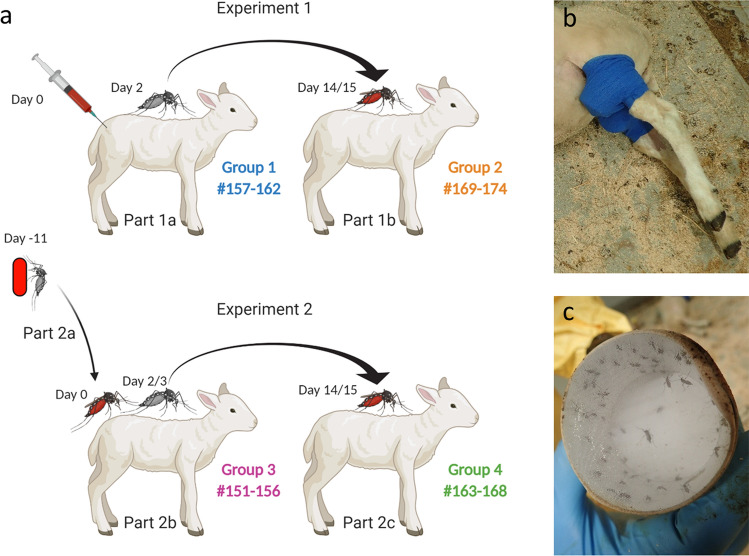
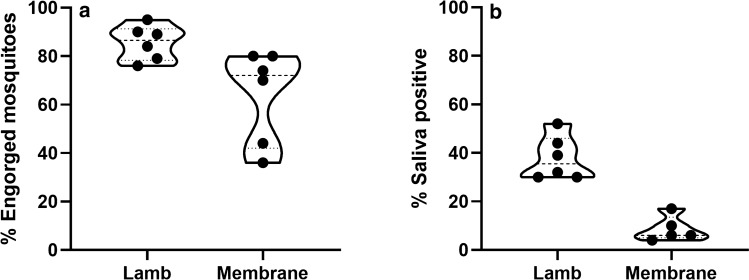
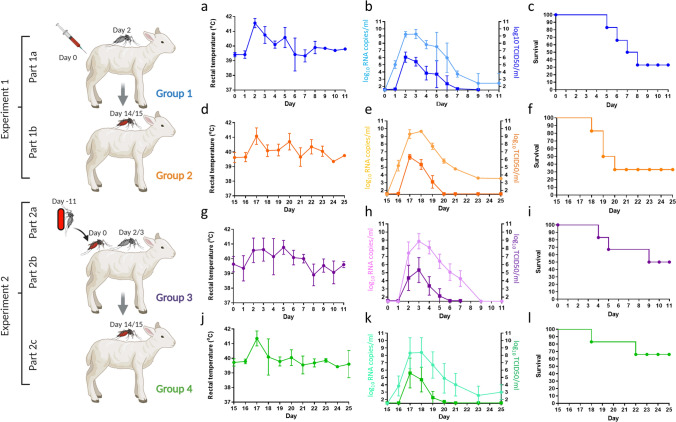
Rift Valley fever virus (RVFV) is a mosquito-borne bunyavirus that is pathogenic to ruminants and humans. The virus is endemic to Africa and the Arabian Peninsula where outbreaks are characterized by abortion storms and mortality of newborns, particularly in sheep herds. Vector competence experiments in laboratory settings have suggested that over 50 mosquito species are capable of transmitting RVFV. Transmission of mosquito-borne viruses in the field is however influenced by numerous factors, including population densities, blood feeding behavior, extrinsic incubation period, longevity of vectors, and viremia levels in vertebrate hosts. Animal models to study these important aspects of RVFV transmission are currently lacking. In the present work, RVFV was transmitted to European (Texel-swifter cross-breed) lambs by laboratory-reared Aedes aegypti mosquitoes that were infected either by membrane feeding on a virus-spiked blood meal or by feeding on lambs that developed viremia after intravenous inoculation of RVFV. Feeding of mosquitoes on viremic lambs resulted in strikingly higher infection rates as compared to membrane feeding. Subsequent transmission of RVFV from lamb to lamb by infected mosquitoes was highly efficient in both models. The animal models described here can be used to study mosquito-mediated transmission of RVFV among the major natural target species and to evaluate the efficacy of vaccines against mosquito-mediated RVFV infection.
裂谷热病毒(RVFV)是一种经蚊子传播的布尼亚病毒,对反刍动物和人类具有致病性。该病毒在非洲和阿拉伯半岛流行,其爆发的特点是流产风暴和新生动物(尤其是绵羊)死亡。实验室中的媒介效能实验表明,超过 50 种蚊子能够传播 RVFV。然而,蚊子传播的病毒在野外的传播受到许多因素的影响,包括种群密度、吸血行为、外潜伏期、媒介寿命以及脊椎动物宿主中的病毒血症水平。目前缺乏用于研究 RVFV 传播这些重要方面的动物模型。在本工作中,通过实验室饲养的埃及伊蚊将 RVFV 传播给欧洲(特克塞尔-斯威夫特杂交种)羔羊,这些蚊子通过膜吸食含病毒的血液餐或通过吸食感染 RVFV 后发生病毒血症的羔羊来感染病毒。与膜吸食相比,给感染病毒的羔羊喂食蚊子导致的感染率明显更高。在这两种模型中,受感染的蚊子从羔羊到羔羊的 RVFV 后续传播效率都非常高。本文描述的动物模型可用于研究主要自然靶标物种中蚊子介导的 RVFV 传播,并评估疫苗对蚊子介导的 RVFV 感染的功效。