Institute of Epidemiology and Health Care, University College London, London, UK.
Public Health, Department of Social Medicine, Osaka University Graduate School of Medicine, Suita, Japan.
Int J Obes (Lond). 2021 Apr;45(4):758-765. doi: 10.1038/s41366-020-00735-9. Epub 2021 Jan 14.
BACKGROUND/OBJECTIVES: The mediating role of eating behaviors in genetic susceptibility to weight gain during mid-adult life is not fully understood. This longitudinal study aims to help us understand contributions of genetic susceptibility and appetite to weight gain.
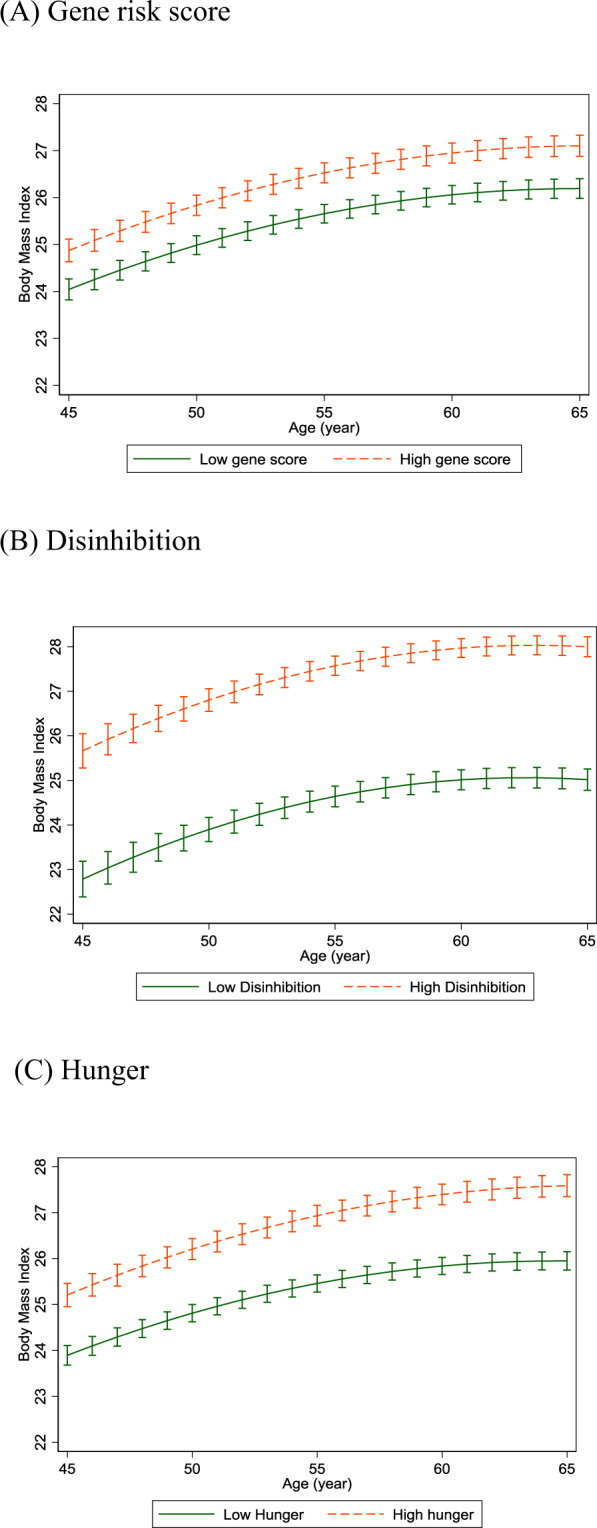
SUBJECTS/METHODS: We followed the body-mass index (BMI) trajectories of 2464 adults from 45 to 65 years of age by measuring weight and height on four occasions at 5-year intervals. Genetic risk of obesity (gene risk score: GRS) was ascertained, comprising 92 BMI-associated single-nucleotide polymorphisms and split at a median (=high and low risk). At the baseline, the Eating Inventory was used to assess appetite-related traits of 'disinhibition', indicative of opportunistic eating or overeating and 'hunger' which is susceptibility to/ability to cope with the sensation of hunger. Roles of the GRS and two appetite-related scores for BMI trajectories were examined using a mixed model adjusted for the cohort effect and sex.
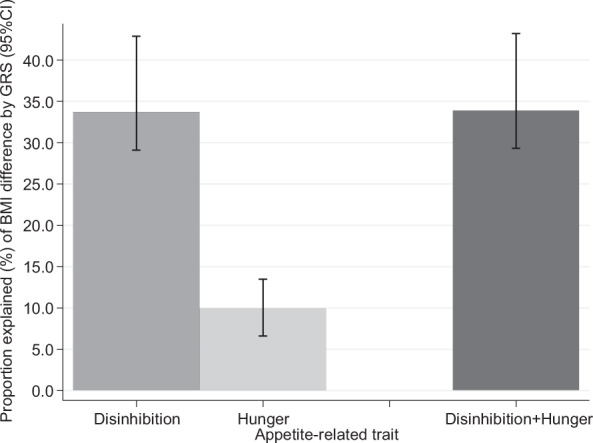
Disinhibition was associated with higher BMI (β = 2.96; 95% CI: 2.66-3.25 kg/m), and accounted for 34% of the genetically-linked BMI difference at age 45. Hunger was also associated with higher BMI (β = 1.20; 0.82-1.59 kg/m) during mid-life and slightly steeper weight gain, but did not attenuate the effect of disinhibition.
Appetite disinhibition is most likely to be a defining characteristic of genetic susceptibility to obesity. High levels of appetite disinhibition, rather than hunger, may underlie genetic vulnerability to obesogenic environments in two-thirds of the population of European ancestry.
背景/目的:在中年时期,遗传易感性对体重增加的中介作用尚不完全清楚。本纵向研究旨在帮助我们了解遗传易感性和食欲对体重增加的贡献。
受试者/方法:我们通过在 5 年的时间间隔内四次测量体重和身高,跟踪了 2464 名年龄在 45 至 65 岁的成年人的体重指数(BMI)轨迹。肥胖的遗传风险(基因风险评分:GRS)是通过确定 92 个与 BMI 相关的单核苷酸多态性来确定的,并按中位数(=高风险和低风险)进行划分。在基线时,使用饮食量表评估与食欲相关的特质,包括“抑制解除”,表示机会性进食或暴饮暴食,以及“饥饿”,表示对饥饿感的易感性/应对能力。使用混合模型,在调整队列效应和性别后,检查 GRS 和两个与食欲相关的评分对 BMI 轨迹的作用。
抑制解除与较高的 BMI 相关(β=2.96;95%CI:2.66-3.25kg/m),并解释了 45 岁时遗传相关 BMI 差异的 34%。饥饿也与中年时较高的 BMI(β=1.20;0.82-1.59kg/m)和稍陡峭的体重增加相关,但不能减弱抑制解除的作用。
食欲抑制解除很可能是肥胖遗传易感性的一个决定性特征。在三分之二的欧洲血统人群中,高水平的食欲抑制解除,而不是饥饿,可能是遗传易感性对肥胖环境的基础。