Deng Shengming, Fan Zhiyao, Xia Huanyu, Gong Yitao, Qian Yunzhen, Huang Qiuyi, Cheng He, Jin Kaizhou, Xiao Zhiwen, Luo Guopei, Yu Xianjun, Liu Chen
Department of Pancreatic Surgery, Fudan University Shanghai Cancer Center, Shanghai, People's Republic of China.
Department of Oncology, Shanghai Medical College, Fudan University, Shanghai, People's Republic of China.
Cancer Manag Res. 2021 Jan 8;13:107-115. doi: 10.2147/CMAR.S275173. eCollection 2021.
The fibrinogen/albumin ratio (FAR) has been widely reported to be a possible biomarker for predicting prognosis in several types of tumors, but the prognostic value of the FAR in pancreatic neuroendocrine neoplasms (Pan-NENs) has not been systematically studied.
In total, 324 patients with Pan-NENs were recruited. The patients were divided into 2 subgroups according to the FAR cutoff value, and clinicopathological characteristics of the 2 subgroups were compared. Overall survival (OS) was the primary endpoint, and progression-free survival (PFS) was the secondary endpoint. The prognostic value of the FAR was analyzed in univariate and multivariate analyses.
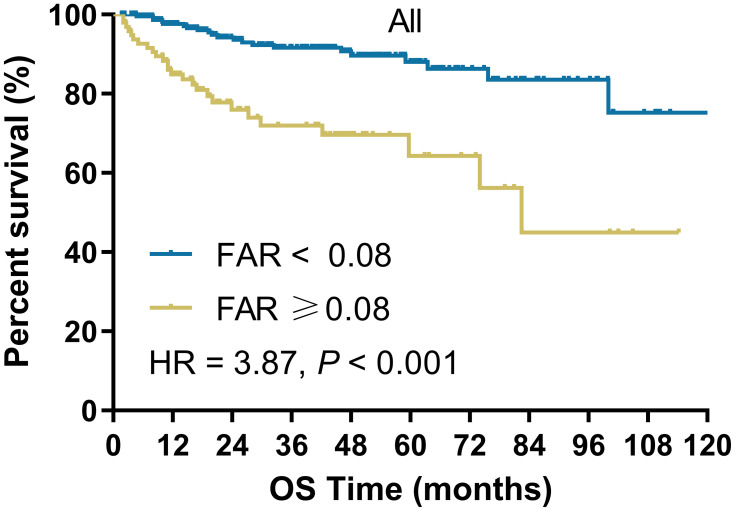
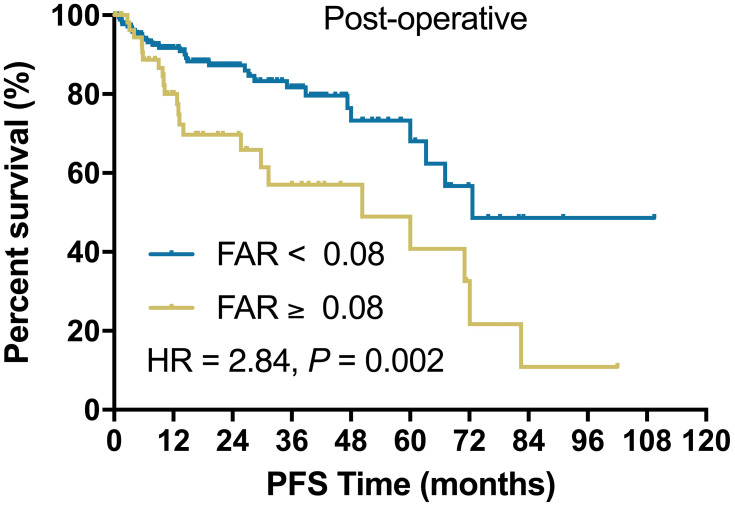
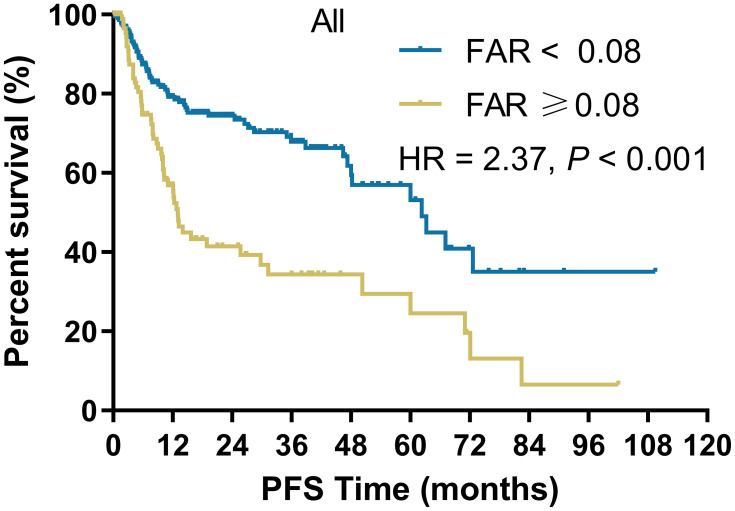
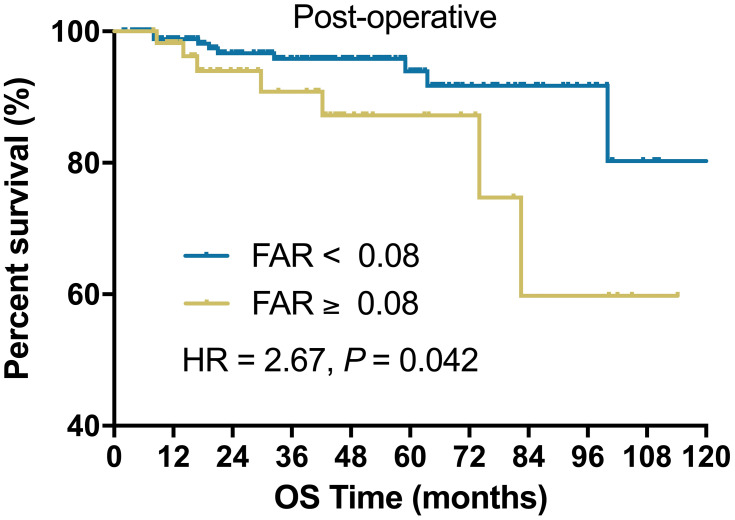
The optimal cutoff value for the FAR was calculated to be 0.08 for OS. The patients with a FAR ≥0.08 had higher proportions of nonfunctioning tumors, Pan-NECs, grade 3 tumors, and stage IV tumors than those with a FAR <0.08. In the univariate analysis, a FAR ≥ 0.08 was associated with poor OS (hazard ratio (HR) = 2.37, < 0.001) and PFS (HR = 2.37, < 0.001). In the multivariate analysis, a FAR ≥0.08 was an independent risk factor for poor OS (HR = 4.70, < 0.001) and PFS (HR = 1.80, = 0.006).
The pretreatment FAR, which includes fibrinogen and albumin, was a feasible and predictive biomarker for prognosis in patients with Pan-NENs. An elevated FAR, based on a cutoff value of 0.08, was an independent risk factor for poor OS and PFS.
纤维蛋白原/白蛋白比值(FAR)已被广泛报道为多种肿瘤预后预测的潜在生物标志物,但FAR在胰腺神经内分泌肿瘤(Pan-NENs)中的预后价值尚未得到系统研究。
共纳入324例Pan-NENs患者。根据FAR临界值将患者分为2个亚组,比较2个亚组的临床病理特征。总生存期(OS)为主要终点,无进展生存期(PFS)为次要终点。在单因素和多因素分析中分析FAR的预后价值。
计算得出OS的FAR最佳临界值为0.08。FAR≥0.08的患者中无功能肿瘤、胰腺神经内分泌癌(Pan-NECs)、3级肿瘤和IV期肿瘤的比例高于FAR<0.08的患者。在单因素分析中,FAR≥0.08与较差的OS(风险比(HR)=2.37,<0.001)和PFS(HR=2.37,<0.001)相关。在多因素分析中,FAR≥0.08是OS较差(HR=4.70,<0.001)和PFS较差(HR=1.80,=0.006)的独立危险因素。
包括纤维蛋白原和白蛋白的治疗前FAR是Pan-NENs患者预后的一种可行且具有预测性作用的生物标志物。基于临界值0.08的FAR升高是OS和PFS较差的独立危险因素。