Kotz Frederik, Quick Alexander S, Risch Patrick, Martin Tanja, Hoose Tobias, Thiel Michael, Helmer Dorothea, Rapp Bastian E
Glassomer GmbH, Georges-Köhler-Allee 103, 79110, Freiburg, Germany.
Laboratory of Process Technology, NeptunLab, Department of Microsystems Engineering (IMTEK), University of Freiburg, 79110, Freiburg, Germany.
Adv Mater. 2021 Mar;33(9):e2006341. doi: 10.1002/adma.202006341. Epub 2021 Jan 14.
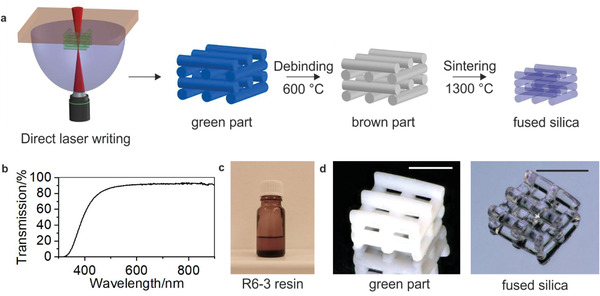
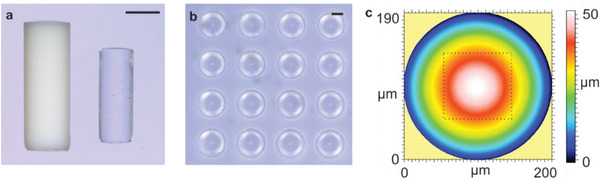
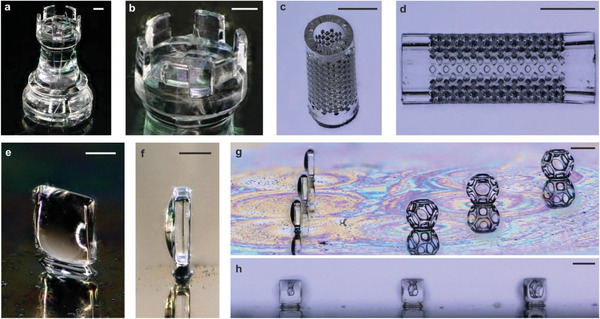
Fused silica glass is the material of choice for many high-performance components in optics due to its high optical transparency combined with its high thermal, chemical, and mechanical stability. Especially, the generation of fused silica microstructures is of high interest for microoptical and biomedical applications. Direct laser writing (DLW) is a suitable technique for generating such devices, as it enables nearly arbitrary structuring down to the sub-micrometer level. In this work, true 3D structuring of transparent fused silica glass using DLW with tens of micrometer resolution and a surface roughness of R ≈ 6 nm is demonstrated. The process uses a two-photon curable silica nanocomposite resin that can be structured by DLW, with the printout being convertible to transparent fused silica glass via thermal debinding and sintering. This technology will enable a plethora of applications from next-generation optics and photonics to microfluidic and biomedical applications with resolutions on the scale of tens of micrometers.
由于其高光学透明度以及高热稳定性、化学稳定性和机械稳定性,熔融石英玻璃是光学领域许多高性能组件的首选材料。特别是,熔融石英微结构的生成对于微光学和生物医学应用具有很高的研究价值。直接激光写入(DLW)是一种适用于生成此类器件的技术,因为它能够实现低至亚微米级的几乎任意结构。在这项工作中,展示了使用具有数十微米分辨率和R≈6nm表面粗糙度的DLW对透明熔融石英玻璃进行真正的3D结构化。该工艺使用一种可通过DLW进行结构化的双光子可固化二氧化硅纳米复合树脂,打印输出物可通过热脱脂和烧结转化为透明熔融石英玻璃。这项技术将实现从下一代光学和光子学到微流体和生物医学应用等众多应用,分辨率可达数十微米级别。