Division of Micro and Nanosystems, School of Electrical Engineering and Computer Science, KTH Royal Institute of Technology, Stockholm, 10044, Sweden.
Institute of Physics, Faculty of Electrical Engineering and Information Technology, University of the Bundeswehr Munich & SENS Research Center, Neubiberg, 85577, Germany.
Nat Commun. 2023 Jun 7;14(1):3305. doi: 10.1038/s41467-023-38996-3.
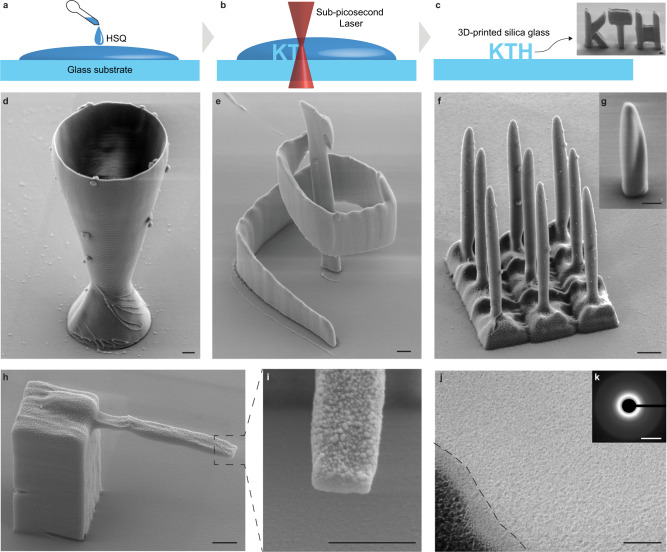
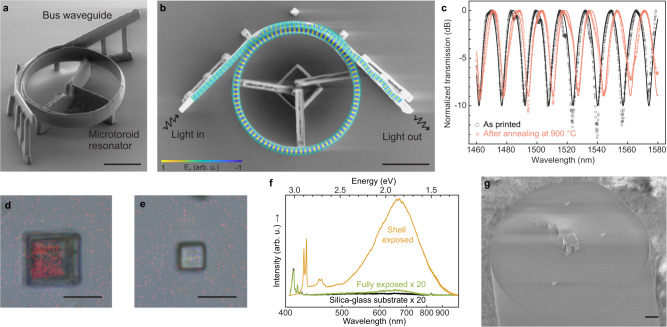
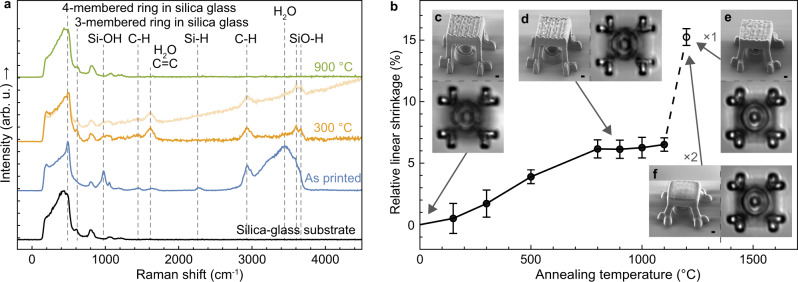
Silica glass is a high-performance material used in many applications such as lenses, glassware, and fibers. However, modern additive manufacturing of micro-scale silica glass structures requires sintering of 3D-printed silica-nanoparticle-loaded composites at ~1200 °C, which causes substantial structural shrinkage and limits the choice of substrate materials. Here, 3D printing of solid silica glass with sub-micrometer resolution is demonstrated without the need of a sintering step. This is achieved by locally crosslinking hydrogen silsesquioxane to silica glass using nonlinear absorption of sub-picosecond laser pulses. The as-printed glass is optically transparent but shows a high ratio of 4-membered silicon-oxygen rings and photoluminescence. Optional annealing at 900 °C makes the glass indistinguishable from fused silica. The utility of the approach is demonstrated by 3D printing an optical microtoroid resonator, a luminescence source, and a suspended plate on an optical-fiber tip. This approach enables promising applications in fields such as photonics, medicine, and quantum-optics.
二氧化硅玻璃是一种高性能材料,广泛应用于透镜、玻璃器皿和光纤等领域。然而,现代微尺度二氧化硅玻璃结构的增材制造需要在 1200°C 左右烧结 3D 打印的负载有二氧化硅纳米颗粒的复合材料,这会导致显著的结构收缩,并限制基底材料的选择。本研究无需烧结步骤,通过亚皮秒激光脉冲的非线性吸收,实现了具有亚微米分辨率的固态二氧化硅玻璃的 3D 打印。通过局部交联氢倍半硅氧烷到二氧化硅玻璃来实现这一点。打印出的玻璃是光学透明的,但显示出高比例的四元硅-氧环和光致发光。在 900°C 下进行可选的退火处理,可使玻璃与熔融二氧化硅无法区分。该方法通过在光纤尖端上打印光学微环谐振器、发光源和悬浮板得到了验证。该方法有望在光子学、医学和量子光学等领域得到应用。