MRC Biostatistics Unit, University of Cambridge, Cambridge, UK.
Population Health Sciences Institute, Newcastle University, Newcastle upon Tyne, UK.
Biometrics. 2022 Mar;78(1):141-150. doi: 10.1111/biom.13424. Epub 2021 Jan 29.
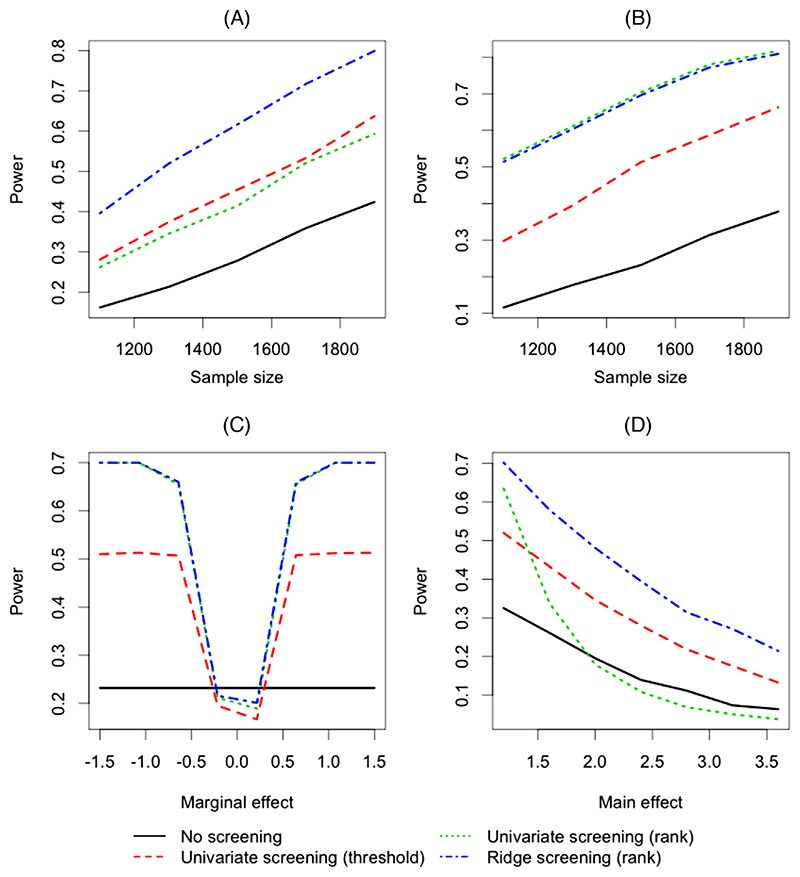
High-dimensional biomarkers such as genomics are increasingly being measured in randomized clinical trials. Consequently, there is a growing interest in developing methods that improve the power to detect biomarker-treatment interactions. We adapt recently proposed two-stage interaction detecting procedures in the setting of randomized clinical trials. We also propose a new stage 1 multivariate screening strategy using ridge regression to account for correlations among biomarkers. For this multivariate screening, we prove the asymptotic between-stage independence, required for familywise error rate control, under biomarker-treatment independence. Simulation results show that in various scenarios, the ridge regression screening procedure can provide substantially greater power than the traditional one-biomarker-at-a-time screening procedure in highly correlated data. We also exemplify our approach in two real clinical trial data applications.
高维生物标志物,如基因组学,在随机临床试验中越来越多地被测量。因此,人们越来越感兴趣的是开发能够提高检测生物标志物-治疗相互作用的功效的方法。我们在随机临床试验的环境中,改编了最近提出的两阶段交互检测程序。我们还提出了一种新的基于岭回归的多变量筛选策略,用于考虑生物标志物之间的相关性。对于这种多变量筛选,我们在生物标志物-治疗独立性的情况下证明了阶段间独立性的渐近性,这是控制总体错误率所必需的。模拟结果表明,在各种情况下,在高度相关的数据中,岭回归筛选程序可以提供比传统的逐个生物标志物筛选程序更大的功效。我们还在两个实际的临床试验数据应用中说明了我们的方法。