Section for Animal Welfare and Disease Control, Department of Veterinary and Animal Sciences, Faculty of Health and Medical Sciences, University of Copenhagen, 1870, Frederiksberg, Denmark.
FaunaPhotonics APS, Ole Maaløes Vej 3, 2200, Copenhagen N, Denmark.
Sci Rep. 2021 Jan 15;11(1):1555. doi: 10.1038/s41598-021-81005-0.
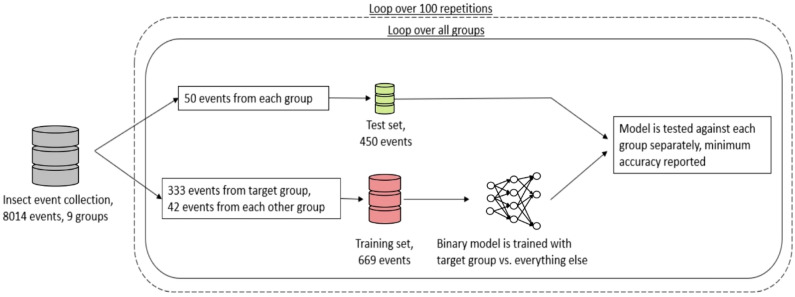
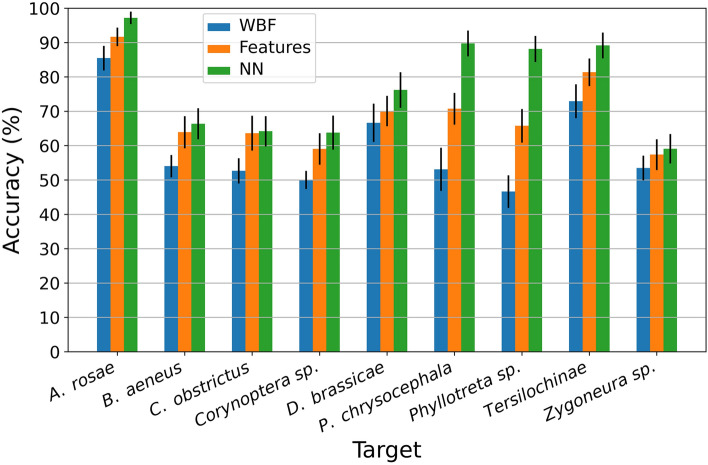
Worldwide, farmers use insecticides to prevent crop damage caused by insect pests, while they also rely on insect pollinators to enhance crop yield and other insect as natural enemies of pests. In order to target pesticides to pests only, farmers must know exactly where and when pests and beneficial insects are present in the field. A promising solution to this problem could be optical sensors combined with machine learning. We obtained around 10,000 records of flying insects found in oilseed rape (Brassica napus) crops, using an optical remote sensor and evaluated three different classification methods for the obtained signals, reaching over 80% accuracy. We demonstrate that it is possible to classify insects in flight, making it possible to optimize the application of insecticides in space and time. This will enable a technological leap in precision agriculture, where focus on prudent and environmentally-sensitive use of pesticides is a top priority.
在全球范围内,农民使用杀虫剂来防止害虫对作物造成损害,同时他们还依靠昆虫传粉者来提高作物产量和利用其他昆虫作为害虫的天敌。为了将杀虫剂仅针对害虫,农民必须准确知道害虫和有益昆虫在田间的位置和时间。光学传感器与机器学习相结合可能是解决这个问题的一个有希望的方法。我们使用光学远程传感器获得了约 10000 条在油菜(甘蓝型油菜)作物中发现的飞行昆虫的记录,并对所获得的信号进行了三种不同的分类方法的评估,准确率超过 80%。我们证明了对飞行中的昆虫进行分类是可能的,这使得在空间和时间上优化杀虫剂的应用成为可能。这将使精准农业实现技术飞跃,谨慎和环境敏感地使用农药是重中之重。