Johns Hopkins Bayview Medical Center, 4940 Eastern Avenue, Baltimore, MD, 21224, USA.
University of California, San Francisco (UCSF), School of Medicine, 513 Parnassus Avenue, San Francisco, CA, 94143, USA.
AIDS Behav. 2021 Jul;25(7):2266-2277. doi: 10.1007/s10461-020-03155-y. Epub 2021 Jan 15.
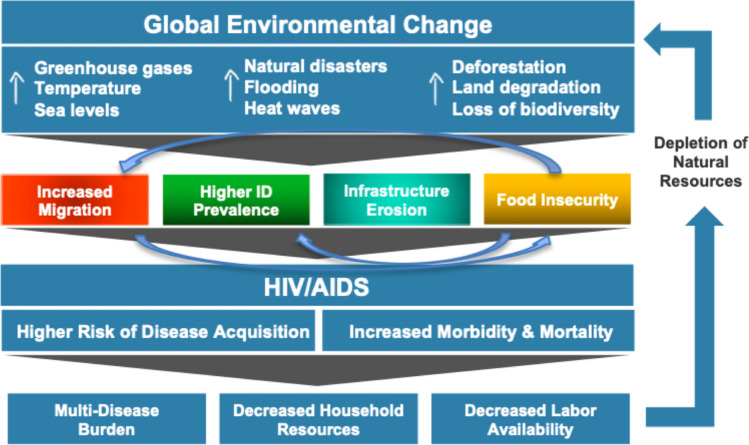
Climate change and HIV/AIDS represent two of the greatest threats to human health in the 21st century. However, limitations in understanding the complex relationship between these syndemics continue to constrain advancements in the prevention and management of HIV/AIDS in the context of a rapidly changing climate. Here, we present a conceptual framework that identifies four pathways linking climate change with HIV/AIDS transmission and health outcomes: increased food insecurity, increased prevalence of other infectious diseases, increased human migration, and erosion of public health infrastructure. This framework is based on an in-depth literature review in PubMed and Google Scholar from June 6 to June 27, 2019. The pathways linking climate change with HIV transmission and health outcomes are complex with multiple interacting factors. Food insecurity emerged as a particularly important mediator by driving sexual risk-taking behaviours and migration, as well as by increasing susceptibility to infections that are common among people living with HIV (PLWHIV). Future interventions should focus on decreasing carbon dioxide emissions globally and increasing education and investment in adaptation strategies, particularly in those areas of sub-Saharan Africa and southeast Asia heavily impacted by both HIV and climate change. Environmentally sustainable interventions such as urban gardening and investing in sustainable agriculture technologies also have significant health co-benefits that may help PLWHIV adapt to the environmental consequences of climate change.
气候变化和艾滋病病毒/艾滋病是 21 世纪人类健康面临的两大最大威胁。然而,对这两种综合征之间复杂关系的理解有限,继续限制了在快速变化的气候背景下预防和管理艾滋病病毒/艾滋病方面的进展。在这里,我们提出了一个概念框架,确定了气候变化与艾滋病病毒传播和健康结果之间的四个联系途径:粮食不安全加剧、其他传染病流行率增加、人口迁移增加以及公共卫生基础设施受损。该框架基于 2019 年 6 月 6 日至 6 月 27 日在 PubMed 和 Google Scholar 上进行的深入文献回顾。气候变化与艾滋病毒传播和健康结果之间的联系途径很复杂,涉及多种相互作用的因素。粮食不安全通过驱动性行为风险和移民行为,以及增加艾滋病毒感染者易患的感染(艾滋病毒感染者常见的感染),成为一个特别重要的中介因素。未来的干预措施应侧重于减少全球二氧化碳排放,并增加适应战略的教育和投资,特别是在受艾滋病病毒和气候变化影响严重的撒哈拉以南非洲和东南亚地区。环境可持续干预措施,如城市园艺和投资可持续农业技术,也具有显著的健康共同效益,这可能有助于艾滋病毒感染者适应气候变化的环境后果。