Beijing Institute of Radiation Medicine, Beijing 100850, China.
Computer Network Information Center, Chinese Academy of Sciences, Beijing 100190, China.
Brief Bioinform. 2021 Sep 2;22(5). doi: 10.1093/bib/bbaa405.
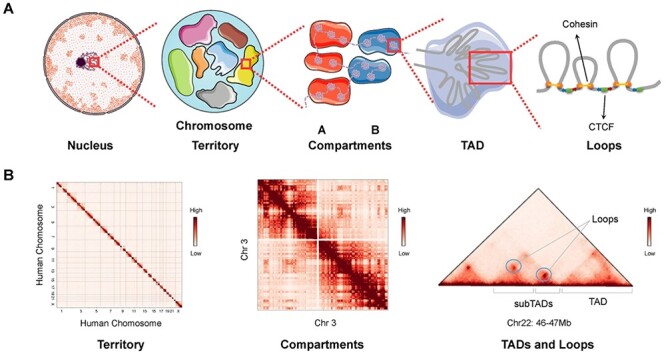
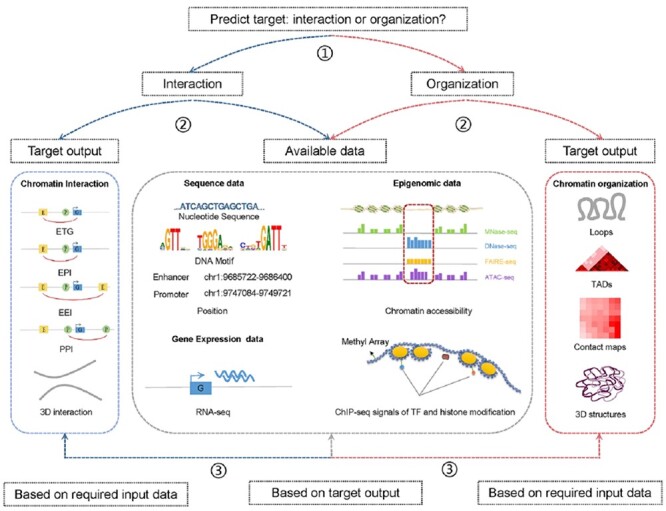
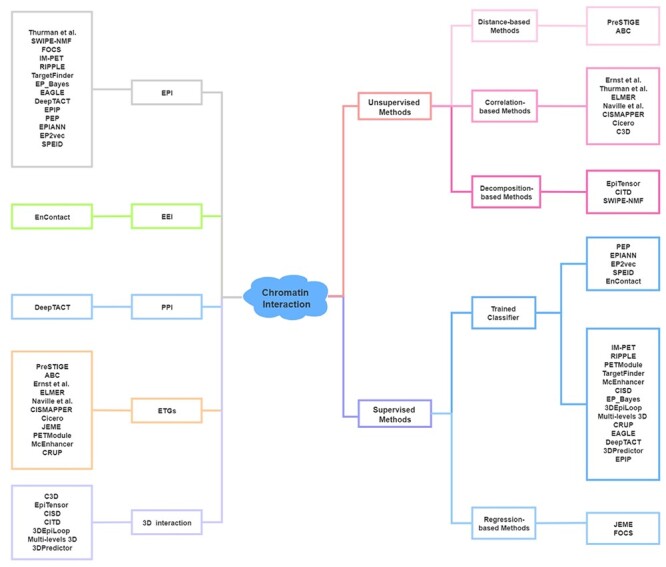
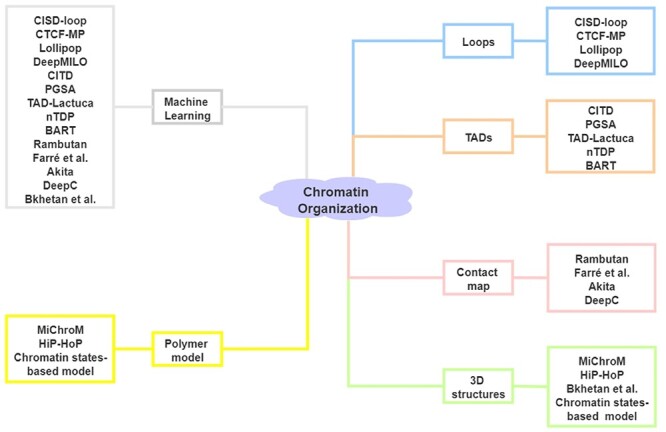
The exploration of three-dimensional chromatin interaction and organization provides insight into mechanisms underlying gene regulation, cell differentiation and disease development. Advances in chromosome conformation capture technologies, such as high-throughput chromosome conformation capture (Hi-C) and chromatin interaction analysis by paired-end tag (ChIA-PET), have enabled the exploration of chromatin interaction and organization. However, high-resolution Hi-C and ChIA-PET data are only available for a limited number of cell lines, and their acquisition is costly, time consuming, laborious and affected by theoretical limitations. Increasing evidence shows that DNA sequence and epigenomic features are informative predictors of regulatory interaction and chromatin architecture. Based on these features, numerous computational methods have been developed for the prediction of chromatin interaction and organization, whereas they are not extensively applied in biomedical study. A systematical study to summarize and evaluate such methods is still needed to facilitate their application. Here, we summarize 48 computational methods for the prediction of chromatin interaction and organization using sequence and epigenomic profiles, categorize them and compare their performance. Besides, we provide a comprehensive guideline for the selection of suitable methods to predict chromatin interaction and organization based on available data and biological question of interest.
三维染色质相互作用和组织的探索为基因调控、细胞分化和疾病发展的机制提供了深入的了解。染色体构象捕获技术的进步,如高通量染色体构象捕获(Hi-C)和基于配对末端标签的染色质相互作用分析(ChIA-PET),使我们能够探索染色质的相互作用和组织。然而,高分辨率的 Hi-C 和 ChIA-PET 数据仅可用于有限数量的细胞系,并且其获取成本高、耗时、费力,并且受到理论限制的影响。越来越多的证据表明,DNA 序列和表观基因组特征是调控相互作用和染色质结构的信息预测因子。基于这些特征,已经开发了许多用于预测染色质相互作用和组织的计算方法,但它们在生物医学研究中尚未广泛应用。仍然需要进行系统的研究来总结和评估这些方法,以促进它们的应用。在这里,我们总结了 48 种使用序列和表观基因组图谱预测染色质相互作用和组织的计算方法,对它们进行了分类,并比较了它们的性能。此外,我们根据可用数据和感兴趣的生物学问题,提供了一个全面的指南,用于选择合适的方法来预测染色质相互作用和组织。