Goel Leela, Wu Huaiyu, Zhang Bohua, Kim Jinwook, Dayton Paul A, Xu Zhen, Jiang Xiaoning
Department of Mechanical & Aerospace Engineering, North Carolina State University, Raleigh, NC 27695 USA.
The Joint Department of Biomedical Engineering, The University of North Carolina at Chapel Hill and North Carolina State University, Chapel Hill, NC 27599 USA.
Microsyst Nanoeng. 2021 Jan 6;7:3. doi: 10.1038/s41378-020-00228-9. eCollection 2021.
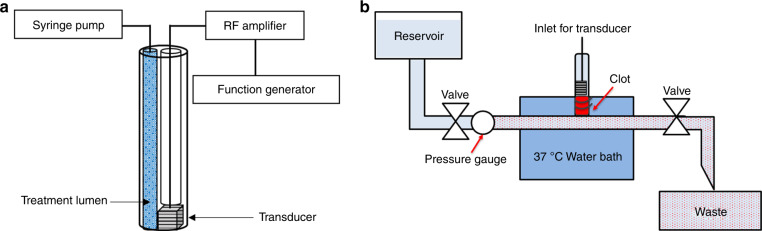
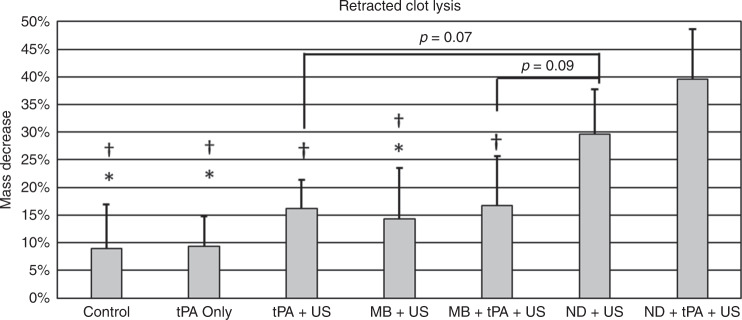
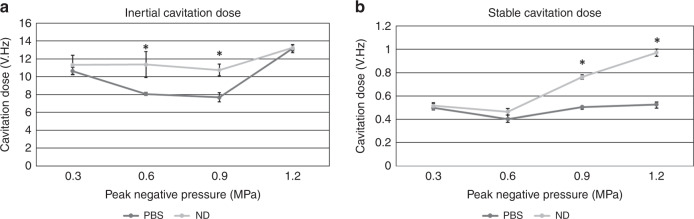
One major challenge in current microbubble (MB) and tissue plasminogen activator (tPA)-mediated sonothrombolysis techniques is effectively treating retracted blood clots, owing to the high density and low porosity of retracted clots. Nanodroplets (NDs) have the potential to enhance retracted clot lysis owing to their small size and ability to penetrate into retracted clots to enhance drug delivery. For the first time, we demonstrate that a sub-megahertz, forward-viewing intravascular (FVI) transducer can be used for ND-mediated sonothrombolysis, in vitro. In this study, we determined the minimum peak negative pressure to induce cavitation with low-boiling point phase change nanodroplets and clot lysis. We then compared nanodroplet mediated sonothrombolysis to MB and tPA mediate techniques. The clot lysis as a percent mass decrease in retracted clots was 9 ± 8%, 9 ± 5%, 16 ± 5%, 14 ± 9%, 17 ± 9%, 30 ± 8%, and 40 ± 9% for the control group, tPA alone, tPA + US, MB + US, MB + tPA + US, ND + US, and ND + tPA + US groups, respectively. In retracted blood clots, combined ND- and tPA-mediated sonothrombolysis was able to significantly enhance retracted clot lysis compared with traditional MB and tPA-mediated sonothrombolysis techniques. Combined nanodroplet with tPA-mediated sonothrombolysis may provide a feasible strategy for safely treating retracted clots.
当前微泡(MB)与组织纤溶酶原激活剂(tPA)介导的超声溶栓技术面临的一个主要挑战是有效治疗收缩性血凝块,这是由于收缩性血凝块密度高且孔隙率低。纳米液滴(NDs)因其尺寸小且能够渗透到收缩性血凝块中以增强药物递送,具有增强收缩性血凝块溶解的潜力。我们首次证明,亚兆赫兹前视血管内(FVI)换能器可用于体外的纳米液滴介导的超声溶栓。在本研究中,我们确定了用低沸点相变纳米液滴诱导空化和血凝块溶解所需的最小峰值负压。然后,我们将纳米液滴介导的超声溶栓与微泡和tPA介导的技术进行了比较。对照组、单独使用tPA组、tPA + 超声组、微泡 + 超声组、微泡 + tPA + 超声组、纳米液滴 + 超声组和纳米液滴 + tPA + 超声组的收缩性血凝块质量减少百分比分别为9 ± 8%、9 ± 5%、16 ± 5%、14 ± 9%、17 ± 9%、30 ± 8%和40 ± 9%。在收缩性血凝块中,与传统的微泡和tPA介导的超声溶栓技术相比,纳米液滴与tPA联合介导的超声溶栓能够显著增强收缩性血凝块的溶解。纳米液滴与tPA联合介导的超声溶栓可能为安全治疗收缩性血凝块提供一种可行的策略。