Fong Megan Hoi Yan, Feng Mingxiao, McConkey David J, Choi Woonyoung
Johns Hopkins Greenberg Bladder Cancer Institute and Brady Urological Institute, Johns Hopkins University, Baltimore, Maryland, USA.
Transl Androl Urol. 2020 Dec;9(6):2881-2889. doi: 10.21037/tau-2019-mibc-12.
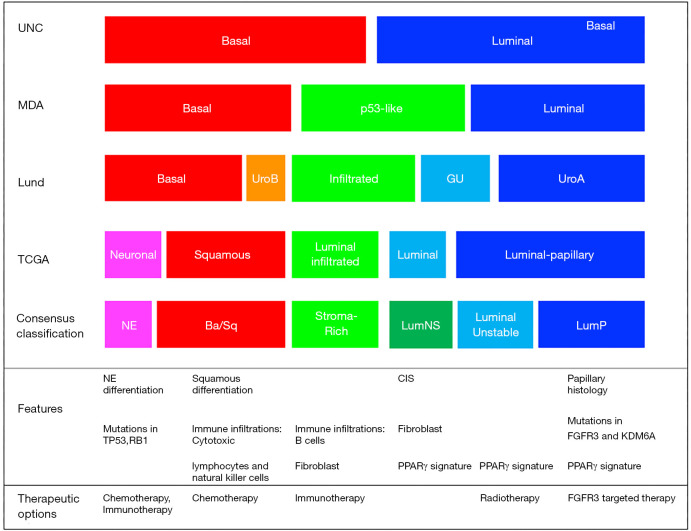
In 2014, there was a burst of studies on the molecular subtypes of bladder cancer in the published literature that was made possible by the advances in high-throughput technologies. Based on gene expression profiling, the major molecular classification subdivisions were basal and luminal subtypes, which resembled to those observed in breast cancers. These basal and luminal subtypes were further subdivided by TCGA into squamous, infiltrated, luminal-papillary, luminal/genomically unstable (GU), and neuronal/small cell carcinoma (SCC) subtypes. Recently, an international subtypes consensus project further expanded on the TCGA subtypes by defining a consensus molecular classification (CMC). A multidisciplinary team of experts generated CMC to overcome the difficulties of clinical applications due to several published bladder cancer molecular classifications with various nomenclatures and molecular features. It included six molecular subtypes with the addition of one more luminal subtype (luminal nonspecified) compared to the TCGA subtype classification. The initial research efforts have focused on the characterization of each subtype at the molecular and histopathologic levels, but more recent studies have examined their significance in terms of clinical utility, i.e., biomarkers that inform prognostication and/or to predict therapeutic responses to be tested in future clinical trials. This review provides an overview of recent investigations into the relationship between molecular subtypes and the clinical management of patients with bladder cancer.
2014年,随着高通量技术的进步,已发表文献中出现了一阵关于膀胱癌分子亚型的研究热潮。基于基因表达谱分析,主要的分子分类亚组为基底型和腔面型亚型,这与在乳腺癌中观察到的亚型相似。这些基底型和腔面型亚型被癌症基因组图谱(TCGA)进一步细分为鳞状、浸润性、腔面乳头型、腔面/基因组不稳定(GU)型以及神经内分泌/小细胞癌(SCC)亚型。最近,一个国际亚型共识项目通过定义一种共识分子分类(CMC)进一步扩展了TCGA亚型。一个多学科专家团队生成了CMC,以克服由于多种已发表的具有不同命名法和分子特征的膀胱癌分子分类所导致的临床应用困难。与TCGA亚型分类相比,它包括六种分子亚型,又增加了一种腔面型亚型(未明确的腔面型)。最初的研究工作集中在分子和组织病理学水平上对每种亚型的特征描述,但最近的研究已经从临床实用性方面考察了它们的意义,即用于在未来临床试验中进行预后判断和/或预测治疗反应的生物标志物。本综述概述了近期关于分子亚型与膀胱癌患者临床管理之间关系的研究。