Wei Lise, Rosen Benjamin, Vallières Martin, Chotchutipan Thong, Mierzwa Michelle, Eisbruch Avraham, El Naqa Issam
Applied Physics Program, University of Michigan, Ann Arbor, MI, United States.
Department of Radiation Oncology, University of Michigan, Ann Arbor, MI, United States.
Phys Imaging Radiat Oncol. 2019 Jun 6;10:49-54. doi: 10.1016/j.phro.2019.05.001. eCollection 2019 Apr.
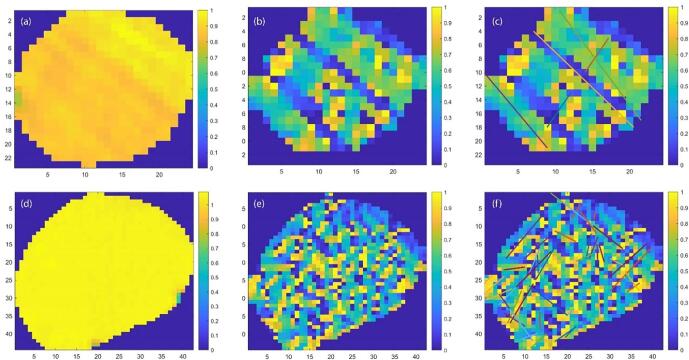
Computed tomography (CT) radiomics of head and neck cancer (HNC) images is susceptible to dental implant artifacts. This work devised and validated an automated algorithm to detect CT metal artifacts and investigate their impact on subsequent radiomics analyses. A new method based on features from total variation, gradient directional distribution, and Hough transform was developed and evaluated.
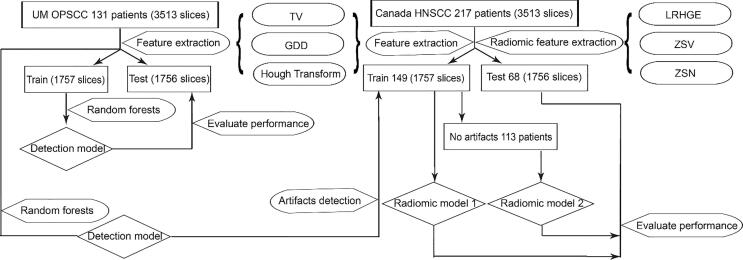
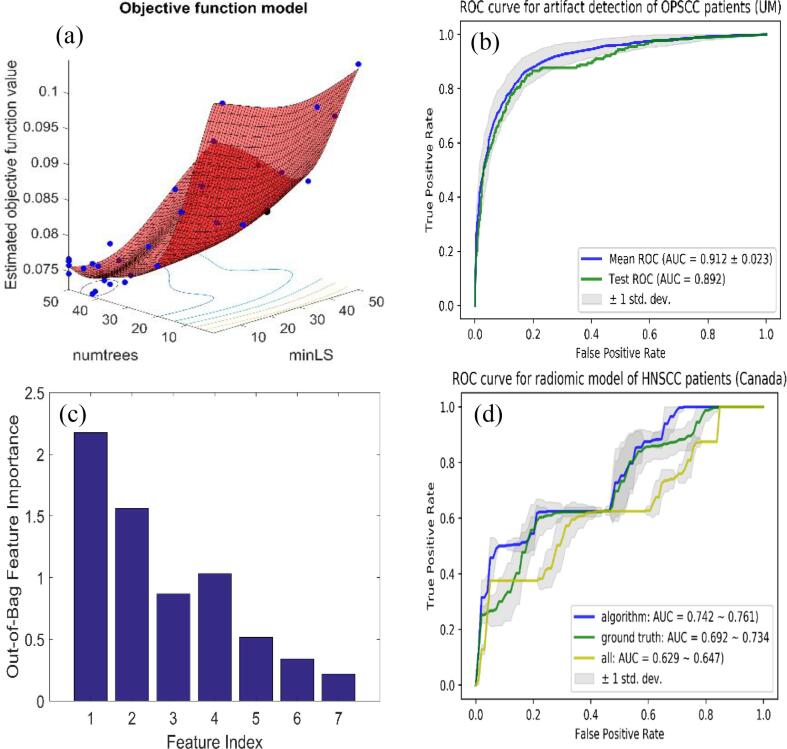
Two HNC datasets were analyzed: a training set of 131 patients for developing the detection algorithm and a testing set of 220 patients. Seven designated features were extracted from ROIs (regions of interest) and machine learning with random forests was used for building the artifact detection algorithm. Performance was assessed using the area under the receiver operating characteristics curve (AUC).
The testing results of artifacts detection yielded a cross-validated AUC of 0.91 (95% CI: 0.89-0.94), and a test AUC of 0.89. External testing validation yielded an accuracy of 0.82. For radiomics model prediction, training with artifacts yielded an AUC of 0.64 (95% CI: 0.63-0.65), while training on images without artifacts improved the AUC to 0.75 (95% CI: 0.74-0.76). This was compared to visual inspection of artifacts (AUC = 0.71 [95% CI: 0.69-0.73]).
We developed a new method for automated and efficient detection of streak artifacts. We also showed that such streak artifacts in HNC CT images can worsen the performance of radiomics modeling.
头颈部癌(HNC)图像的计算机断层扫描(CT)放射组学易受牙种植体伪影影响。本研究设计并验证了一种自动算法,用于检测CT金属伪影,并研究其对后续放射组学分析的影响。开发并评估了一种基于全变差、梯度方向分布和霍夫变换特征的新方法。
分析了两个HNC数据集:一个包含131例患者的训练集用于开发检测算法,一个包含220例患者的测试集。从感兴趣区域(ROI)提取七个指定特征,并使用随机森林机器学习构建伪影检测算法。使用受试者操作特征曲线(AUC)下的面积评估性能。
伪影检测的测试结果产生交叉验证AUC为0.91(95%CI:0.89 - 0.94),测试AUC为0.89。外部测试验证的准确率为0.82。对于放射组学模型预测,使用有伪影的图像训练得到的AUC为0.64(95%CI:0.63 - 0.65),而使用无伪影的图像训练可将AUC提高到0.75(95%CI:0.74 - 0.76)。这与人工检查伪影的结果(AUC = 0.71 [95%CI:0.69 - 0.73])进行了比较。
我们开发了一种自动高效检测条纹伪影的新方法。我们还表明,HNC CT图像中的此类条纹伪影会降低放射组学建模的性能。