Deng Mei, Liu Anqi, Kang Han, Xi Linfeng, Yu Pengxin, Xu Wenqing, Yang Haoyu, Xie Wanmu, Liu Min, Zhang Rongguo
Department of Radiology, China-Japan Friendship Hospital of Chinese Academy of Medical Sciences & Peking Union Medical College, Beijing, China.
Institute of Advanced Research, Infervision Medical Technology Co., Ltd., Beijing, China.
Quant Imaging Med Surg. 2023 Oct 1;13(10):6710-6723. doi: 10.21037/qims-22-1059. Epub 2023 Sep 1.
Computed tomography pulmonary angiography (CTPA) is a first-line noninvasive method to diagnose acute pulmonary thromboembolism (APE); however, whether chest noncontrast CT (NC-CT) could aid in the diagnosis of APE remains unknown. The aim of this study was to build and evaluate a holistic lung graph-based machine learning (HLG-ML) using NC-CT for the diagnosis of APE and to compare its performance with that of radiologists and the YEARS algorithm.
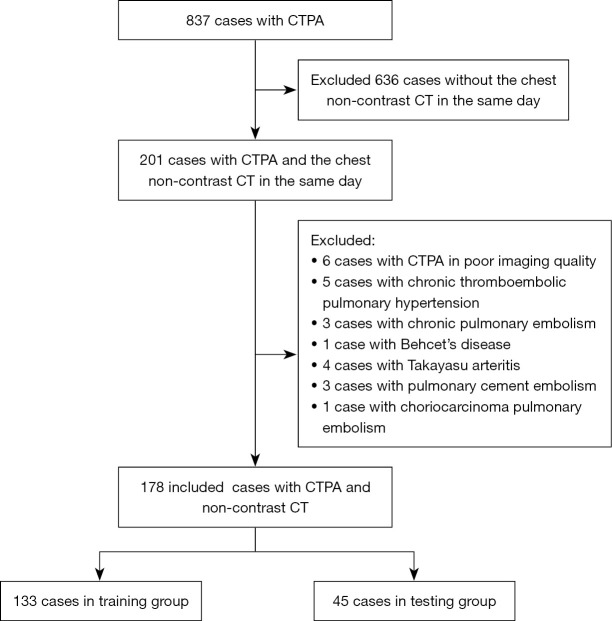
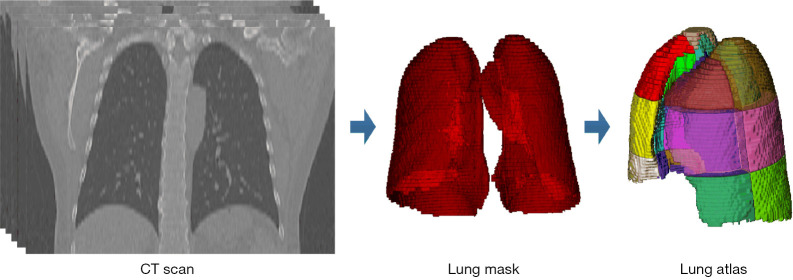
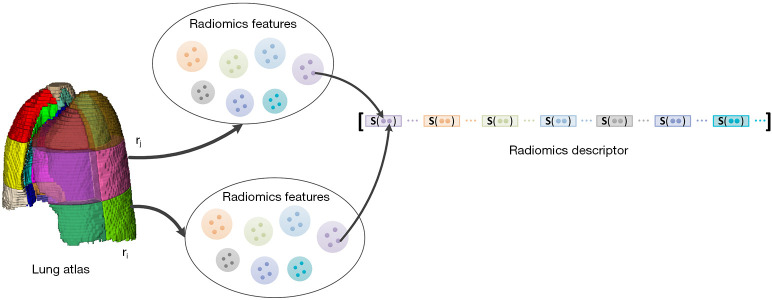
This study enrolled 178 cases (77 males; age 63.9±16.7 years) who underwent NC-CT and CTPA in the same day from January 2019 to December 2020. Of these patients, 133 (75% of cases; 58 males; age 65.4±15.6 years) were placed into a training group and 45 (25% of cases; 19 males; age 59.6±19.2 years) into a testing group. The other 43 cases (18 males; age 62.8±20.0 years) were used to externally validate the model between January 2021 and March 2022. A HLG was developed with a pulmonary radiomics descriptor derived from NC-CT images. The approach extracted local radiomics features and encoded these local features into a radiomics descriptor as a characterization of global radiomics feature distribution. Subsequently, 8 ML models were trained and compared based on the radiomics descriptor. In the validation group, area under the curves (AUCs) of the HLG-ML model in the diagnosis of APE were compared with those of the 3 radiologists and the YEARS algorithm.
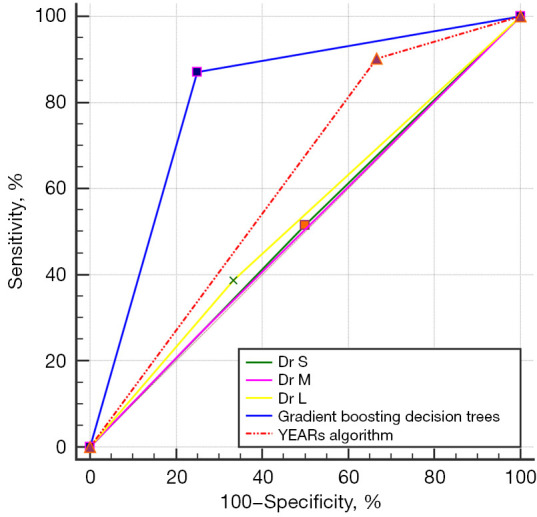
Among the 8 ML models, gradient boosting decision tree demonstrated the best classification performance (AUC =0.772) on the training set. In the testing set, the AUC of gradient boosting decision trees was 0.857 [95% confidence intervals (CIs): 0.699-0.951]. In the validation set, the performance of gradient boosting decision tree (AUC =0.810; 95% CI: 0.669-0.952; Youden index =0.621) outperformed 3 radiologists (AUC =0.508, 95% CI: 0.335-0.681, Youden index =0.016; AUC =0.504, 95% CI: 0.354-0.654, Youden index =0.008; AUC =0.527, 95% CI: 0.363-0.691, Youden index =0.050) and the YEARS algorithm (AUC =0.618; 95% CI: 0.469-0.767; Youden index =0.237).
Compared to all 3 radiologists and the YEARS algorithm, the proposed HLG-based gradient boosting decision tree model achieved a superior performance in the diagnosis of APE on the NC-CT and may thus serve as a valuable tool for physicians in the diagnosis of APE.
计算机断层扫描肺动脉造影(CTPA)是诊断急性肺栓塞(APE)的一线非侵入性方法;然而,胸部非增强CT(NC-CT)是否有助于APE的诊断仍不清楚。本研究的目的是构建并评估一种基于整体肺图的机器学习(HLG-ML)方法,利用NC-CT诊断APE,并将其性能与放射科医生和YEARS算法的性能进行比较。
本研究纳入了2019年1月至2020年12月期间同一天接受NC-CT和CTPA检查的178例患者(77例男性;年龄63.9±16.7岁)。其中,133例(75%;58例男性;年龄65.4±15.6岁)被纳入训练组,45例(25%;19例男性;年龄59.6±19.2岁)被纳入测试组。另外43例(18例男性;年龄62.8±20.0岁)在2021年1月至2022年3月期间用于外部验证该模型。利用从NC-CT图像中提取的肺影像组学描述符构建了一个HLG。该方法提取局部影像组学特征,并将这些局部特征编码为一个影像组学描述符,作为全局影像组学特征分布的表征。随后,基于该影像组学描述符训练并比较了8种机器学习模型。在验证组中,将HLG-ML模型诊断APE的曲线下面积(AUC)与3名放射科医生和YEARS算法的AUC进行比较。
在8种机器学习模型中,梯度提升决策树在训练集上表现出最佳的分类性能(AUC =0.772)。在测试集中,梯度提升决策树的AUC为0.857[95%置信区间(CI):0.699-0.951]。在验证集中,梯度提升决策树的性能(AUC =0.810;95%CI:0.669-0.952;约登指数=0.621)优于3名放射科医生(AUC =0.508,95%CI:0.335-0.681,约登指数=0.016;AUC =0.504,95%CI:0.354-0.654,约登指数=0.008;AUC =0.527,95%CI:0.363-0.691,约登指数=0.050)和YEARS算法(AUC =0.618;95%CI:0.469-0.767;约登指数=0.237)。
与3名放射科医生和YEARS算法相比,所提出的基于HLG的梯度提升决策树模型在利用NC-CT诊断APE方面表现出卓越的性能,因此可能成为医生诊断APE的有价值工具。