Craft Daniel F, Balter Peter, Woodward Wendy, Kry Stephen F, Salehpour Mohammad, Ger Rachel, Peters Mary, Baltz Garrett, Traneus Erik, Howell Rebecca M
Department of Radiation Physics, The University of Texas MD Anderson Cancer Center, Houston, TX 77030, USA.
The University of Texas Graduate School of Biomedical Sciences at Houston, Houston, TX 77030, USA.
Phys Imaging Radiat Oncol. 2018 Nov 29;8:38-43. doi: 10.1016/j.phro.2018.11.005. eCollection 2018 Oct.
Postmastectomy radiotherapy (PMRT) is complex to plan and deliver, but could be improved with 3D-printed, patient-specific electron tissue compensators. The purposes of this study were to develop an algorithm to design patient-specific compensators that achieve clinical goals, to 3D-print the planned compensators, and validate calculated dose distributions with film and thermoluminescent dosimeter (TLD) measurements in 3D-printed phantoms of PMRT patients.
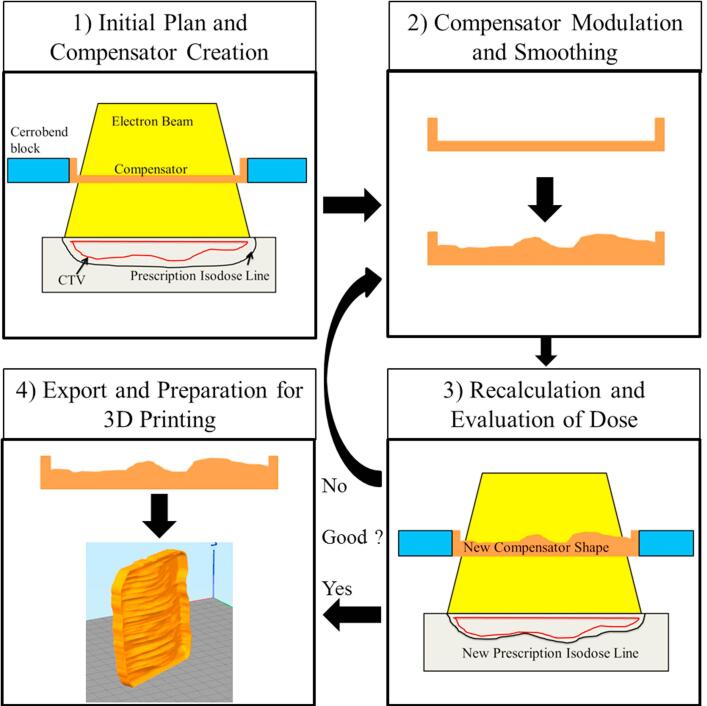
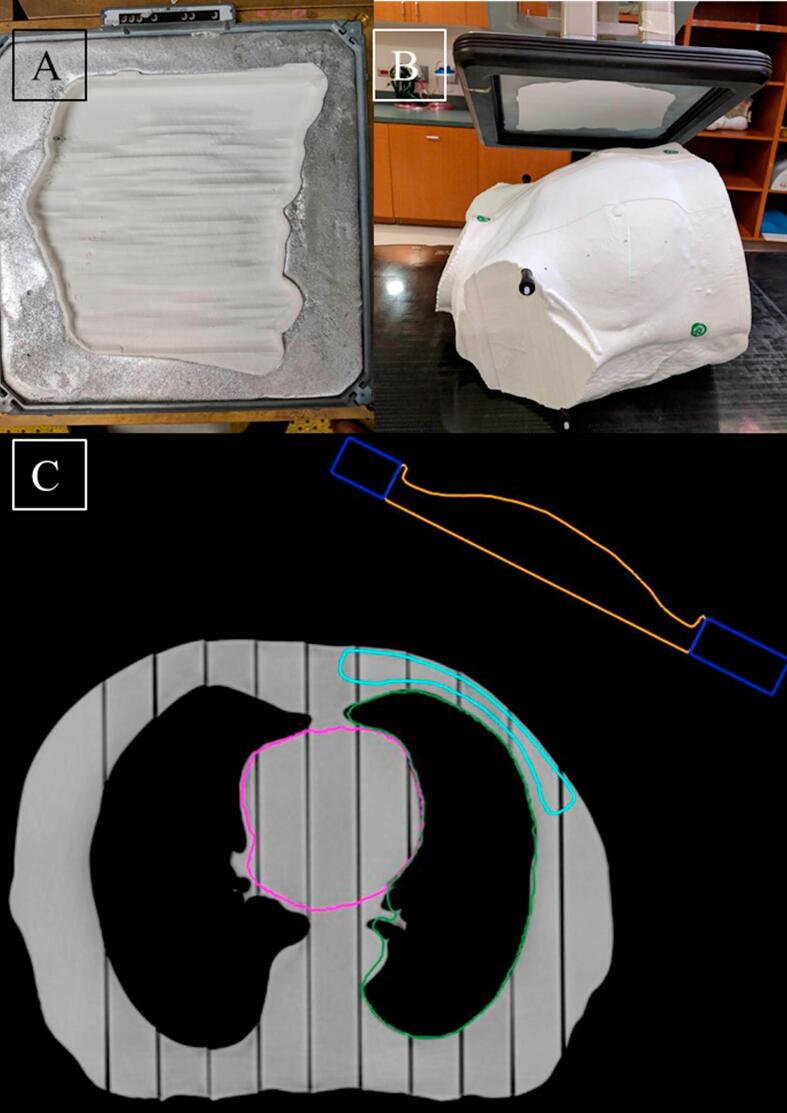
An iterative algorithm was developed to design compensators corresponding to single-field, single-energy electron plans for PMRT patients. The 3D-printable compensators were designed to fit into the electron aperture, with cerrobend poured around it. For a sample of eight patients, calculated dose distributions for compensator plans were compared with patients' (multi-field, multi-energy) clinical treatment plans. For all patients, dosimetric parameters were compared including clinical target volume (CTV), lung, and heart metrics. For validation, compensators were fabricated and irradiated for a set of six 3D-printed patient-specific phantoms. Dose distributions in the phantoms were measured with TLD and film. These measurements were compared with the treatment planning system calculated dose distributions.
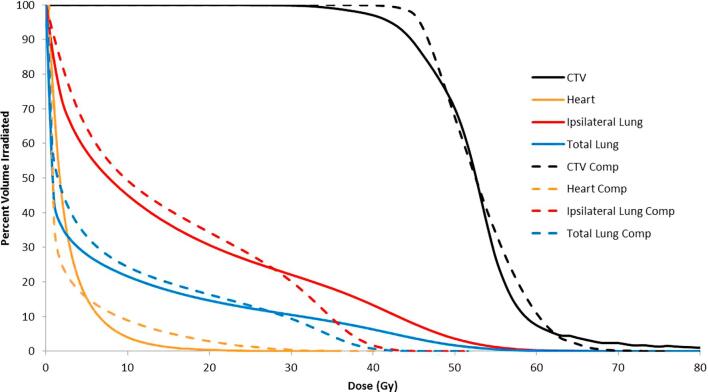
The compensator treatment plans achieved superior CTV coverage (97% vs 89% of the CTV receiving the prescription dose, p < 0.0025), and similar heart and lung doses (p > 0.35) to the conventional treatment plans. Average differences between calculated and measured TLD values were 2%, and average film profile differences were <2 mm.
We developed a new compensator based treatment methodology for PMRT and demonstrated its validity and superiority to conventional multi-field plans through end-to-end testing.
乳房切除术后放疗(PMRT)的计划制定和实施较为复杂,但使用3D打印的、针对患者的电子组织补偿器可能会有所改善。本研究的目的是开发一种算法,以设计能够实现临床目标的针对患者的补偿器,3D打印计划好的补偿器,并在PMRT患者的3D打印体模中使用胶片和热释光剂量计(TLD)测量来验证计算出的剂量分布。
开发了一种迭代算法,用于设计与PMRT患者的单野、单能量电子计划相对应的补偿器。可3D打印的补偿器设计为可装入电子限光筒,并在其周围灌注低熔点铅合金。对于8例患者的样本,将补偿器计划的计算剂量分布与患者的(多野、多能量)临床治疗计划进行比较。对于所有患者,比较包括临床靶体积(CTV)、肺和心脏指标在内的剂量学参数。为了进行验证,制作了补偿器并对一组6个3D打印的患者专用体模进行照射。使用TLD和胶片测量体模中的剂量分布。将这些测量结果与治疗计划系统计算出的剂量分布进行比较。
补偿器治疗计划实现了更好的CTV覆盖(接受处方剂量的CTV占比为97%,而传统治疗计划为89%,p<0.0025),并且与传统治疗计划相比,心脏和肺部剂量相似(p>0.35)。计算值与测量的TLD值之间的平均差异为2%,胶片剂量曲线的平均差异<2mm。
我们开发了一种新的基于补偿器的PMRT治疗方法,并通过端到端测试证明了其有效性和优于传统多野计划的优势。