Department of Health Services, University of Washington, Seattle, WA, USA.
Clinical Research Division, Fred Hutchinson Cancer Research Center, 1100 Fairview Ave N., Mail Stop D5-220, Seattle, WA, 98109, USA.
Support Care Cancer. 2021 Aug;29(8):4493-4500. doi: 10.1007/s00520-021-05989-1. Epub 2021 Jan 18.
Due to recent treatment advances, people who have non-small cell lung cancer with oncogenic alterations are an important new group of cancer survivors. Little is known about lung cancer online support communities. This research was guided by two primary questions: (1) How do these lung cancer survivors engage in online support communities? and (2) What are the psychological, social, and physical impacts of such engagement?
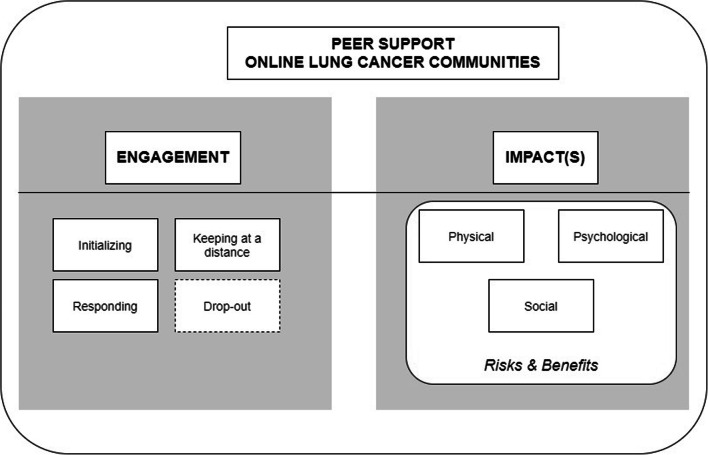
Qualitative in-depth interviews were conducted with patients with advanced lung cancer (N = 40) to learn about their experiences with the illness. We used qualitative thematic analysis, inductive and deductive, as outlined by Carspecken. We adapted the framework for studying online communities developed by Zhang and colleagues to examine engagement with and impacts of involvement in online lung cancer support communities.
Participants described engaging in the online community through (1) initializing communication through asking questions or sharing resources, (2) responding to others comments or inquiries, or (3) simply observing/reading others posts. Participation had physical, psychological, or social impacts, with benefits (e.g., empowerment) and risks (e.g., feelings of jealousy or misinformation) in each domain. Participants used various strategies to mitigate negative impacts, such as distancing oneself as needed.
Online lung cancer support communities provide support, camaraderie, and specialized health information. However, there are also risks of online engagement, such as social comparison or accessing misinformation. Understanding the utility of online support communities for lung cancer survivors on targeted therapies and further addressing their risks are urgent tasks, especially in the post-COVID era.
由于最近的治疗进展,患有致癌突变的非小细胞肺癌患者成为了一个重要的新癌症幸存者群体。对于肺癌在线支持社区,我们知之甚少。本研究主要围绕两个问题展开:(1)这些肺癌幸存者如何参与在线支持社区?(2)参与此类在线支持社区会对他们产生哪些心理、社会和生理影响?
对 40 名晚期肺癌患者进行了深入的定性访谈,以了解他们的患病经历。我们采用了定性主题分析,即归纳和演绎,如 Carspecken 所述。我们借鉴了 Zhang 及其同事开发的用于研究在线社区的框架,以研究参与和参与在线肺癌支持社区对他们的影响。
参与者描述了通过以下三种方式参与在线社区:(1)通过提问或共享资源来发起交流,(2)回复他人的评论或询问,或(3)简单地观察/阅读他人的帖子。参与在线社区在身体、心理或社会方面都有影响,每个领域都有好处(例如赋权)和风险(例如嫉妒或错误信息的感觉)。参与者使用各种策略来减轻负面影响,例如在需要时保持距离。
肺癌在线支持社区提供支持、友谊和专业的健康信息。然而,在线参与也存在风险,例如社会比较或获取错误信息。了解靶向治疗后在线支持社区对肺癌幸存者的实用性,并进一步解决其风险是当务之急,尤其是在后 COVID-19 时代。