Rheumatology Department, Cochin Hospital, Assistance Publique Hôpitaux de Paris, Paris, France
ECAMO, INSERM (U1153): Clinical Epidemiology and Biostatistics, University of Paris, Paris, France.
RMD Open. 2021 Jan;7(1). doi: 10.1136/rmdopen-2020-001450.
To characterise peripheral musculoskeletal involvement in patients with spondyloarthritis (SpA) including psoriatic arthritis (PsA), across the world.
Cross-sectional study with 24 participating countries. Patients with a diagnosis of axial SpA (axSpA), peripheral SpA (pSpA) or PsA according to their rheumatologist were included. The investigators were asked which diagnosis out of a list of six (axSpA, PsA, pSpA, inflammatory bowel disease-associated SpA, reactive arthritis or juvenile SpA (Juv-SpA)) fitted the patient best. Peripheral manifestations (ie, peripheral joint disease, enthesitis, dactylitis and root joint disease), their localisation and treatments were evaluated.
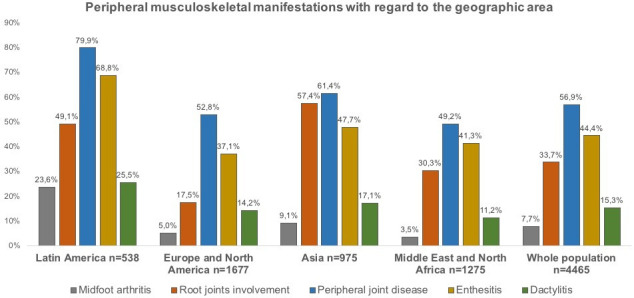
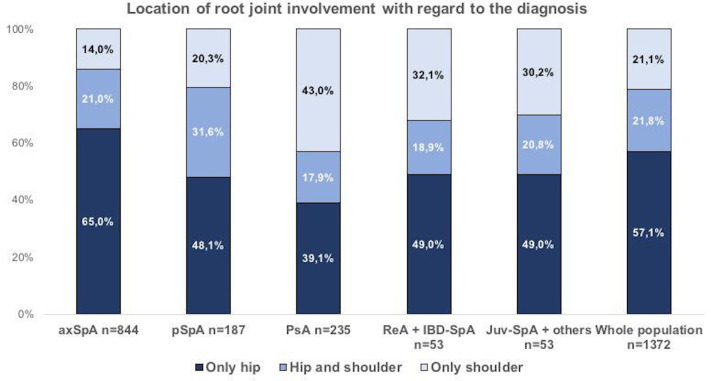
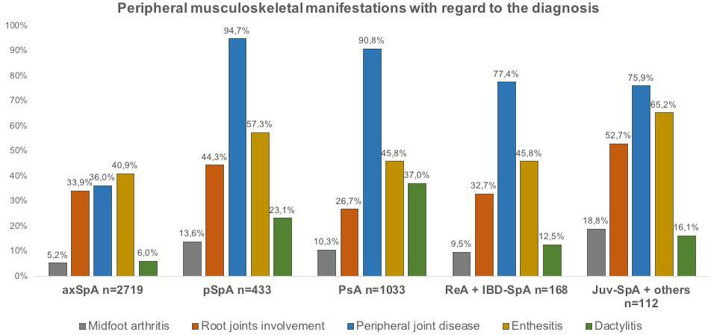
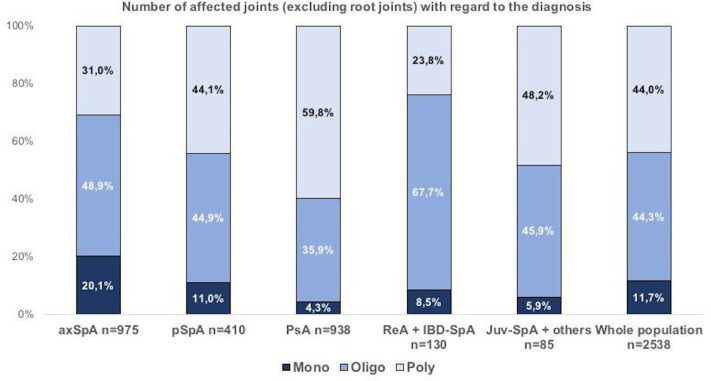
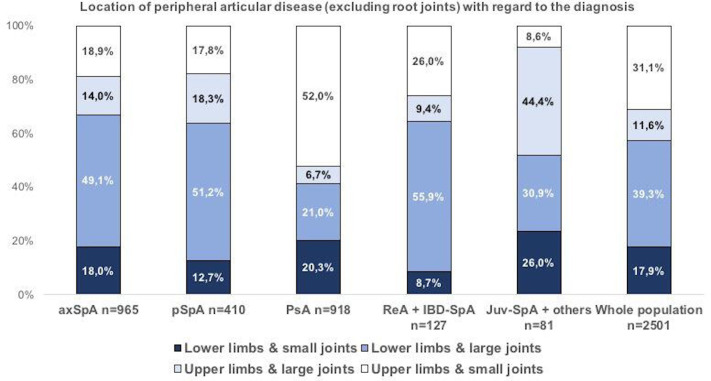
A total of 4465 patients were included (61% men, mean age 44.5 years) from four geographic areas: Latin America (n=538), Europe plus North America (n=1677), Asia (n=975) and the Middle East plus North Africa (n=1275). Of those, 78% had ever suffered from at least one peripheral musculoskeletal manifestation; 57% had peripheral joint disease, 44% had enthesitis and 15% had dactylitis. Latin American had far more often peripheral joint disease (80%) than patients from other areas. Patients with PsA had predominantly upper limb and small joint involvement (52%).Hip and shoulder involvement was found in 34% of patients. The prevalence of enthesitis ranged between 41% in patients with axSpA and 65% in patients with Juv-SpA. Dactylitis was most frequent among patients with PsA (37%).
These results suggest that all peripheral features can be found in all subtypes of SpA, and that differences are quantitative rather than qualitative. In a high proportion of patients, axial and peripheral manifestations coincided. These findings reconfirm SpA clinical subtypes are descendants of the same underlying disease, called SpA.
描述世界各地患有脊柱关节炎(SpA)包括银屑病关节炎(PsA)患者的外周肌肉骨骼受累情况。
这是一项包含 24 个参与国家的横断面研究。根据风湿病医生的诊断,纳入患有中轴型 SpA(axSpA)、外周型 SpA(pSpA)或 PsA 的患者。研究者被要求从 6 种诊断(axSpA、PsA、pSpA、炎症性肠病相关 SpA、反应性关节炎或幼年型 SpA(Juv-SpA))中选择最符合患者情况的诊断。评估了外周表现(即外周关节病、附着点炎、指炎和根关节病)、其定位和治疗。
共纳入来自四个地理区域的 4465 名患者(61%为男性,平均年龄为 44.5 岁):拉丁美洲(n=538)、欧洲和北美(n=1677)、亚洲(n=975)和中东和北非(n=1275)。其中,78%的患者曾至少患有一种外周肌肉骨骼表现;57%的患者患有外周关节病,44%的患者患有附着点炎,15%的患者患有指炎。与其他地区的患者相比,拉丁美洲患者更常患有外周关节病(80%)。患有 PsA 的患者主要累及上肢和小关节(52%)。34%的患者存在髋关节和肩关节受累。附着点炎的患病率在 axSpA 患者中为 41%,在 Juv-SpA 患者中为 65%。指炎在 PsA 患者中最为常见(37%)。
这些结果表明,所有外周特征都可以在 SpA 的所有亚型中发现,且差异是定量的而非定性的。在很大比例的患者中,轴性和外周性表现同时存在。这些发现再次证实,SpA 临床亚型是同一潜在疾病(称为 SpA)的后代。