Ethiopian Field Epidemiology Training Program, Addis Ababa, Ethiopia.
Ethiopian Public Health Association, Addis Ababa, Ethiopia.
PLoS Negl Trop Dis. 2021 Jan 19;15(1):e0008992. doi: 10.1371/journal.pntd.0008992. eCollection 2021 Jan.
Dengue Fever (DF) is a viral disease primarily transmitted by Aedes (Ae.) aegypti mosquitoes. Outbreaks in Eastern Ethiopia were reported during 2014-2016. In May 2017, we investigated the first suspected DF outbreak from Kabridahar Town, Somali region (Eastern Ethiopia) to describe its magnitude, assess risk factors, and implement control measures.
Suspected DF cases were defined as acute febrile illness plus ≥2 symptoms (headache, fever, retro-orbital pain, myalgia, arthralgia, rash, or hemorrhage) in Kabridahar District residents. All reported cases were identified through medical record review and active searches. Severe dengue was defined as DF with severe organ impairment, severe hemorrhage, or severe plasma leakage. We conducted a neighborhood-matched case-control study using a subset of suspected cases and conveniently-selected asymptomatic community controls and interviewed participants to collect demographic and risk factor data. We tested sera by RT-PCR to detect dengue virus (DENV) and identify serotypes. Entomologists conducted mosquito surveys at community households to identify species and estimate larval density using the house index (HI), container index (CI) and Breteau index (BI), with BI≥20 indicating high density.
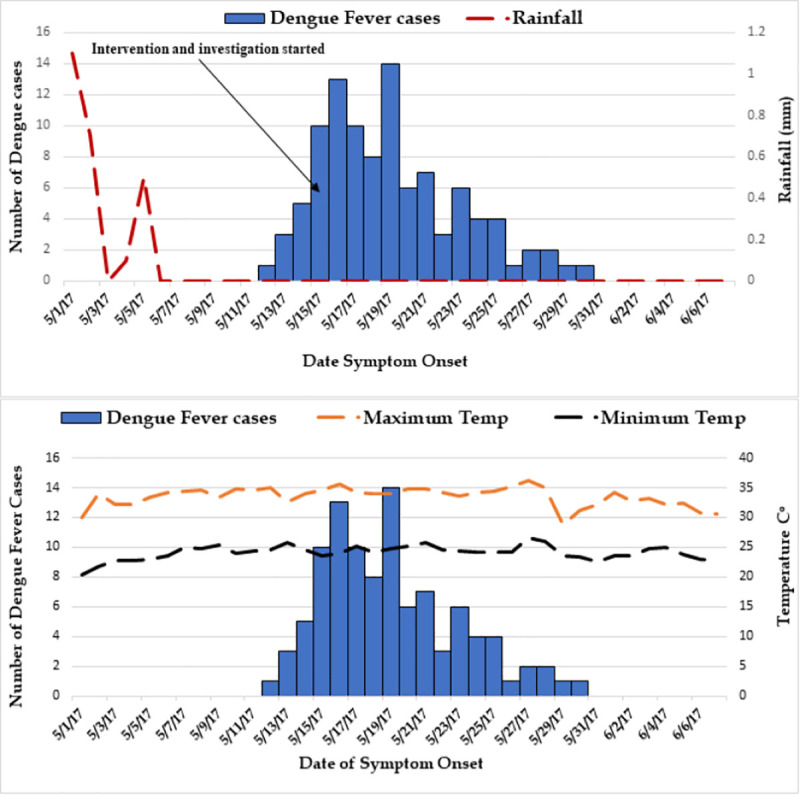
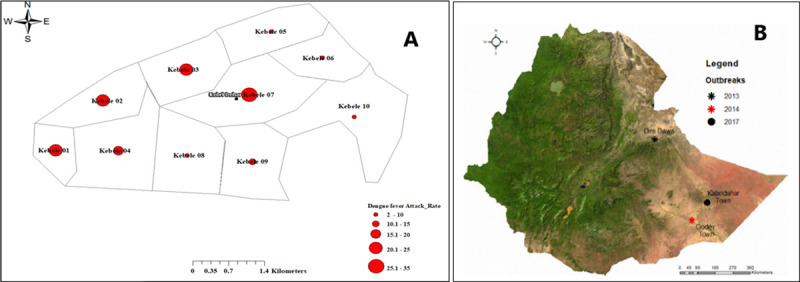
We identified 101 total cases from May 12-31, 2017, including five with severe dengue (one death). The attack rate (AR) was 17/10,000. Of 21 tested samples, 15 (72%) were DENV serotype 2 (DENV 2). In the case-control study with 50 cases and 100 controls, a lack of formal education (AOR [Adjusted Odds Ratio] = 4.2, 95% CI [Confidence Interval] 1.6-11.2) and open water containers near the home (AOR = 3.0, 95% CI 1.2-7.5) were risk factors, while long-lasting insecticide treated-net (LLITN) usage (AOR = 0.21, 95% CI 0.05-0.79) was protective. HI and BI were 66/136 (49%) and 147 per 100 homes (147%) respectively, with 151/167 (90%) adult mosquitoes identified as Ae. aegypti.
The epidemiologic, entomologic, and laboratory investigation confirmed a DF outbreak. Mosquito indices were far above safe thresholds, indicating inadequate vector control. We recommended improved vector surveillance and control programs, including best practices in preserving water and disposal of open containers to reduce Aedes mosquito density.
登革热(DF)是一种主要由埃及伊蚊(Ae. aegypti)传播的病毒性疾病。2014-2016 年期间,埃塞俄比亚东部报告了疫情爆发。2017 年 5 月,我们对来自索马里地区卡布里达哈尔镇(埃塞俄比亚东部)的首例疑似登革热疫情进行了调查,以描述其规模、评估风险因素并实施控制措施。
疑似登革热病例的定义为卡布里达哈尔区居民出现急性发热疾病加上≥2 种症状(头痛、发热、眼眶后疼痛、肌痛、关节痛、皮疹或出血)。所有报告的病例均通过病历回顾和主动搜索确定。重症登革热的定义为登革热伴有严重器官损伤、严重出血或严重血浆渗漏。我们使用疑似病例的一个子集和方便选择的无症状社区对照进行了邻里匹配病例对照研究,并对参与者进行了访谈,以收集人口统计学和风险因素数据。我们使用 RT-PCR 检测血清以检测登革热病毒(DENV)并确定血清型。昆虫学家在社区家庭中进行蚊子调查,使用房屋指数(HI)、容器指数(CI)和布雷特指数(BI)来确定物种并估计幼虫密度,BI≥20 表示高密度。
我们于 2017 年 5 月 12 日至 31 日共发现 101 例确诊病例,其中 5 例为重症登革热(1 例死亡)。发病率(AR)为每 10,000 人中有 17 例。在有 50 例病例和 100 例对照的病例对照研究中,缺乏正规教育(调整后的优势比 [AOR] = 4.2,95%置信区间 [CI] 1.6-11.2)和家庭附近的敞开式水容器(AOR = 3.0,95%CI 1.2-7.5)是风险因素,而长效杀虫剂处理蚊帐(LLITN)的使用(AOR = 0.21,95%CI 0.05-0.79)则具有保护作用。HI 和 BI 分别为 66/136(49%)和每 100 户 147 个(147%),167 个成虫中有 151 个被鉴定为埃及伊蚊。
流行病学、昆虫学和实验室调查证实了一起登革热疫情爆发。蚊子指数远远高于安全阈值,表明媒介控制不足。我们建议改进蚊虫监测和控制计划,包括在保存水和处理敞开容器方面的最佳实践,以降低埃及伊蚊的密度。