Alliance for Research in Exercise, Nutrition and Activity (ARENA), Allied Health & Human Performance, University of South Australia, Adelaide, South Australia, Australia.
Murdoch Children's Research Institute, Parkville, Victoria, Australia.
PLoS One. 2021 Jan 19;16(1):e0245501. doi: 10.1371/journal.pone.0245501. eCollection 2021.
Daily time spent on one activity cannot change without compensatory changes in others, which themselves may impact on health outcomes. Optimal daily activity combinations may differ across outcomes. We estimated optimal daily activity durations for the highest fitness and lowest adiposity.
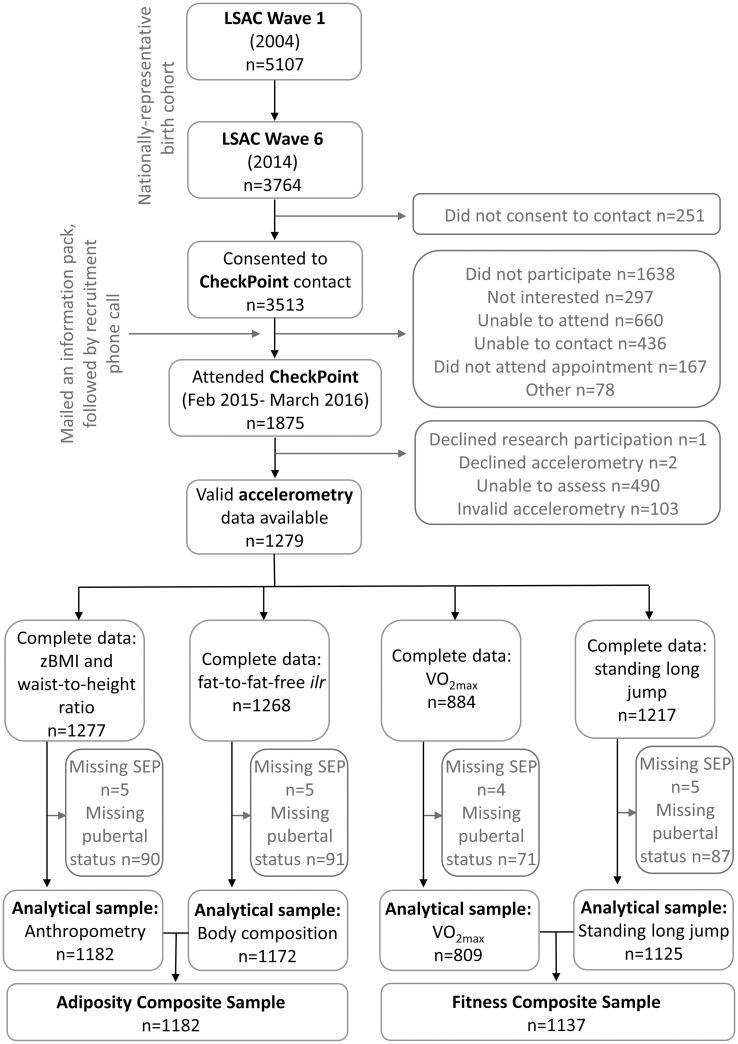
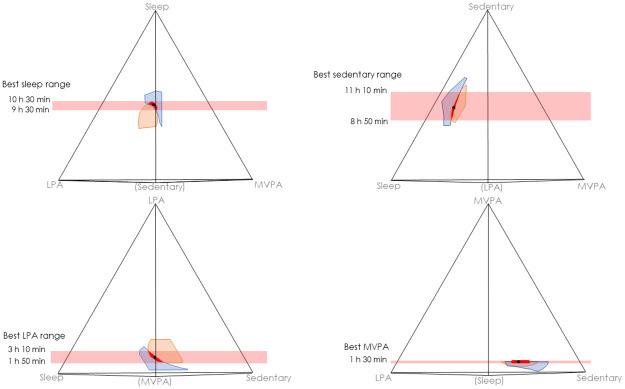
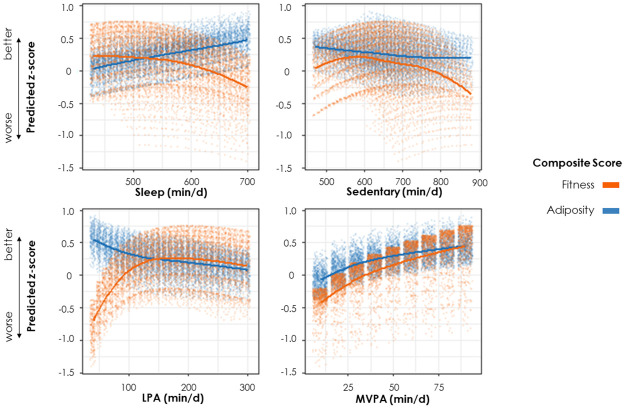
Cross-sectional Child Health CheckPoint data (1182 11-12-year-olds; 51% boys) from the population-based Longitudinal Study of Australian Children were used. Daily activity composition (sleep, sedentary time, light physical activity [LPA], moderate-to-vigorous physical activity [MVPA]) was from 8-day, 24-hour accelerometry. We created composite outcomes for fitness (VO2max; standing long jump) and adiposity (waist-to-height ratio; body mass index; fat-to-fat-free log-ratio). Adjusted compositional models regressed activity log-ratios against each outcome. Best activity compositions (optimal time-use zones) were plotted in quaternary tetrahedrons; the overall optimal time-use composition was the center of the overlapping area.
Time-use composition was associated with fitness and adiposity (all measures p<0.001). Optimal time use differed for fitness and adiposity. While both maximized MVPA and minimized sedentary time, optimal fitness days had higher LPA (3.4 h) and shorter sleep (8.25 h), but optimal adiposity days had lower LPA (1.0 h) and longer sleep (10.9 h). Balancing both outcomes, the overall optimal time-use composition was (mean [range]): 10.2 [9.5; 10.5] h sleep, 9.9 [8.8; 11.2] h sedentary time, 2.4 [1.8; 3.2] h LPA and 1.5 [1.5; 1.5] h MVPA.
Optimal time use for children's fitness and adiposity involves trade-offs. To best balance both outcomes, estimated activity durations for sleep and LPA align with, but for MVPA exceed, 24-h guidelines.
如果不通过改变其他活动的补偿性变化,就无法改变某一活动的日常时间分配,而这些活动本身可能会影响健康结果。最佳的日常活动组合可能因结果而异。我们估计了最高健康水平和最低肥胖水平下的最佳日常活动持续时间。
使用基于人群的澳大利亚儿童纵向研究的儿童健康 CheckPoint 数据(1182 名 11-12 岁儿童;51%为男性)进行横断面研究。日常活动组成(睡眠、久坐时间、低强度体力活动[LPA]、中高强度体力活动[MVPA])来自 8 天、24 小时加速计。我们为体能(最大摄氧量;立定跳远)和肥胖(腰高比;体重指数;脂肪与无脂肪的对数比值)创建了综合指标。调整后的组成模型将活动对数比与每个结果进行回归。最佳活动组成(最佳时间利用区)绘制在四元四面体中;重叠区域的中心是总体最佳时间利用组成。
时间利用组成与体能和肥胖有关(所有指标 p<0.001)。最佳时间利用因健康和肥胖而异。虽然两者都最大化了 MVPA 并最小化了久坐时间,但最佳体能日的 LPA 更高(3.4 小时),睡眠时间更短(8.25 小时),而最佳肥胖日的 LPA 更低(1.0 小时),睡眠时间更长(10.9 小时)。平衡两个结果,整体最佳时间利用组成是(平均值[范围]):10.2 [9.5;10.5]小时睡眠,9.9 [8.8;11.2]小时久坐时间,2.4 [1.8;3.2]小时 LPA 和 1.5 [1.5;1.5]小时 MVPA。
儿童体能和肥胖的最佳时间利用涉及权衡。为了最好地平衡两个结果,估计的睡眠和 LPA 活动持续时间符合但超过 24 小时指南。