Center for Radiological Research, Columbia University Medical Center, New York, NY, USA.
Photochem Photobiol. 2021 May;97(3):517-523. doi: 10.1111/php.13383. Epub 2021 Feb 5.
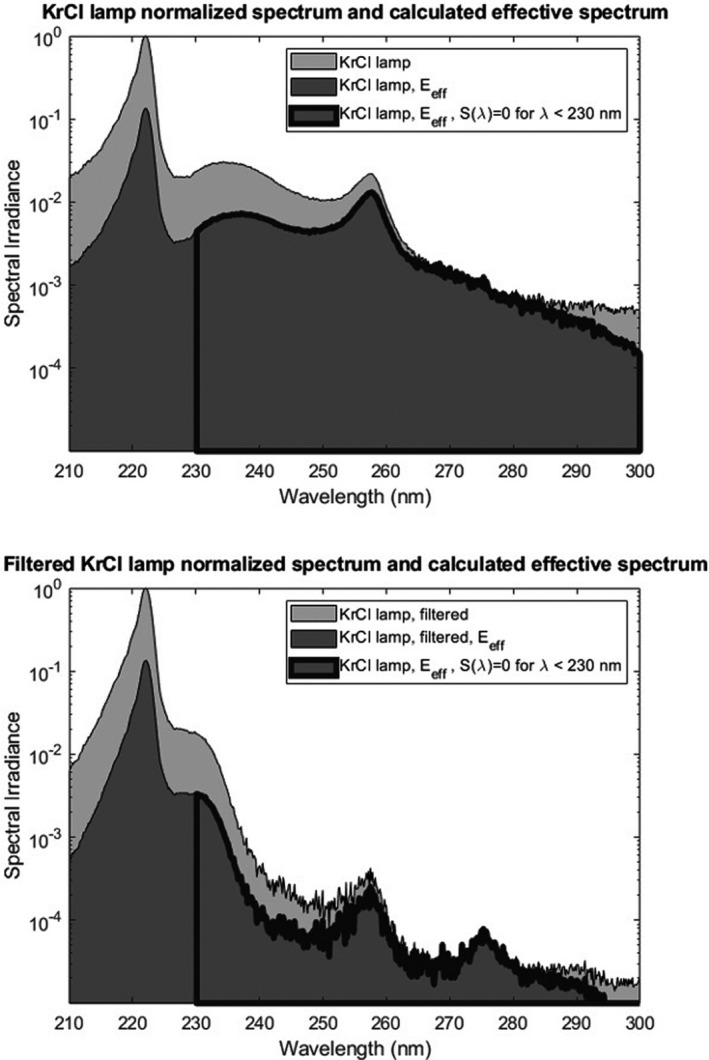
Far-UVC radiation is a promising technology that is potentially both effective at killing airborne microbes such as coronaviruses and influenza, and being minimally hazardous to the skin and eyes. Our previous studies on health risks from far-UVC have employed a krypton-chloride (KrCl) excimer lamp, emitting principally at 222 nm, supplemented with an optical filter to remove longer wavelength emissions inherent to these lamps. This study explores KrCl lamp health hazards by comparing filtered and unfiltered KrCl lamps using effective spectral irradiance calculations and experimental skin exposures. Analysis of effective irradiances showed a notable increase in allowable exposure when using a filter. Induction of DNA dimers (CPD and 6-4PP) was measured in human skin models exposed to a range of radiant exposures up to 500 mJ cm . Compared to sham-exposed tissues, the unfiltered KrCl lamps induced a statistically significant increase in the yield of both DNA lesions at all the radiant exposures studied. Conversely, filtered KrCl lamps do not induce increased levels of dimers at the current daily TLV exposure limit for 222 nm (23 mJ cm ). This work supports the use of filters for far-UVC KrCl excimer lamps when used to limit disease transmission in occupied locations.
远紫外线 C 辐射是一种很有前途的技术,它既能有效杀灭空气中的微生物,如冠状病毒和流感病毒,又对皮肤和眼睛的危害极小。我们之前关于远紫外线 C 健康风险的研究使用的是氪-氯(KrCl)准分子灯,主要发射波长为 222nm,并辅以光学滤波器以去除这些灯固有的长波长发射。本研究通过使用有效光谱辐照度计算和皮肤暴露实验比较过滤和未过滤的 KrCl 灯,探讨了 KrCl 灯的健康危害。有效辐照度分析表明,使用滤光片时允许的暴露量显著增加。在暴露于一系列辐照剂量高达 500mJ/cm 的范围内,测量了人皮肤模型中 DNA 二聚体(CPD 和 6-4PP)的诱导。与假暴露组织相比,未过滤的 KrCl 灯在所有研究的辐照剂量下均诱导 DNA 损伤的产率显著增加。相反,在当前 222nm 的每日 TLV 暴露限值(23mJ/cm)下,过滤后的 KrCl 灯不会诱导二聚体水平升高。这项工作支持在使用远紫外线 C KrCl 准分子灯限制有人居住场所的疾病传播时使用滤光片。