Wei Xiaoyuan, Bottoms Kristopher A, Stein Hans H, Blavi Laia, Bradley Casey L, Bergstrom Jon, Knapp Joshua, Story Robert, Maxwell Charles, Tsai Tsungcheng, Zhao Jiangchao
Department of Animal Science, Division of Agriculture, University of Arkansas, Fayetteville, AR 72701, USA.
Department of Animal Science, University of Illinois Urbana-Champaign, Champaign, IL 61801, USA.
Microorganisms. 2021 Jan 5;9(1):110. doi: 10.3390/microorganisms9010110.
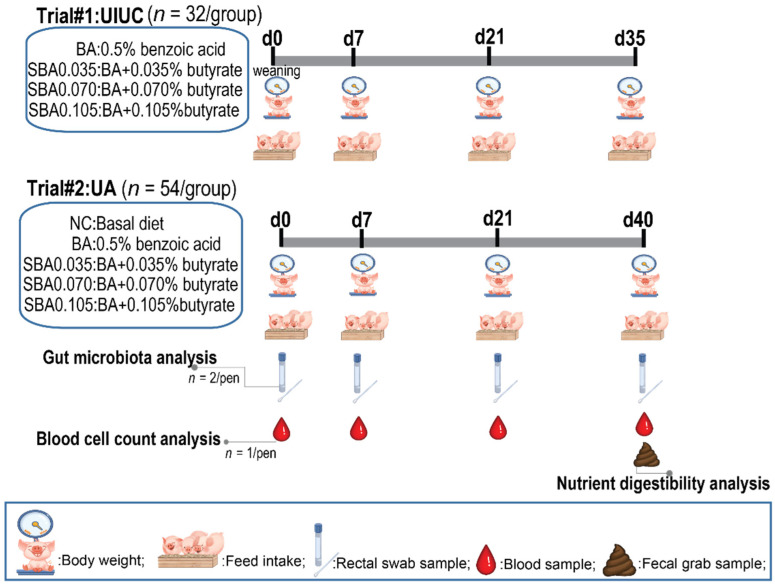
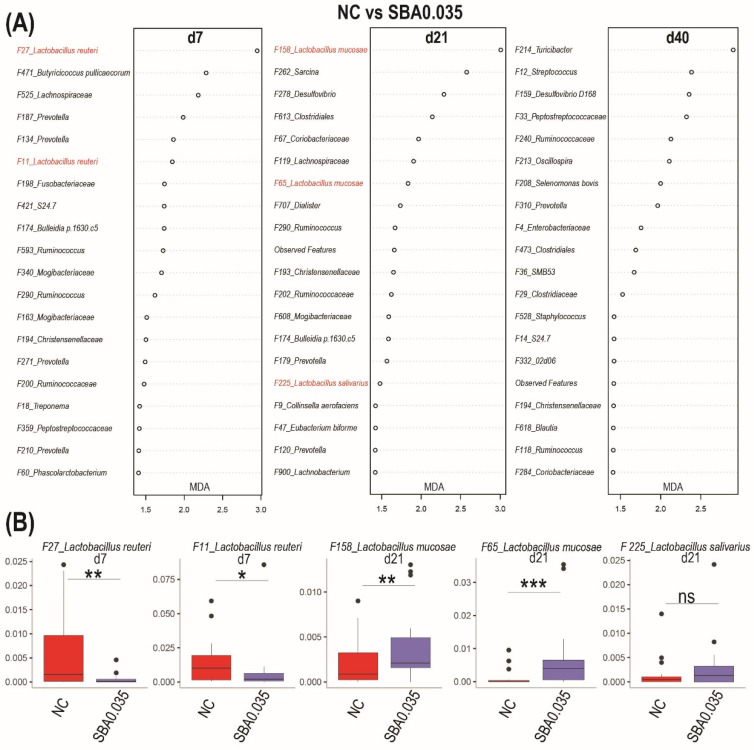
Feed additives have been suggested to improve animal growth performance through modulating the gut microbiota. The hypothesis of this study was that the combination of two organic acids would exert synergistic effects on the growth performance and gut microbiota of weaning pigs. To test this hypothesis, we followed 398 weaning pigs from two university experiment stations (University of Illinois at Urbana-Champaign (UIUC) and University of Arkansas (UA)) to determine the effects of increasing levels (0%, 0.035%, 0.070%, and 0.105%) of sodium butyrate combined with 0.5% benzoic acid on the growth performance of nursery pigs. At the UA, an additional negative control diet was included and the gut microbiota analysis was carried out. At both universities, increasing levels of sodium butyrate in a diet containing 0.5% benzoic acid improved growth performance, which reached a plateau in the pigs fed 0.035% (SBA0.035) or 0.070% (SBA0.070) butyrate. Gut microbiota analysis revealed that pigs fed the SBA0.035 diet had more diverse microbiota and contained more potentially beneficial bacteria such as , , and and reduced levels of and . Results of the present study indicated that the inclusion of sodium butyrate at moderate levels in a diet containing 0.5% benzoic acid improved growth performance of weaning pigs and established potential health benefits on gut microbiota.
饲料添加剂已被建议通过调节肠道微生物群来提高动物生长性能。本研究的假设是,两种有机酸的组合对断奶仔猪的生长性能和肠道微生物群会产生协同作用。为了验证这一假设,我们跟踪了来自两个大学实验站(伊利诺伊大学厄巴纳-香槟分校(UIUC)和阿肯色大学(UA))的398头断奶仔猪,以确定添加不同水平(0%、0.035%、0.070%和0.105%)的丁酸钠与0.5%苯甲酸对保育猪生长性能的影响。在阿肯色大学,额外设置了一个阴性对照日粮,并进行了肠道微生物群分析。在两所大学,在含有0.5%苯甲酸的日粮中增加丁酸钠水平均改善了生长性能,在饲喂0.035%(SBA0.035)或0.070%(SBA0.070)丁酸钠的仔猪中生长性能达到平台期。肠道微生物群分析显示,饲喂SBA0.035日粮的仔猪微生物群更多样化,含有更多潜在有益细菌,如 、 和 ,且 和 的水平降低。本研究结果表明,在含有0.5%苯甲酸的日粮中添加适量丁酸钠可提高断奶仔猪的生长性能,并对肠道微生物群产生潜在的健康益处。