Department of Biotechnology, College of Biomedical & Health Science, Konkuk University, Chungju 27478, Korea.
Department of Anatomy, Chonnam National University Medical School, Hwasun 58128, Jeollanam-do, Korea.
Int J Mol Sci. 2021 Jan 5;22(1):463. doi: 10.3390/ijms22010463.
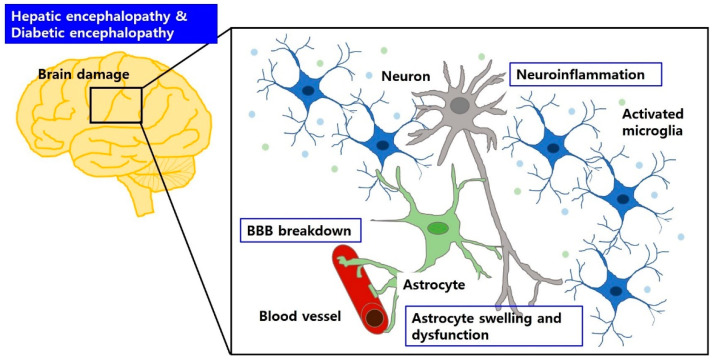
Hepatic encephalopathy (HE) is one of the main consequences of liver disease and is observed in severe liver failure and cirrhosis. Recent studies have provided significant evidence that HE shows several neurological symptoms including depressive mood, cognitive dysfunction, impaired circadian rhythm, and attention deficits as well as motor disturbance. Liver disease is also a risk factor for the development of diabetes mellitus. Diabetic encephalopathy (DE) is characterized by cognitive dysfunction and motor impairment. Recent research investigated the relationship between metabolic changes and the pathogenesis of neurological disease, indicating the importance between metabolic organs and the brain. Given that a diverse number of metabolites and changes in the brain contribute to neurologic dysfunction, HE and DE are emerging types of neurologic disease. Here, we review significant evidence of the association between HE and DE, and summarise the common risk factors. This review may provide promising therapeutic information and help to design a future metabolic organ-related study in relation to HE and DE.
肝性脑病(HE)是肝病的主要后果之一,见于严重肝衰竭和肝硬化。最近的研究提供了重要证据表明,HE 表现出几种神经系统症状,包括抑郁情绪、认知功能障碍、昼夜节律紊乱和注意力缺陷以及运动障碍。肝脏疾病也是糖尿病发生的一个危险因素。糖尿病性脑病(DE)的特征是认知功能障碍和运动障碍。最近的研究调查了代谢变化与神经疾病发病机制之间的关系,表明代谢器官与大脑之间的重要关系。鉴于大量代谢物和大脑变化导致神经功能障碍,HE 和 DE 是新兴的神经疾病类型。在这里,我们综述了 HE 和 DE 之间关联的重要证据,并总结了常见的危险因素。这篇综述可能提供有希望的治疗信息,并有助于设计与 HE 和 DE 相关的未来代谢器官相关研究。