Fiorilli Giovanni, Quinzi Federico, Buonsenso Andrea, Di Martino Giulia, Centorbi Marco, Giombini Arrigo, Calcagno Giuseppe, di Cagno Alessandra
Department of Medicine and Health Sciences, University of Molise, v. De Sanctis 1, 86100 Campobasso, Italy.
Department of Motor, Human and Health Sciences, University of Rome "Foro Italico", Lauro de Bosis Square 15, 00197 Rome, Italy.
J Funct Morphol Kinesiol. 2020 Nov 19;5(4):84. doi: 10.3390/jfmk5040084.
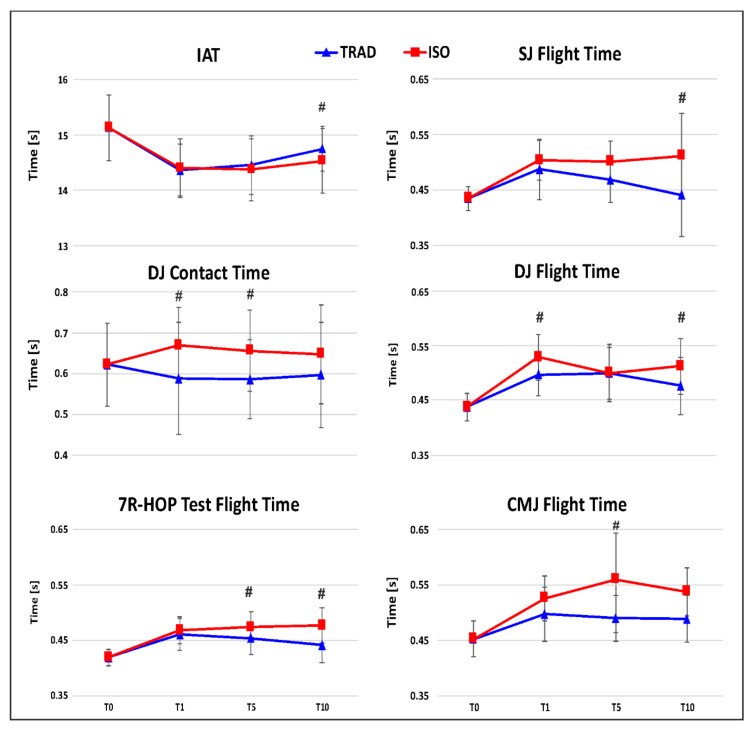
Functional inertial training, a popular high-intensity training mode, provides high neuromuscular activation, developing proprioception, postural control, power, and sprint time. Aim of the study was to assess the acute effects of two types of warm-up (WU), inertial warm-up (IWU) vs. traditional warm-up (TWU), on explosive and reactive strength, sprint, and Change of Directions (COD) in young soccer players. In a randomized cross-over design study, twelve soccer players (aged 13.3 ± 0.7) performed 16 min of IWU and 16 min of TWU. IWU and TWU were spaced two weeks apart. Pre and post intervention tests, aimed at assessing explosive and reactive strength, sprint, and COD ability included: Squat Jump test (SJ), Countermovement Jump test (CMJ), Drop Jump test (DJ), Seven Repetition Hopping test (7R-HOP), 40 m-sprint test (40 m), and Illinois Agility Test (IAT). RM-ANOVA, used to compare differences between IWU and TWU effects (the level of significance set at ≤ 0.05), showed enhanced performance after the IWU compared to the TWU. In addition, the effects of the IWU on performance lasted longer after the IWU than after the TWU. For IAT, the enhanced effects of IWU on performance lasted up to ten minutes after the administration of the IWU. Our results suggest that IWU affects functional changes displaying earlier adaptation in explosive and reactive strength with longer lasting effects compared to TWU and it could be recommended in young soccer athletes as a WU procedure.
功能性惯性训练是一种流行的高强度训练模式,能提供高度的神经肌肉激活,增强本体感觉、姿势控制、力量和短跑速度。本研究的目的是评估两种热身方式,即惯性热身(IWU)与传统热身(TWU),对年轻足球运动员爆发力、反应力量、短跑和变向能力的急性影响。在一项随机交叉设计研究中,12名足球运动员(年龄13.3±0.7岁)分别进行了16分钟的IWU和16分钟的TWU。IWU和TWU之间间隔两周。干预前后的测试旨在评估爆发力、反应力量、短跑和变向能力,包括:深蹲跳测试(SJ)、纵跳测试(CMJ)、跳深测试(DJ)、七次重复单脚跳测试(7R-HOP)、40米短跑测试(40m)和伊利诺伊敏捷性测试(IAT)。采用重复测量方差分析来比较IWU和TWU效果之间的差异(显著性水平设定为≤0.05),结果显示与TWU相比,IWU后运动员的表现有所提高。此外,IWU对表现的影响在训练后持续的时间比TWU更长。对于IAT,IWU对表现的增强作用在训练后长达十分钟仍持续存在。我们的结果表明,与TWU相比,IWU会影响功能变化,在爆发力和反应力量方面表现出更早的适应性,且效果持续时间更长,因此在年轻足球运动员中,IWU可作为一种热身程序被推荐使用。