Gladstone Center for Cell Circuitry, Gladstone Institutes, San Francisco, California, USA.
University of California, Berkeley, San Francisco Joint Graduate Group in Bioengineering, San Francisco, California, USA.
mBio. 2021 Jan 19;12(1):e01724-20. doi: 10.1128/mBio.01724-20.
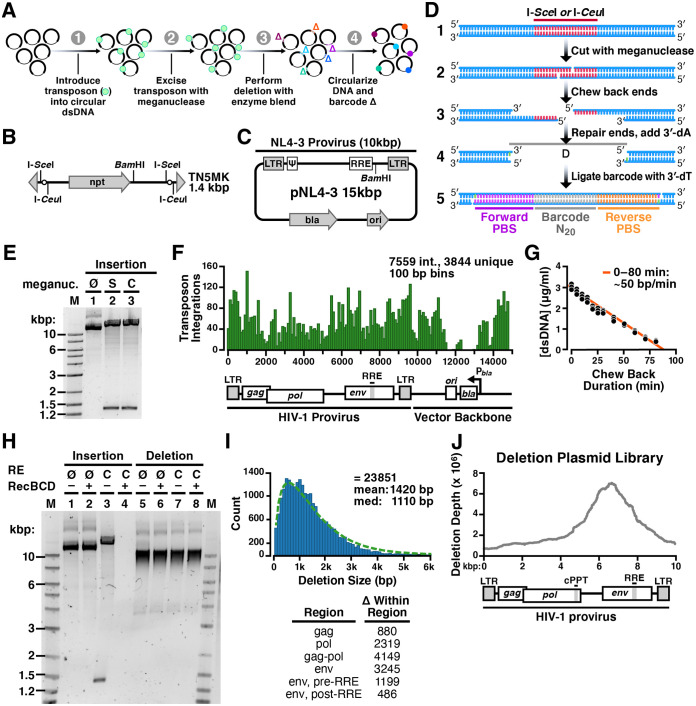
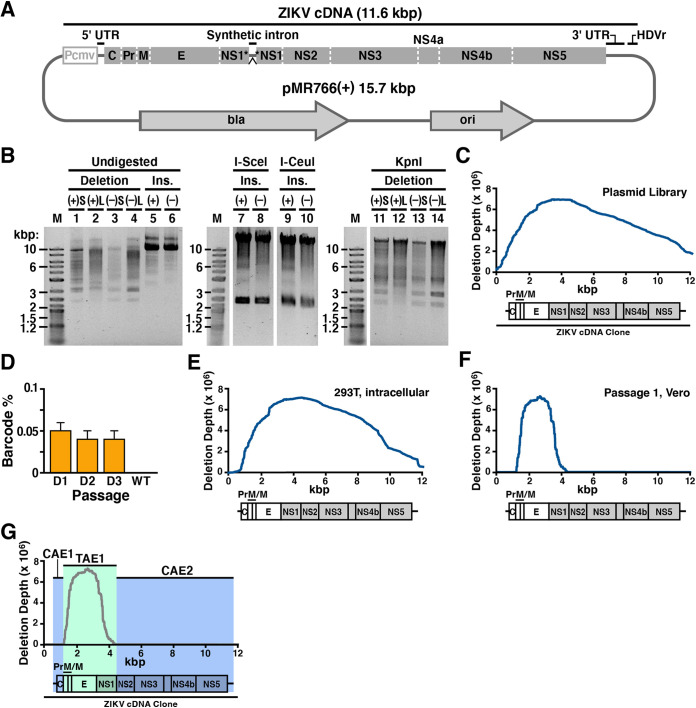
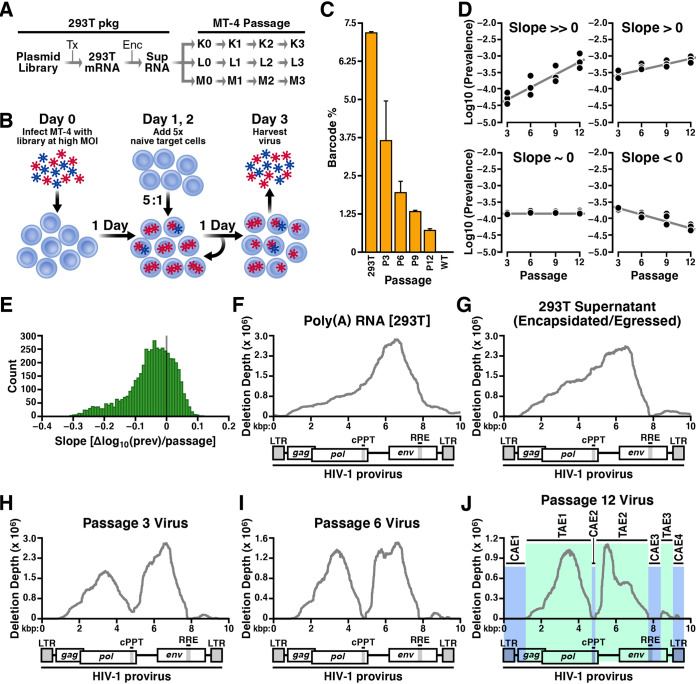
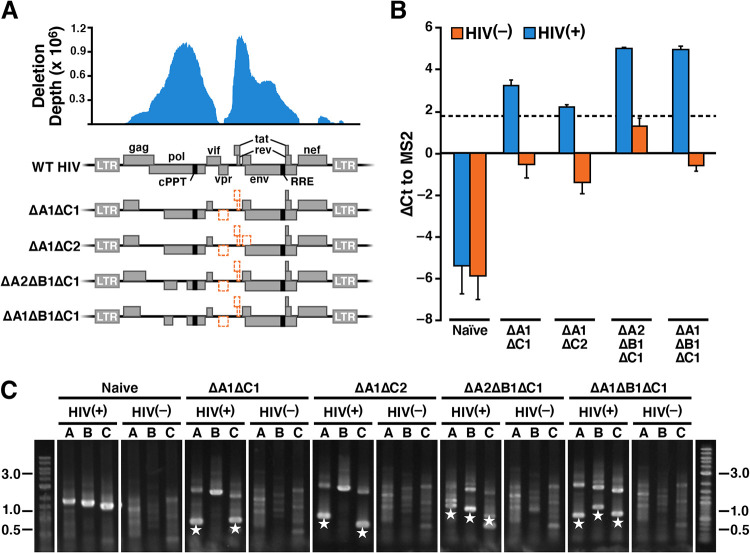
It has long been known that noncoding genomic regions can be obligate elements acted upon in by gene products. In viruses, elements regulate gene expression, encapsidation, and other maturation processes, but mapping these elements relies on targeted iterative deletion or laborious prospecting for rare spontaneously occurring mutants. Here, we introduce a method to comprehensively map viral and elements at single-nucleotide resolution by high-throughput random deletion. Variable-size deletions are randomly generated by transposon integration, excision, and exonuclease chewback and then barcoded for tracking via sequencing (i.e., dom letion ibrary uencing [RanDeL-seq]). Using RanDeL-seq, we generated and screened >23,000 HIV-1 variants to generate a single-base resolution map of HIV-1's and elements. The resulting landscape recapitulated HIV-1's known -acting elements (i.e., long terminal repeat [LTR], Ψ, and Rev response element [RRE]) and, surprisingly, indicated that HIV-1's central DNA flap (i.e., central polypurine tract [cPPT] to central termination sequence [CTS]) is as critical as the LTR, Ψ, and RRE for long-term passage. Strikingly, RanDeL-seq identified a previously unreported ∼300-bp region downstream of RRE extending to splice acceptor 7 that is equally critical for sustained viral passage. RanDeL-seq was also used to construct and screen a library of >90,000 variants of Zika virus (ZIKV). Unexpectedly, RanDeL-seq indicated that ZIKV's -acting regions are larger than the untranscribed (UTR) termini, encompassing a large fraction of the nonstructural genes. Collectively, RanDeL-seq provides a versatile framework for generating viral deletion mutants, enabling discovery of replication mechanisms and development of novel antiviral therapeutics, particularly for emerging viral infections. Recent studies have renewed interest in developing novel antiviral therapeutics and vaccines based on defective interfering particles (DIPs)-a subset of viral deletion mutants that conditionally replicate. Identifying and engineering DIPs require that viral - and -acting elements be accurately mapped. Here, we introduce a high-throughput method (random deletion library sequencing [RanDeL-seq]) to comprehensively map and -acting elements within a viral genome. RanDeL-seq identified essential elements in HIV, including the obligate nature of the once-controversial viral central polypurine tract (cPPT), and identified a new region proximal to the Rev responsive element (RRE). RanDeL-seq also identified regions of Zika virus required for replication and packaging. RanDeL-seq is a versatile and comprehensive technique to rapidly map and regions of a genome.
长期以来,人们一直知道非编码基因组区域可以作为基因产物作用的必需元件。在病毒中,元件调节基因表达、包装和其他成熟过程,但这些元件的映射依赖于靶向迭代删除或费力地寻找罕见的自发发生的突变体。在这里,我们引入了一种通过高通量随机缺失全面绘制病毒和元件的方法。通过转座子整合、切除和核酸外切酶回咬随机产生可变大小的缺失,然后通过测序进行标记跟踪(即,dom letion ibrary uencing [RanDeL-seq])。使用 RanDeL-seq,我们生成并筛选了超过 23000 个 HIV-1 变体,以生成 HIV-1 的单个碱基分辨率的和元件图谱。由此产生的景观再现了 HIV-1 的已知作用元件(即长末端重复序列 [LTR]、Ψ 和 Rev 反应元件 [RRE]),令人惊讶的是,表明 HIV-1 的中央 DNA 瓣(即中央多嘧啶 tract [cPPT]到中央终止序列 [CTS])与 LTR、Ψ 和 RRE 一样重要,是长期传递所必需的。引人注目的是,RanDeL-seq 鉴定了一个以前未报道的位于 RRE 下游延伸到剪接受体 7 的约 300bp 区域,该区域对持续的病毒传递同样重要。RanDeL-seq 还用于构建和筛选超过 90000 个寨卡病毒(ZIKV)变体的文库。出乎意料的是,RanDeL-seq 表明 ZIKV 的作用区域大于未转录(UTR)末端,包含非结构基因的很大一部分。总的来说,RanDeL-seq 为生成病毒缺失突变体提供了一个通用框架,能够发现复制机制并开发新型抗病毒治疗方法,特别是针对新兴的病毒感染。最近的研究重新激发了基于缺陷干扰颗粒(DIP)的新型抗病毒治疗和疫苗的开发兴趣,DIP 是一种条件复制的病毒缺失突变体亚群。鉴定和工程 DIP 需要准确映射病毒和作用元件。在这里,我们引入了一种高通量方法(随机缺失文库测序 [RanDeL-seq])来全面绘制病毒基因组中的和作用元件。RanDeL-seq 鉴定了 HIV 中的必需元件,包括曾经有争议的病毒中央多嘧啶 tract(cPPT)的强制性,以及鉴定了 Rev 反应元件(RRE)附近的新元件。RanDeL-seq 还鉴定了寨卡病毒复制和包装所必需的区域。RanDeL-seq 是一种快速绘制基因组和区域的通用且全面的技术。