Wheaton Michael G, Prikhidko Alena, Messner Gabrielle R
Department of Psychology, Barnard College, Columbia University, New York, NY, United States.
Department of Leadership and Professional Studies, School of Counseling, Recreation and School Psychology, Florida International University, Miami, FL, United States.
Front Psychol. 2021 Jan 5;11:567379. doi: 10.3389/fpsyg.2020.567379. eCollection 2020.
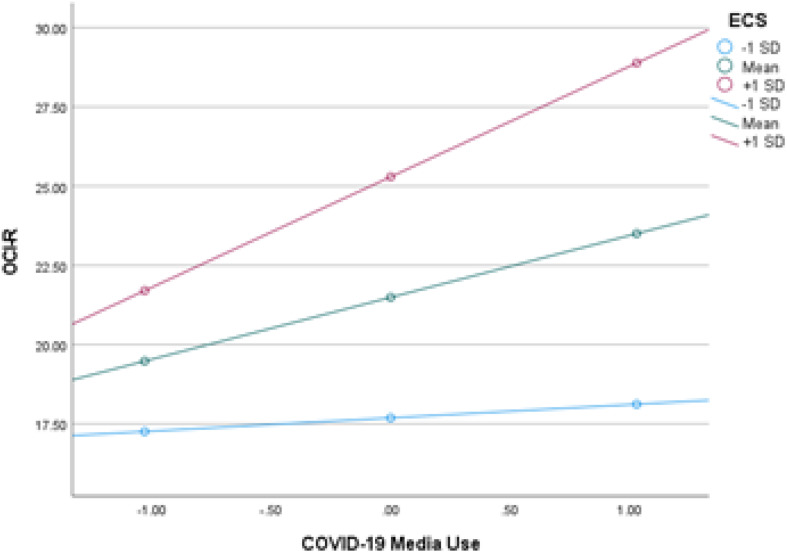
The novel coronavirus disease (COVID-19) has become a global pandemic, causing substantial anxiety. One potential factor in the spread of anxiety in response to a pandemic threat is emotion contagion, the finding that emotional experiences can be socially spread through conscious and unconscious pathways. Some individuals are more susceptible to social contagion effects and may be more likely to experience anxiety and other mental health symptoms in response to a pandemic threat. Therefore, we studied the relationship between emotion contagion and mental health symptoms during the COVID-19 pandemic. We administered the Emotion Contagion Scale (ESC) along with a measure of anxiety in response to COVID-19 (modified from a previous scale designed to quantify fear of the Swine Flu outbreak) and secondary outcome measures of depression, anxiety, stress, and obsessive-compulsive disorder (OCD) symptoms. These measures were completed by a large ( = 603) student sample in the United States. Data were collected in the months of April and May of 2020 when the fear of COVID-19 was widespread. Results revealed that greater susceptibility to emotion contagion was associated with greater concern about the spread of COVID-19, more depression, anxiety, stress, and OCD symptoms. Consumption of media about COVID-19 also predicted anxiety about COVID-19, though results were not moderated by emotion contagion. However, emotion contagion did moderate the relationship between COVID-19-related media consumption and elevated OCD symptoms. Although limited by a cross-sectional design that precludes causal inferences, the present results highlight the need for study of how illness fears may be transmitted socially during a pandemic.
新型冠状病毒病(COVID-19)已成为全球大流行疾病,引发了大量焦虑情绪。应对大流行威胁时,焦虑情绪传播的一个潜在因素是情绪感染,即情绪体验可通过有意识和无意识途径在社会中传播这一发现。一些人更容易受到社会感染效应的影响,在应对大流行威胁时可能更易出现焦虑及其他心理健康症状。因此,我们研究了COVID-19大流行期间情绪感染与心理健康症状之间的关系。我们实施了情绪感染量表(ESC),同时采用了一种针对COVID-19的焦虑测量方法(改编自先前用于量化对猪流感爆发恐惧的量表)以及抑郁、焦虑、压力和强迫症(OCD)症状的次要结果测量方法。这些测量由美国一个规模较大(n = 603)的学生样本完成。数据于2020年4月和5月收集,当时对COVID-19的恐惧广泛存在。结果显示,对情绪感染的易感性越高,与对COVID-19传播的更大担忧、更多抑郁抑郁、焦虑、压力和强迫症症状相关。对COVID-19相关媒体的消费也预示着对COVID-19的焦虑,尽管结果不受情绪感染的调节。然而,情绪感染确实调节了与COVID-19相关的媒体消费与强迫症症状加重之间的关系。尽管本研究受限于横断面设计,无法进行因果推断,但目前的结果凸显了研究在大流行期间疾病恐惧如何在社会中传播的必要性。