Department of Psychology and Sociology, Faculty of Social and Human Sciences, University of Zaragoza, C/ Cdad. Escolar, S/N, 44003, Teruel, Spain.
Department of Basic Psychology, Faculty of Psychology, University of Valencia, Avd. Blasco Ibañez, 10, 46010, Valencia, Spain.
J Psychiatr Res. 2021 May;137:311-318. doi: 10.1016/j.jpsychires.2021.03.004. Epub 2021 Mar 11.
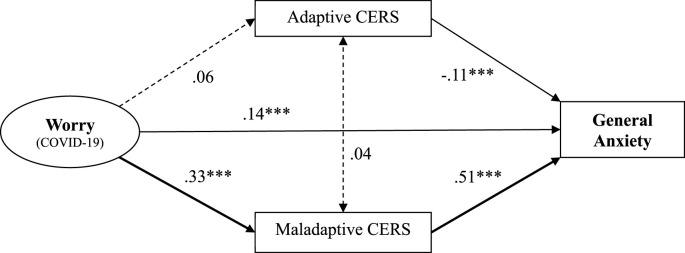
The global pandemic caused by coronavirus disease 2019 (COVID-19) occasioned that most of the population in Spain was confined to home to reduce the risk of contagion. This affected mental health, increasing anxiety and worry about COVID-19 contagion. The aim of this study was assessing the moderation and mediation effect of cognitive emotion regulation strategies (CERS) on general anxiety and whether the mediation effect was moderated by gender and/or age. A total of 1753 Spanish adults (78,6% female; M = 40.4 years, SD = 12.9) participated in an online survey that was available from March 26 to April 25 (2020) during the time period in which the population in Spain was confined. Participants completed measures of worry about COVID-19 contagion, the Cognitive Emotion Regulation Questionnaire-Short (CERQ-Short) and the Generalized Anxiety Disorder-7 (GAD-7). Several models were tested through structural equation modelling. Moderation analyses reported that maladaptive strategies moderated positively anxiety, whereas adaptive strategies moderated negatively anxiety. Also, the best fitted mediation model found that worry about COVID-19 contagion and general anxiety was mediated by CERS in different directions. Maladaptive CERS increased anxiety, whereas adaptive CERS reduced anxiety. Age (not gender) also moderated this mediation, were younger adults presented an indirect effect only through maladaptive CERS, but older adults through both adaptive and maladaptive. Limitations are related to the study design which was a convenience sample. CERS moderated and mediated between worry about COVID-19 contagion and general anxiety. Prevention programs for mental health problems during the pandemic must be provided, especially for younger adults.
由 2019 年冠状病毒病(COVID-19)引起的全球大流行导致西班牙大部分人口被限制在家中以降低感染风险。这影响了心理健康,增加了对 COVID-19 感染的焦虑和担忧。本研究旨在评估认知情绪调节策略(CERS)对一般焦虑的调节和中介作用,以及这种中介作用是否受到性别和/或年龄的调节。共有 1753 名西班牙成年人(78.6%为女性;M=40.4 岁,SD=12.9)参加了一项在线调查,该调查于 2020 年 3 月 26 日至 4 月 25 日期间进行,当时西班牙人口被限制在家中。参与者完成了对 COVID-19 感染的担忧、认知情绪调节问卷-简短版(CERQ-Short)和广泛性焦虑症 7 项量表(GAD-7)的测量。通过结构方程模型测试了几种模型。调节分析报告称,适应不良策略对焦虑有积极的调节作用,而适应策略对焦虑有消极的调节作用。此外,最佳拟合的中介模型发现,对 COVID-19 感染的担忧和一般焦虑通过 CERS 以不同的方向中介。适应不良的 CERS 增加了焦虑,而适应良好的 CERS 则减轻了焦虑。年龄(而不是性别)也调节了这种中介作用,年轻成年人仅通过适应不良的 CERS 呈现间接效应,而年龄较大的成年人则通过适应良好和适应不良的 CERS 呈现间接效应。局限性与研究设计有关,该设计是一个方便样本。CERS 调节了对 COVID-19 感染的担忧和一般焦虑之间的关系,并起到了中介作用。在大流行期间,必须提供针对心理健康问题的预防计划,特别是针对年轻成年人。