Barua Niloy, Herken Ashlee M, Stern Kyle R, Reese Sean, Powers Roger L, Morrell-Falvey Jennifer L, Platt Thomas G, Hansen Ryan R
Tim Taylor Department of Chemical Engineering, Kansas State University, Manhattan, KS, United States.
Division of Biology, Kansas State University, Manhattan, KS, United States.
Front Microbiol. 2021 Jan 5;11:601788. doi: 10.3389/fmicb.2020.601788. eCollection 2020.
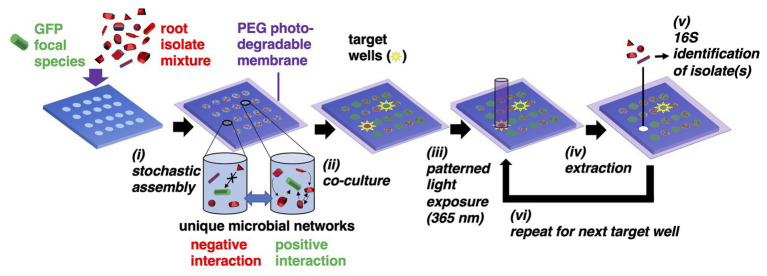
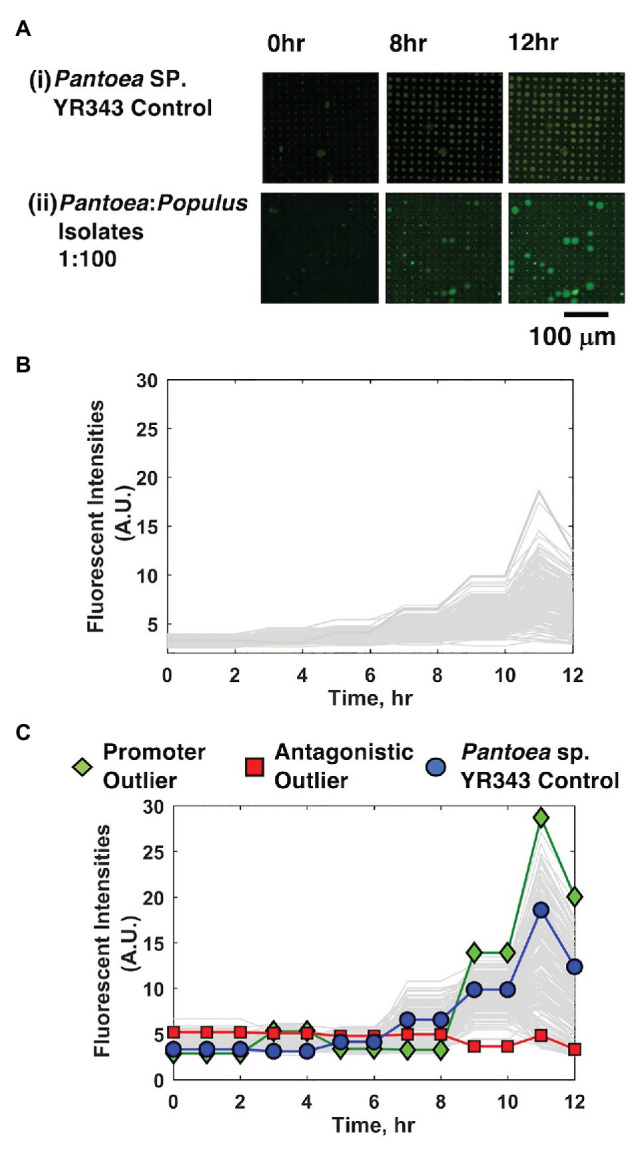
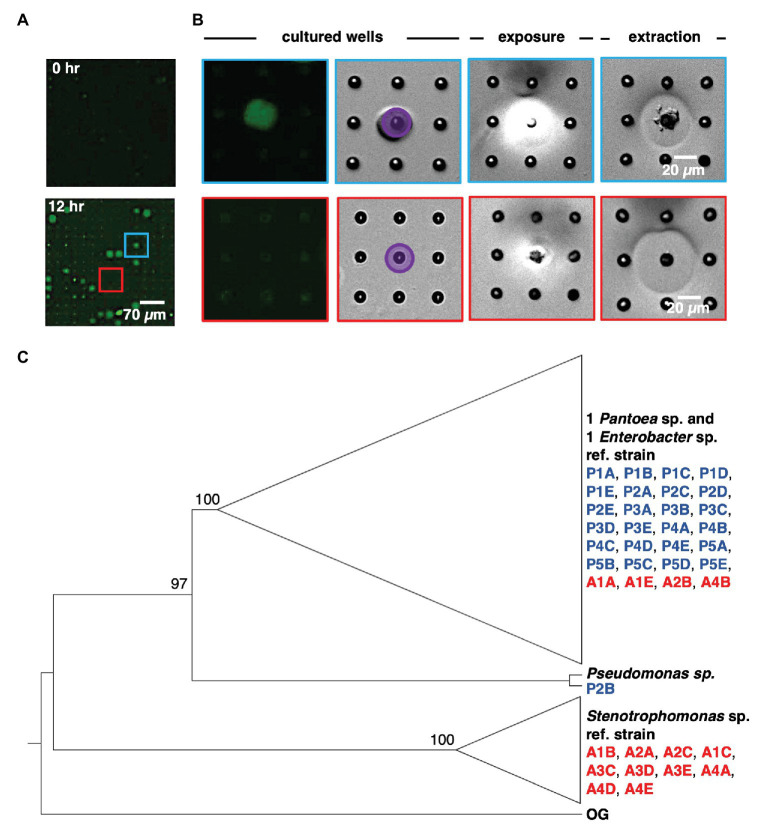
Understanding microbe-microbe interactions is critical to predict microbiome function and to construct communities for desired outcomes. Investigation of these interactions poses a significant challenge due to the lack of suitable experimental tools available. Here we present the microwell recovery array (MRA), a new technology platform that screens interactions across a microbiome to uncover higher-order strain combinations that inhibit or promote the function of a focal species. One experimental trial generates 10 microbial communities that contain the focal species and a distinct random sample of uncharacterized cells from plant rhizosphere. Cells are sequentially recovered from individual wells that display highest or lowest levels of focal species growth using a high-resolution photopolymer extraction system. Interacting species are then identified and putative interactions are validated. Using this approach, we screen the poplar rhizosphere for strains affecting the growth of sp. YR343, a plant growth promoting bacteria isolated from rhizosphere. In one screen, we montiored 3,600 microwells within the array to uncover multiple antagonistic strains and a set of strains that promoted YR343 growth. The later demonstrates the unique ability of the platform to discover multi-membered consortia that generate emergent outcomes, thereby expanding the range of phenotypes that can be characterized from microbiomes. This knowledge will aid in the development of consortia for production, while the platform offers a new approach for screening and discovery of microbial interactions, applicable to any microbiome.
了解微生物与微生物之间的相互作用对于预测微生物组功能以及构建具有理想结果的群落至关重要。由于缺乏合适的实验工具,对这些相互作用的研究面临重大挑战。在此,我们展示了微孔回收阵列(MRA),这是一种新技术平台,可筛选整个微生物组中的相互作用,以发现抑制或促进目标物种功能的高阶菌株组合。一次实验可产生10个微生物群落,其中包含目标物种以及来自植物根际的未鉴定细胞的独特随机样本。使用高分辨率光聚合物提取系统,从显示目标物种生长水平最高或最低的各个孔中依次回收细胞。然后鉴定相互作用的物种,并验证假定的相互作用。使用这种方法,我们在杨树根际中筛选影响从根际分离的植物促生细菌sp. YR343生长的菌株。在一次筛选中,我们监测了阵列中的3600个微孔,以发现多种拮抗菌株和一组促进YR343生长的菌株。后者证明了该平台发现产生新出现结果的多成员联合体的独特能力,从而扩大了可从微生物组中表征的表型范围。这些知识将有助于开发用于生产的联合体,同时该平台为筛选和发现微生物相互作用提供了一种新方法,适用于任何微生物组。