Department of Radiation Oncology, Stanford University School of Medicine, Stanford Cancer Institute, Stanford, CA, USA.
Division of Gynecologic Oncology, Department of Gynecology, Stanford University School of Medicine, Stanford, CA, USA.
J Gynecol Oncol. 2021 Mar;32(2):e22. doi: 10.3802/jgo.2021.32.e22. Epub 2021 Jan 8.
Patients with early-stage endometrial cancers (EC) with disease recurrences have worse survival outcomes. The purpose of this study was to identify clinical and pathologic factors that predict for all recurrences in stage IA grade 1 (IAG1) EC.
Records from patients diagnosed with EC were retrospectively reviewed. Baseline characteristics of 222 patients with IAG1 EC who underwent surgical resection were analyzed. Cox proportional hazard analysis was used to identify univariate and multivariate risk factors that predict for recurrence.
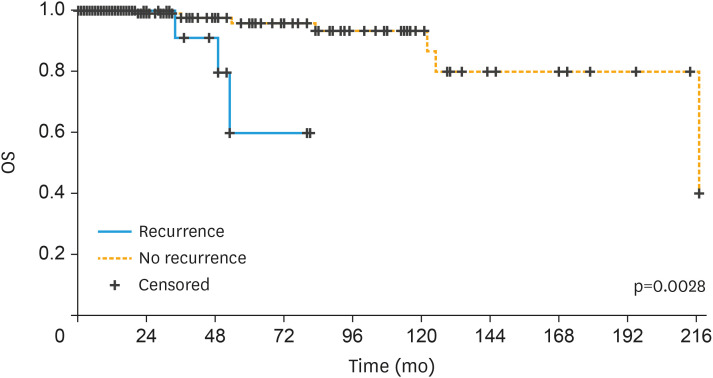
Seventeen (7.65%) patients had recurrences. The 3-year cumulative incidence of recurrence were significantly higher for patients with time from biopsy to surgery ≥6 months (54% vs. 8%, p=0.003), simple hysterectomy with ovarian preservation vs. total hysterectomy and bilateral salpingo-oophorectomy (31% vs. 9%, p=0.032), any myometrial invasion vs. no invasion (18% vs. 2%, p=0.004), and tumor size ≥2 cm (15% vs. 2%, p=0.021). On, multivariate analysis, any myometrial invasion, increasing time from biopsy to surgery, and larger tumor size were independent predictors of any recurrence. Patients with recurrences had worse outcomes than those without (5-year overall survival [OS]=60%; 95% confidence interval [CI]=16%-86% vs. 5-year OS=95%; 95% CI=87%-99%, respectively, p=0.003).
Time from biopsy to surgery, larger tumors, and myometrial invasion are the most important predictors of recurrence. Though the recurrence rates are generally low in IAG1 EC, the survival rate for the patients with recurrences was worse than those without. Identification of additional recurrence risk factors can help select patients who may benefit from adjuvant treatment.
患有疾病复发的早期子宫内膜癌(EC)患者的生存结果更差。本研究的目的是确定预测 IA 期 1 级(IAG1)EC 所有复发的临床和病理因素。
回顾性分析诊断为 EC 的患者的记录。分析了 222 例接受手术切除的 IAG1EC 患者的基线特征。使用 Cox 比例风险分析确定预测复发的单因素和多因素危险因素。
17(7.65%)例患者复发。活检至手术时间≥6 个月的患者(54% vs. 8%,p=0.003)、单纯子宫切除术保留卵巢与全子宫切除术和双侧输卵管卵巢切除术(31% vs. 9%,p=0.032)、任何肌层浸润与无浸润(18% vs. 2%,p=0.004)和肿瘤大小≥2cm(15% vs. 2%,p=0.021)的患者,3 年复发累积发生率显著更高。多因素分析显示,任何肌层浸润、活检至手术时间延长和肿瘤体积增大是任何复发的独立预测因素。有复发的患者比没有复发的患者预后更差(5 年总生存率[OS]=60%;95%置信区间[CI]=16%-86%vs.5 年 OS=95%;95%CI=87%-99%,分别,p=0.003)。
从活检到手术的时间、较大的肿瘤和肌层浸润是复发的最重要预测因素。尽管 IAG1EC 的复发率通常较低,但复发患者的生存率比没有复发的患者差。确定其他复发风险因素可以帮助选择可能受益于辅助治疗的患者。