University of Iowa Iowa City IA.
The University of Alabama at Birmingham AL.
J Am Heart Assoc. 2021 Feb 2;10(3):e018350. doi: 10.1161/JAHA.120.018350. Epub 2021 Jan 20.
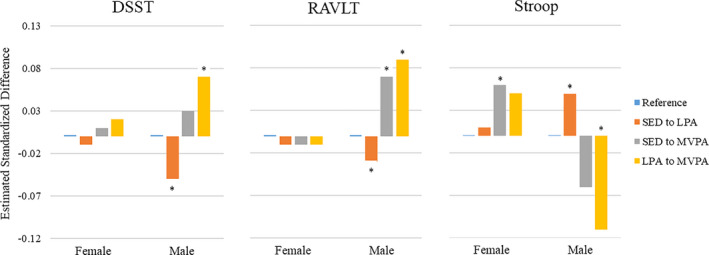
Background To determine if accelerometer measured sedentary behavior (SED), light-intensity physical activity (LPA), and moderate-to-vigorous-intensity physical activity (MVPA) in midlife is prospectively associated with cognitive function. Methods and Results Participants were 1970 adults enrolled in the CARDIA (Coronary Artery Risk Development in Young Adults) study who wore an accelerometer in 2005 to 2006 (ages 38-50 years) and had cognitive function assessments completed 5 and/or 10 years later. SED, LPA, and MVPA were measured by an ActiGraph 7164 accelerometer. Cognitive function tests included the Digit Symbol Substitution Test, Rey Auditory Verbal Learning Test, and Stroop Test. Compositional isotemporal substitution analysis examined associations of SED, LPA, and MVPA with repeated measures of the cognitive function standardized scores. In men, statistical reallocation of 30 minutes of LPA with 30 minutes of MVPA resulted in an estimated difference of SD 0.07 (95% CI, 0.01-0.14), SD 0.09 (95% CI, 0.02-0.17), and SD -0.11 (95% CI, -0.19 to -0.04) in the Digit Symbol Substitution Test, Rey Auditory Verbal Learning Test, and Stroop scores, respectively, indicating better performance. Associations were similar when reallocating time in SED with MVPA, but results were less robust. Reallocation of time in SED with LPA resulted in an estimated difference of SD -0.05 (95% CI, -0.06 to -0.03), SD -0.03 (95% CI, -0.05 to -0.01), and SD 0.05 (95% CI, 0.03- 0.07) in the Digit Symbol Substitution Test, Rey Auditory Verbal Learning Test, and Stroop scores, respectively, indicating worse performance. Associations were largely nonsignificant among women. Conclusions Our findings support the idea that for men, higher-intensity activities (MVPA) may be necessary in midlife to observe beneficial associations with cognition.
为了确定中年代谢静止行为(SED)、低强度体力活动(LPA)和中高强度体力活动(MVPA)是否与认知功能呈前瞻性相关,我们检测了加速度计的测量值。
这项研究的参与者是 1970 名参加 CARDIA(年轻人冠状动脉风险发展)研究的成年人,他们在 2005 年至 2006 年(年龄 38-50 岁)期间佩戴了加速度计,并且在 5 年或 10 年后完成了认知功能评估。SED、LPA 和 MVPA 通过 ActiGraph 7164 加速度计进行测量。认知功能测试包括数字符号替换测试、 Rey 听觉言语学习测试和 Stroop 测试。组成等时替代分析检查了 SED、LPA 和 MVPA 与认知功能标准化评分的重复测量之间的关联。在男性中,对 30 分钟的 LPA 和 30 分钟的 MVPA 进行统计再分配,导致数字符号替换测试、 Rey 听觉言语学习测试和 Stroop 测试的得分分别估计相差 0.07(95%CI,0.01-0.14)、0.09(95%CI,0.02-0.17)和-0.11(95%CI,-0.19 至-0.04),表明表现更好。当重新分配 SED 与 MVPA 之间的时间时,关联相似,但结果不太稳健。SED 与 LPA 之间时间的再分配导致数字符号替换测试、 Rey 听觉言语学习测试和 Stroop 测试的得分估计相差 0.05(95%CI,-0.06 至-0.03)、0.03(95%CI,-0.05 至-0.01)和 0.05(95%CI,0.03-0.07),表明表现更差。女性中这些关联大多不显著。
我们的研究结果支持这样一种观点,即对于男性而言,中年代谢静止行为(SED)、低强度体力活动(LPA)和中高强度体力活动(MVPA)可能需要更高强度的活动(MVPA),才能观察到与认知功能的有益关联。