Advanced Therapies Group, Oral and Biomedical Sciences, School of Dentistry, College of Biomedical and Life Sciences, Cardiff University, Cardiff, United Kingdom.
Cardiff School of Bioscience, Cardiff University, Cardiff, United Kingdom.
mSphere. 2021 Jan 20;6(1):e01216-20. doi: 10.1128/mSphere.01216-20.
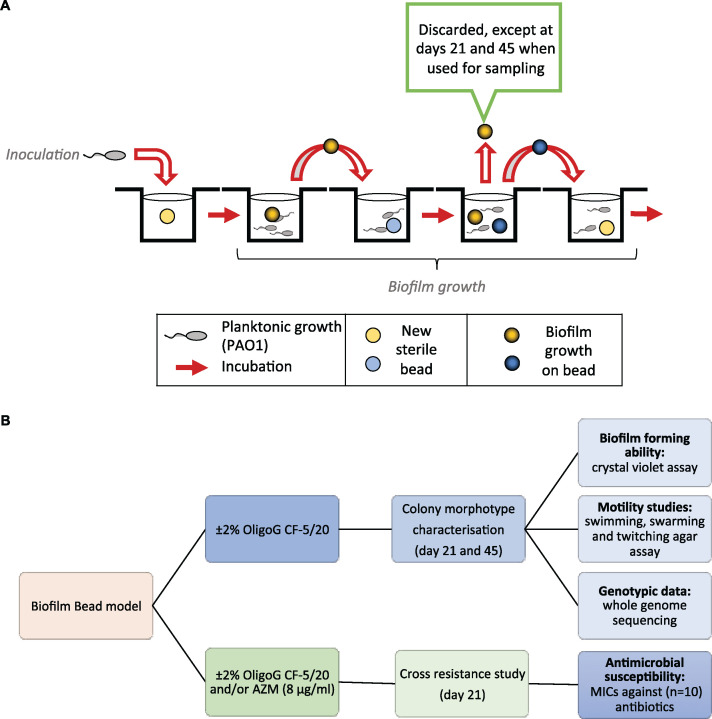
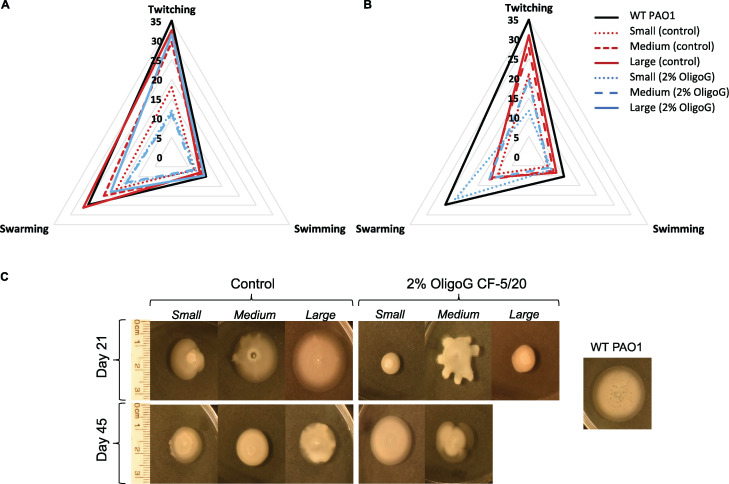
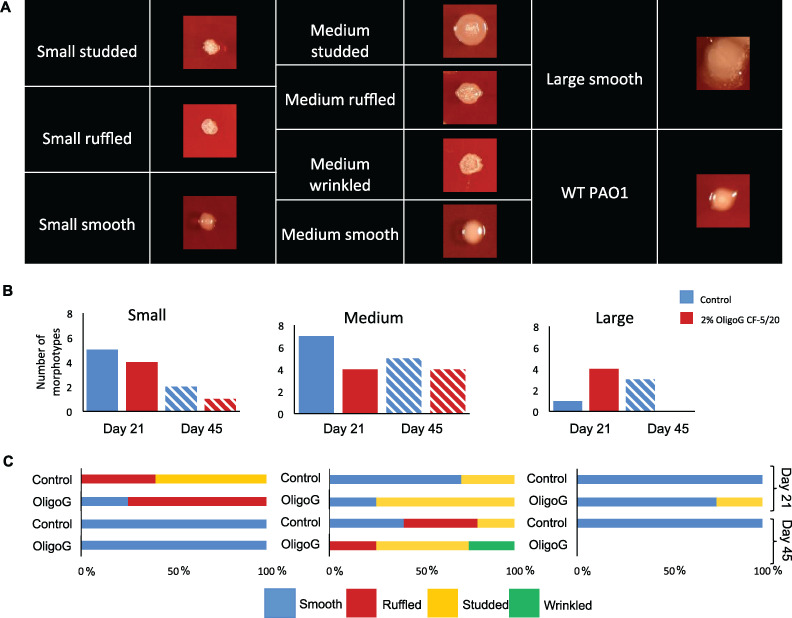
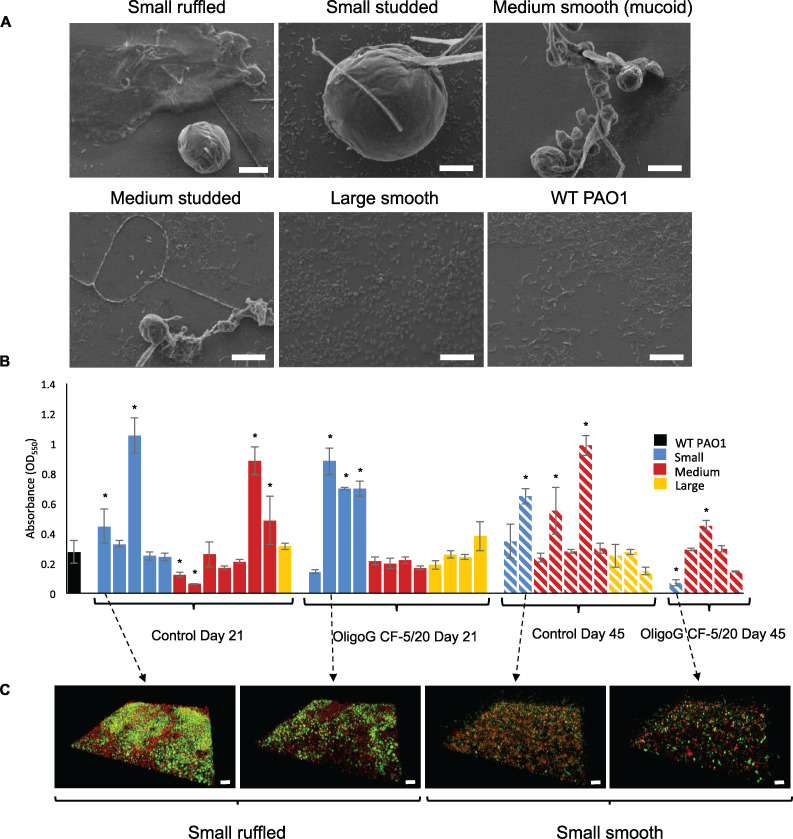
Chronic lung infections in cystic fibrosis (CF) evolve to generate environmentally adapted biofilm communities, leading to increased patient morbidity and mortality. OligoG CF-5/20, a low-molecular-weight inhaled alginate oligomer therapy, is currently in phase IIb/III clinical trials in CF patients. Experimental evolution of in response to OligoG CF-5/20 was assessed using a bead biofilm model allowing continuous passage (45 days; ∼245 generations). Mutants isolated after OligoG CF-5/20 treatment typically had a reduced biofilm-forming ability and altered motility profile. Genotypically, OligoG CF-5/20 provided no selective pressure on genomic mutations within morphotypes. Chronic exposure to azithromycin, a commonly prescribed antibiotic in CF patients, with or without OligoG CF-5/20 in the biofilm evolution model also had no effect on rates of resistance acquisition. Interestingly, however, cross-resistance to other antibiotics (e.g., aztreonam) was reduced in the presence of OligoG CF-5/20. Collectively, these findings show no apparent adverse effects from long-term exposure to OligoG CF-5/20, instead resulting in both fewer colonies with multidrug resistance (MDR)-associated phenotypes and improved antibiotic susceptibility of The emergence of multidrug-resistant (MDR) pathogens within biofilms in the cystic fibrosis lung results in increased morbidity. An inhalation therapy derived from alginate, OligoG CF-5/20, is currently in clinical trials for cystic fibrosis patients. OligoG CF-5/20 has been shown to alter sputum viscoelasticity, disrupt mucin polymer networks, and disrupt MDR pseudomonal biofilms. Long-term exposure to inhaled therapeutics may induce selective evolutionary pressures on bacteria within the lung biofilm. Here, a bead biofilm model with repeated exposure of to OligoG CF-5/20 (alone and in combination with azithromycin) was conducted to study these long-term effects and characterize the phenotypic and genotypic adaptations which result. These findings, over 6 weeks, show that long-term use of OligoG CF-5/20 does not lead to extensive mutational changes and may potentially decrease the pathogenicity of the bacterial biofilm and improve the susceptibility of to other classes of antibiotics.
囊性纤维化(CF)中的慢性肺部感染会演变为具有环境适应性的生物膜群落,导致患者发病率和死亡率增加。寡聚 CF-5/20 是一种低分子量的吸入性藻酸盐低聚物疗法,目前正在 CF 患者的 IIb/III 期临床试验中。使用允许连续传代的珠状生物膜模型(45 天;约 245 代)评估了对寡聚 CF-5/20 的反应的实验进化。寡聚 CF-5/20 治疗后分离的突变体通常具有降低的生物膜形成能力和改变的运动轮廓。从遗传型来看,寡聚 CF-5/20 对形态型内的基因组突变没有提供选择性压力。在生物膜进化模型中,慢性暴露于阿奇霉素(CF 患者常用的抗生素),无论是否有寡聚 CF-5/20,对抗生素耐药性获得率也没有影响。然而,有趣的是,在存在寡聚 CF-5/20 的情况下,对其他抗生素(如氨曲南)的交叉耐药性降低。总的来说,这些发现表明,长期暴露于寡聚 CF-5/20 没有明显的不良影响,反而导致具有多药耐药(MDR)相关表型的菌落减少,并且提高了 的抗生素敏感性。囊性纤维化肺部生物膜中多药耐药(MDR)病原体的出现导致发病率增加。一种源自藻酸盐的吸入疗法,寡聚 CF-5/20,目前正在 CF 患者的临床试验中。寡聚 CF-5/20 已被证明可改变痰的粘弹性,破坏粘蛋白聚合物网络,并破坏 MDR 铜绿假单胞菌生物膜。长期吸入治疗可能会对肺部生物膜中的细菌产生选择性进化压力。在这里,使用珠状生物膜模型对 进行了重复暴露于寡聚 CF-5/20(单独和与阿奇霉素联合使用)的实验,以研究这些长期影响并表征由此产生的表型和基因型适应。这些发现历时 6 周,表明长期使用寡聚 CF-5/20 不会导致广泛的突变,并可能降低细菌生物膜的致病性,提高 的抗生素敏感性。