Yang Kiwoung, Lee Jonghoon, Lee Sang-Choon, Yang Tae-Jin, Kim Hoyteak, Chung Mi-Young, Nou Ill-Sup
Department of Horticulture, Sunchon National University, Suncheon, Republic of Korea.
Department of Plant Science, Plant Genomics and Breeding Institute, and Research Institute for Agriculture and Life Sciences, College of Agriculture and Life Sciences, Seoul National University, Seoul, Republic of Korea.
Mitochondrial DNA B Resour. 2016 Feb 1;1(1):29-30. doi: 10.1080/23802359.2015.1137805.
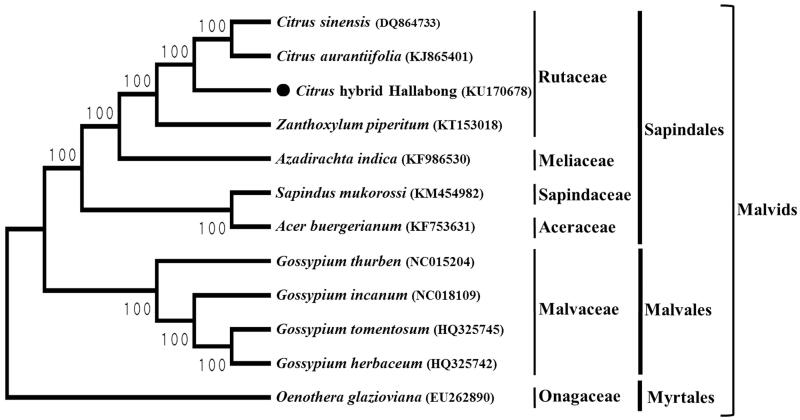
A hybrid, Hallabong mandarin, is a major tree largely cultivated in Korea. The complete chloroplast genome sequence of Hallabong mandarin was characterized by assembly using whole genome next generation sequences. The chloroplast genome was 160 703 bp in length and separated into four distinct regions such as large single copy region (87 922 bp), small single copy region (18 801 bp) and a pair of inverted repeat regions (26 990 bp). The genome contained a total of 114 genes including 80 protein-coding genes, 30 tRNA genes and 4 rRNA genes. Phylogenetic inference using chloroplast genome sequences revealed that Hallabong mandarin was close to (Omani lime) and (sweet orange).
一种杂交品种,汉拿峰柑橘,是韩国广泛种植的主要树种。利用全基因组下一代测序技术对汉拿峰柑橘的完整叶绿体基因组序列进行了组装和特征分析。叶绿体基因组长度为160703bp,分为四个不同区域,即大单拷贝区域(87922bp)、小单拷贝区域(18801bp)和一对反向重复区域(26990bp)。该基因组共包含114个基因,包括80个蛋白质编码基因、30个tRNA基因和4个rRNA基因。利用叶绿体基因组序列进行的系统发育推断表明,汉拿峰柑橘与(阿曼酸橙)和(甜橙)亲缘关系较近。