Hang Peng-Zhou, Zhu Hua, Li Pei-Feng, Liu Jie, Ge Feng-Qin, Zhao Jing, Du Zhi-Min
Department of Pharmacy, Clinical Medical College, Yangzhou University, Northern Jiangsu People's Hospital, Yangzhou 225001, China.
Institute of Clinical Pharmacology, The Second Affiliated Hospital of Harbin Medical University (University Key Laboratory of Drug Research), Harbin 150086, China.
Life (Basel). 2021 Jan 19;11(1):70. doi: 10.3390/life11010070.
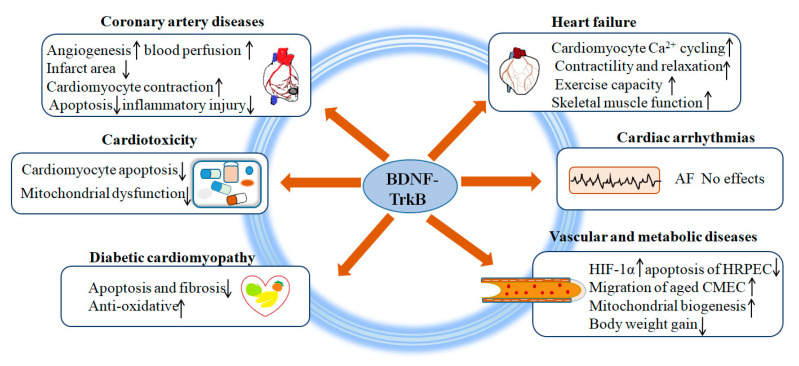
Brain-derived neurotrophic factor (BDNF) is one of the most abundantneurotrophins in the central nervous system. Numerous studies suggestthat BDNF has extensive roles by binding to its specific receptor, tropomyosin-related kinase receptor B (TrkB), and thereby triggering downstream signaling pathways. Recently, growing evidence highlightsthat the BDNF/TrkB pathway is expressed in the cardiovascular system andclosely associated with the development and outcome of cardiovascular diseases (CVD), including coronary artery disease, heart failure, cardiomyopathy, hypertension, and metabolic diseases. Furthermore, circulating BDNF has also been revealed as a new potential biomarker for both diagnosis and prognosis of CVD. In this review, we discuss the current evidence of the emerging role of BDNF/TrkBsignalingand address the challenges that remain in translating these discoveries to novel therapeutic strategies for CVD.
脑源性神经营养因子(BDNF)是中枢神经系统中含量最为丰富的神经营养因子之一。大量研究表明,BDNF通过与其特异性受体——原肌球蛋白相关激酶受体B(TrkB)结合,进而触发下游信号通路,发挥着广泛的作用。最近,越来越多的证据表明,BDNF/TrkB通路在心血管系统中表达,并与心血管疾病(CVD)的发生发展及预后密切相关,这些疾病包括冠状动脉疾病、心力衰竭、心肌病、高血压和代谢性疾病。此外,循环BDNF也已被证实是一种用于CVD诊断和预后评估的新型潜在生物标志物。在本综述中,我们讨论了BDNF/TrkB信号通路新作用的当前证据,并阐述了将这些发现转化为CVD新型治疗策略所面临的挑战。