Rachman Moira, Bajusz Dávid, Hetényi Anasztázia, Scarpino Andrea, Merő Balázs, Egyed Attila, Buday László, Barril Xavier, Keserű György M
Facultat de Farmàcia and Institut de Biomedicina , Universitat de Barcelona , Av. Joan XXIII 27-31 , 08028 Barcelona , Spain.
Medicinal Chemistry Research Group , Research Centre for Natural Sciences , Magyar Tudósok Körútja 2 , Budapest 1117 , Hungary . Email:
RSC Med Chem. 2020 Mar 4;11(5):552-558. doi: 10.1039/c9md00519f. eCollection 2020 May 1.
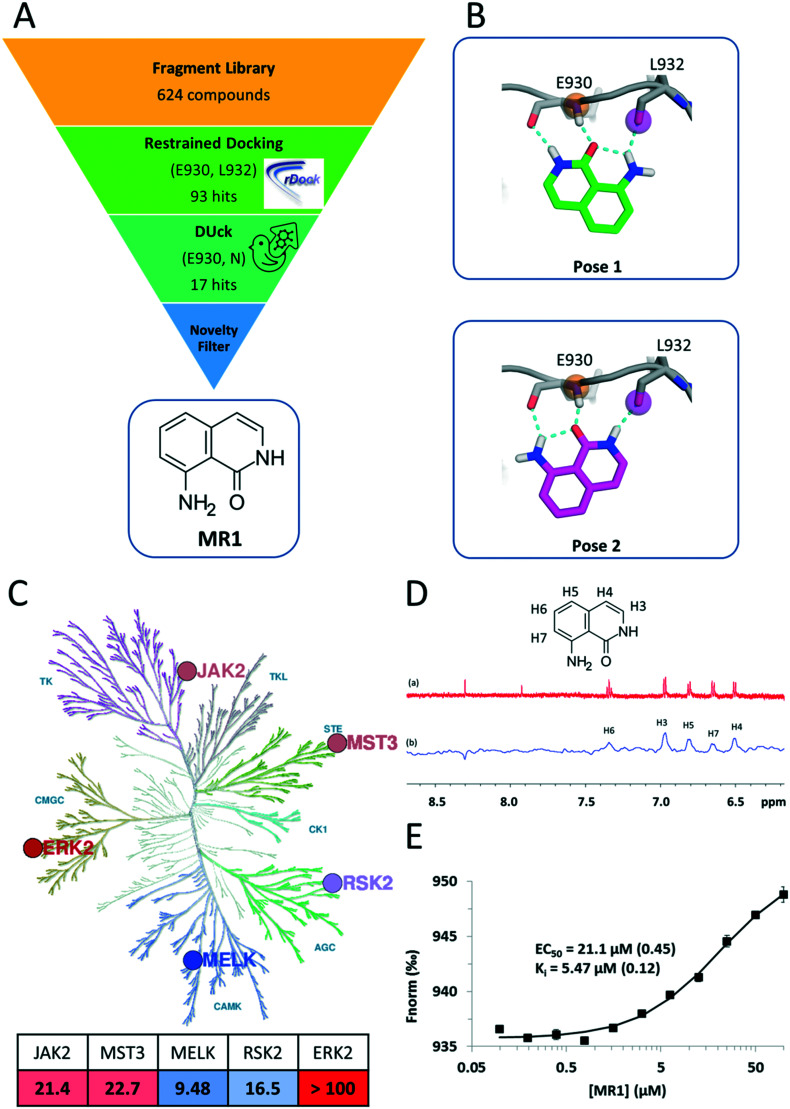
One of the key motifs of type I kinase inhibitors is their interactions with the hinge region of ATP binding sites. These interactions contribute significantly to the potency of the inhibitors; however, only a tiny fraction of the available chemical space has been explored with kinase inhibitors reported in the last twenty years. This paper describes a workflow utilizing docking with rDock and dynamic undocking (DUck) for the virtual screening of fragment libraries in order to identify fragments that bind to the kinase hinge region. We have identified 8-amino-2-isoquinolin-1-one (), a novel and potent hinge binding fragment, which was experimentally tested on a diverse set of kinases, and is hereby suggested for future fragment growing or merging efforts against various kinases, particularly MELK. Direct binding of to MELK was confirmed by STD-NMR, and its binding to the ATP-pocket was confirmed by a new competitive binding assay based on microscale thermophoresis.
I型激酶抑制剂的关键基序之一是它们与ATP结合位点的铰链区的相互作用。这些相互作用对抑制剂的效力有显著贡献;然而,在过去二十年报道的激酶抑制剂中,仅探索了可用化学空间的一小部分。本文描述了一种利用rDock对接和动态去对接(DUck)对片段库进行虚拟筛选的工作流程,以识别与激酶铰链区结合的片段。我们鉴定出了8-氨基-2-异喹啉-1-酮(),这是一种新型强效的铰链结合片段,已在多种激酶上进行了实验测试,特此建议将其用于未来针对各种激酶,特别是MELK的片段生长或合并研究。通过STD-NMR证实了其与MELK的直接结合,并通过基于微量热泳的新型竞争性结合测定法证实了其与ATP口袋的结合。