Department of Psychosocial Research and Epidemiology, Netherlands Cancer Institute, Amsterdam, the Netherlands.
Health, Medical and Neuropsychology Unit, Institute of Psychology, Leiden University, Leiden, the Netherlands.
J Biol Rhythms. 2021 Feb;36(1):71-83. doi: 10.1177/0748730420987327. Epub 2021 Jan 22.
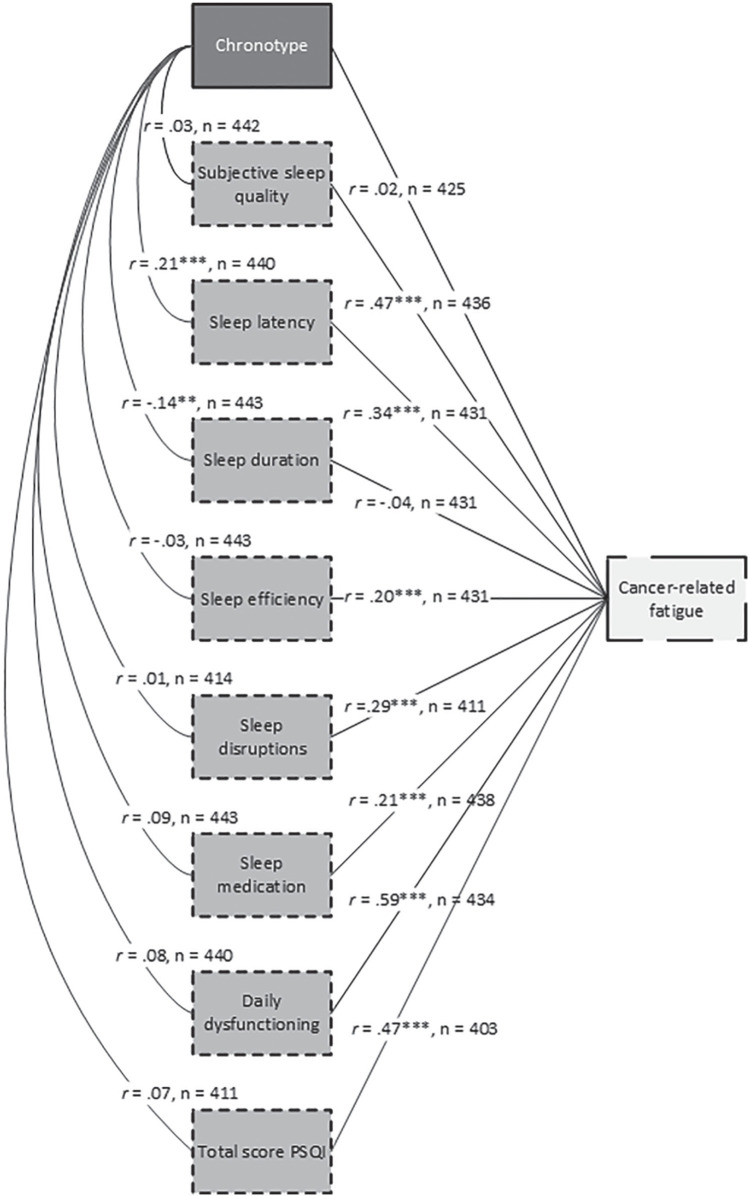
Cancer-related fatigue has been related to circadian disruptions and lower levels of sleep quality. However, it is unknown whether the circadian phase, which is associated with chronotype and timing of sleep, is related to fatigue after cancer. The aims of this study were to investigate the associations between (1) chronotype and cancer-related fatigue and (2) sleep quality and cancer-related fatigue. In this cross-sectional questionnaire study, 458 (non-)Hodgkin lymphoma survivors ( = 231 female, mean age 49.7 years) completed a Visual Analogue Scale for fatigue (VAS-fatigue) from 0 () to 10 (), the Munich Chronotype Questionnaire (MCTQ), and the Pittsburgh Sleep Quality Index (PSQI) between October 2018 and July 2019. A hierarchical linear regression analysis was used to evaluate the associations between the dependent variable fatigue and chronotype (based on early, intermediate, or late average midsleep) in Model 1, and fatigue and sleep quality in Model 2. The results showed no indications for an association between chronotype and fatigue (all values ≥ 0.50). There were associations between two (out of seven) aspects of sleep quality and fatigue: subjective sleep quality ( < 0.001) and daily dysfunctioning ( < 0.001). Therefore, it is more likely that fatigue is associated with self-reported sleep quality rather than with chronotype. However, experimental studies with objective, physiological data on circadian phase and sleep quality are necessary to confirm the conclusions of this cross-sectional study.
癌症相关性疲劳与昼夜节律紊乱和睡眠质量下降有关。然而,目前尚不清楚昼夜节律相位(与睡眠类型和时间有关)是否与癌症后疲劳有关。本研究的目的是调查(1)睡眠类型与癌症相关性疲劳之间的关系,以及(2)睡眠质量与癌症相关性疲劳之间的关系。在这项横断面问卷调查研究中,458 名(非)霍奇金淋巴瘤幸存者(=231 名女性,平均年龄 49.7 岁)于 2018 年 10 月至 2019 年 7 月期间完成了疲劳视觉模拟量表(VAS-fatigue)(范围为 0 至 10)、慕尼黑睡眠类型问卷(MCTQ)和匹兹堡睡眠质量指数(PSQI)。采用分层线性回归分析评估了模型 1 中因变量疲劳与睡眠类型(基于平均晚睡时间的早、中、晚三种类型)之间的关系,以及模型 2 中疲劳与睡眠质量之间的关系。结果显示,睡眠类型与疲劳之间没有关联(所有 值≥0.50)。睡眠质量的两个方面(七个方面中的两个)与疲劳有关:主观睡眠质量(<0.001)和日间功能障碍(<0.001)。因此,疲劳更可能与自我报告的睡眠质量有关,而不是与睡眠类型有关。然而,需要进行具有客观、生理数据的昼夜节律相位和睡眠质量的实验研究,以验证这项横断面研究的结论。