Non-Communicable Diseases Research Center, Endocrinology and Metabolism Population Sciences Institute, Tehran University of Medical Sciences, Tehran, Iran.
Endocrinology and Metabolism Research Center, Endocrinology and Metabolism Clinical Sciences Institute, Tehran University of Medical Sciences, Tehran, Iran.
PLoS One. 2021 Jan 22;16(1):e0245468. doi: 10.1371/journal.pone.0245468. eCollection 2021.
The incidence of Hepatocellular carcinoma (HCC), the most common primary liver cancer with high mortality, is undergoing global change due to evolving risk factor profiles. We aimed to describe the epidemiologic incidence of HCC in Iran by sex, age, and geographical distribution from 2000 to 2016.
We used the Iran Cancer Registry to extract cancer incidence data and applied several statistical procedures to overcome the dataset's incompleteness and misclassifications. Using Spatio-temporal and random intercept mixed effect models, we imputed missing values for cancer incidence by sex, age, province, and year. Besides, we addressed case duplicates and geographical misalignments in the data.
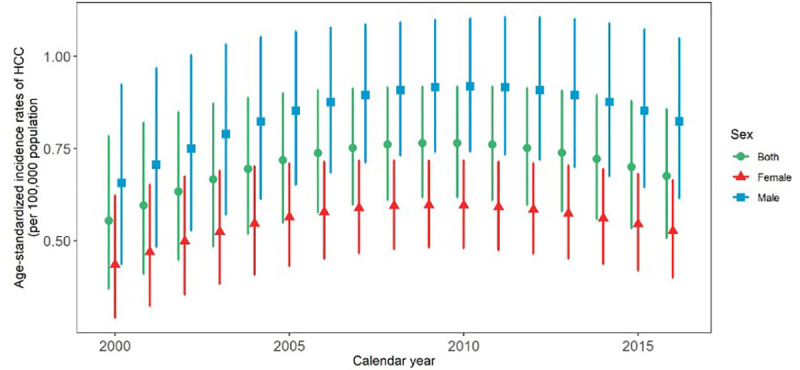
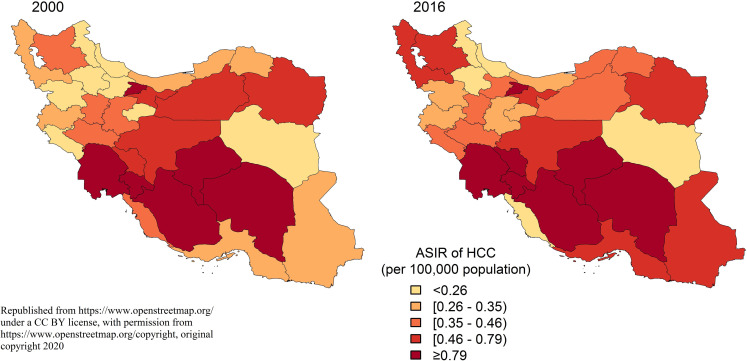
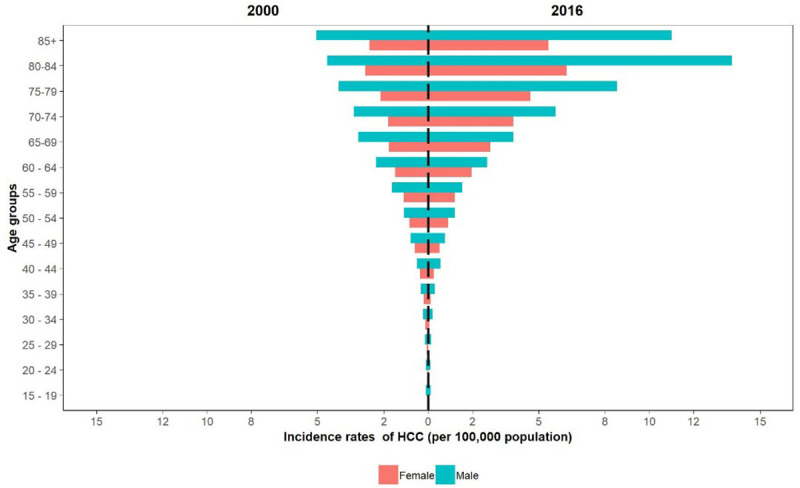
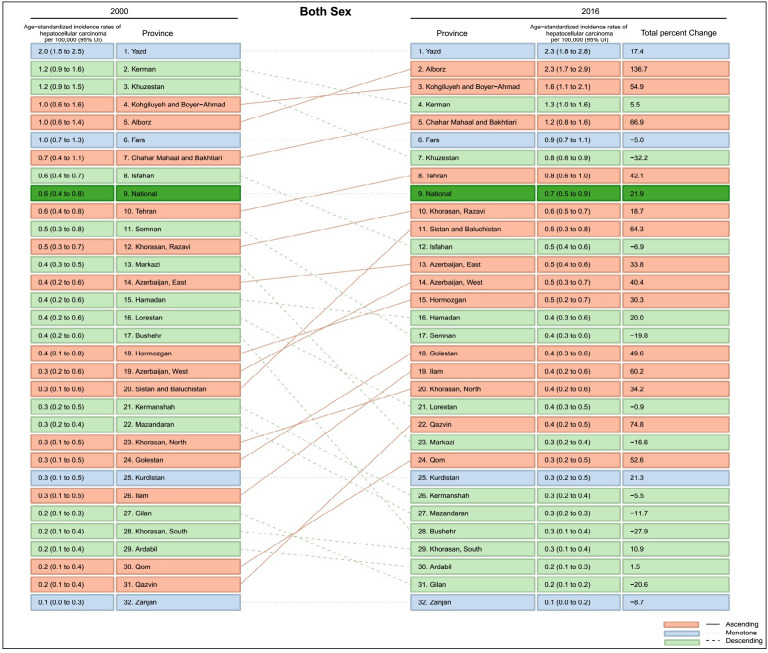
Age-standardized incidence rate (ASIR) increased 1.17 times from 0.57 (95% UI: 0.37-0.78) per 100,000 population in 2000 to 0.67 (0.50-0.85) in 2016. It had a 21.8% total percentage change increase during this time, with a 1.28 annual percentage change in both sexes. Male to female ASIR ratio was 1.51 in 2000 and 1.57 in 2016. Overall, after the age of 50 years, HCC incidence increased dramatically with age and increased from 1.19 (0.98-1.40) in the 50-55 age group to 6.65 (5.45-7.78) in the >85 age group. The geographical distribution of this cancer was higher in the central, southern, and southwestern regions of Iran.
The HCC incidence rate increased from 2000 to 2016, with a more significant increase in subgroups such as men, individuals over 50 years of age, and the central, southern, and southwestern regions of the country. We recommend health planners and policymakers to adopt more preventive and screening strategies for high-risk populations and provinces in Iran.
原发性肝癌是最常见的肝癌,其死亡率极高,由于风险因素谱的不断变化,其发病率在全球范围内发生了变化。本研究旨在描述 2000 年至 2016 年伊朗按性别、年龄和地理分布的肝癌流行病学发病率。
我们使用伊朗癌症登记处提取癌症发病率数据,并应用多种统计程序来克服数据集的不完整性和分类错误。我们使用时空和随机截距混合效应模型,按性别、年龄、省份和年份对肝癌发病率的缺失值进行了估算。此外,我们还解决了数据中的病例重复和地理不匹配问题。
年龄标准化发病率(ASIR)从 2000 年的 0.57(95%置信区间:0.37-0.78)/100,000 人增加到 2016 年的 0.67(0.50-0.85)/100,000 人,增加了 1.17 倍。在此期间,总百分比变化增加了 21.8%,男女两性的年百分比变化均为 1.28%。2000 年和 2016 年男女 ASIR 比值分别为 1.51 和 1.57。总的来说,50 岁以后,随着年龄的增长,肝癌发病率显著增加,从 50-55 岁年龄组的 1.19(0.98-1.40)增加到 85 岁以上年龄组的 6.65(5.45-7.78)。该癌症在伊朗的中、南部和西南部地区的地理分布较高。
2000 年至 2016 年,肝癌发病率呈上升趋势,男性、50 岁以上人群以及该国中、南部和西南部地区发病率增幅更为显著。我们建议卫生规划人员和决策者为伊朗的高危人群和省份制定更多的预防和筛查策略。