Division of Biology and Biological Engineering, California Institute of Technology, Pasadena, California 91125
T&C Chen Brain-Machine Interface Center, California Institute of Technology, Pasadena, California 91125.
J Neurosci. 2021 Mar 10;41(10):2177-2185. doi: 10.1523/JNEUROSCI.2460-20.2021. Epub 2021 Jan 22.
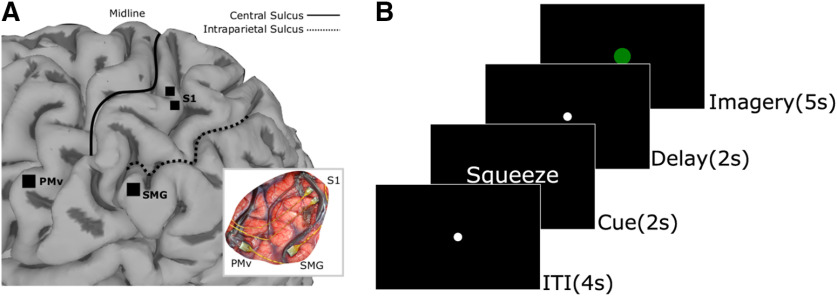
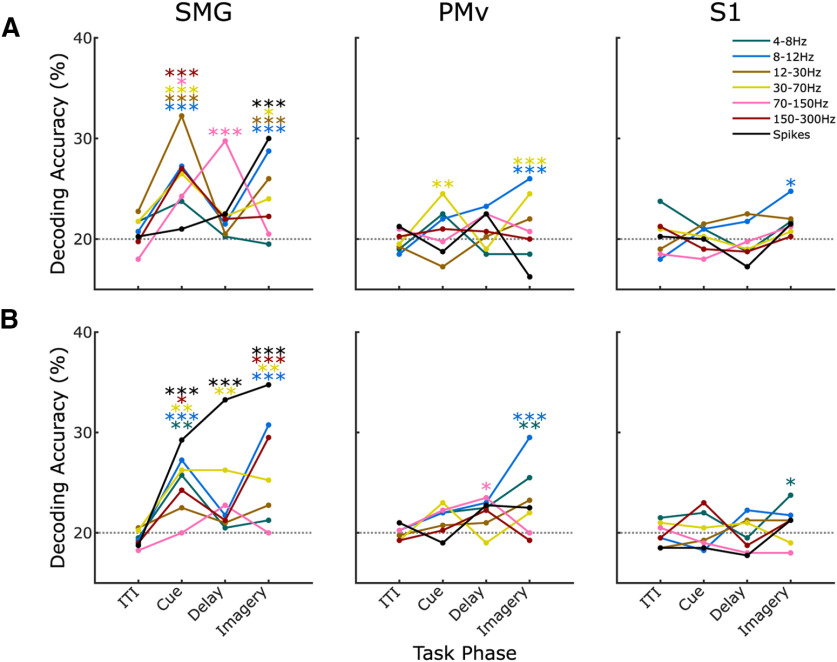
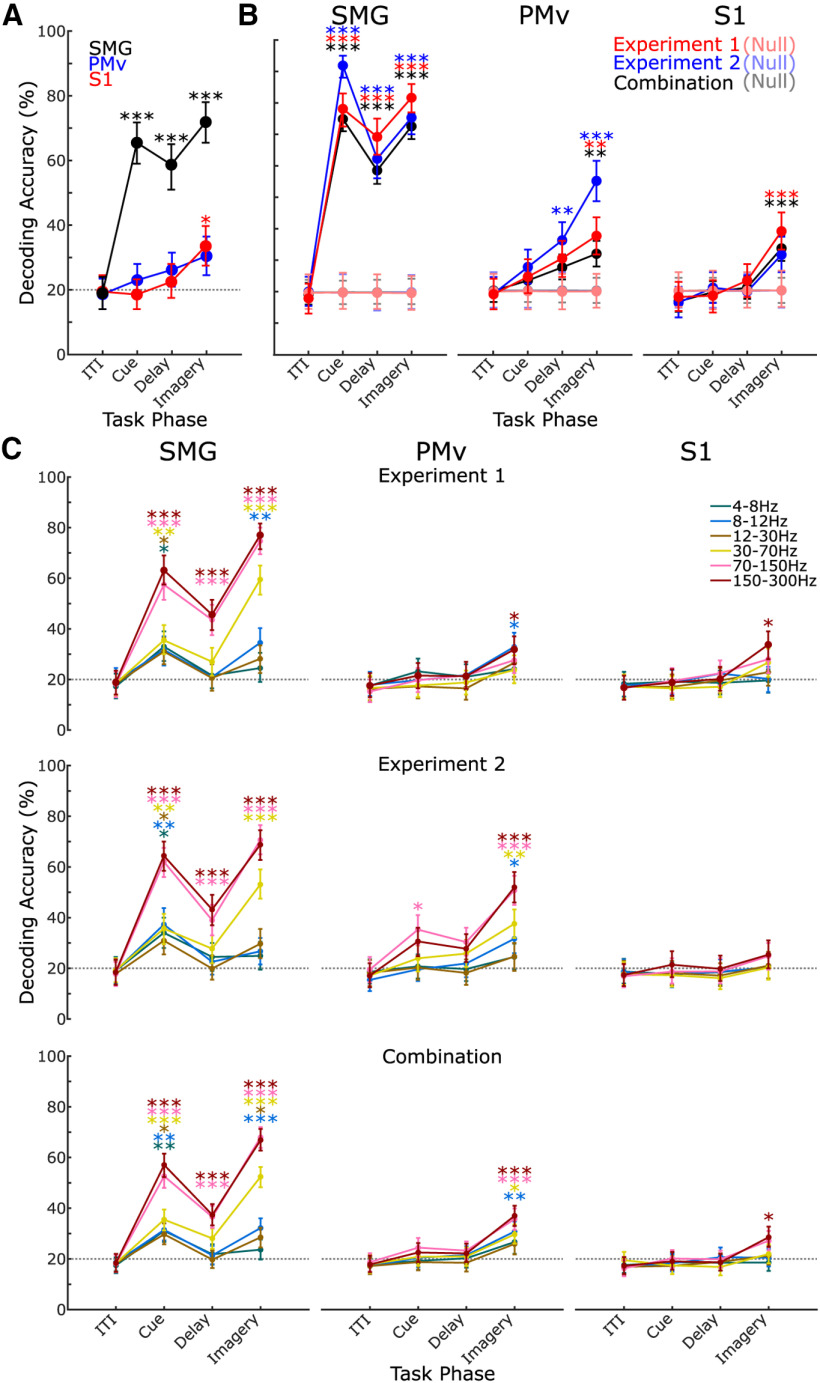
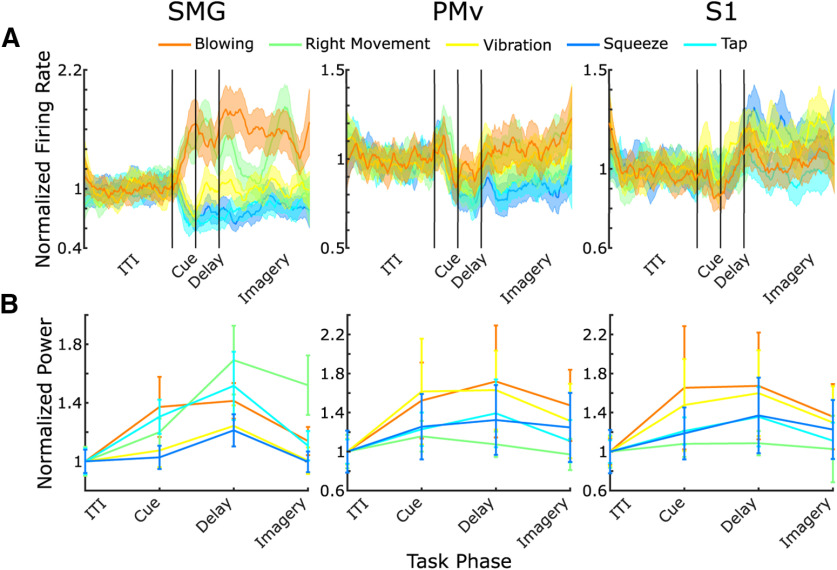
Intracortical microstimulation (ICMS) in human primary somatosensory cortex (S1) has been used to successfully evoke naturalistic sensations. However, the neurophysiological mechanisms underlying the evoked sensations remain unknown. To understand how specific stimulation parameters elicit certain sensations we must first understand the representation of those sensations in the brain. In this study we record from intracortical microelectrode arrays implanted in S1, premotor cortex, and posterior parietal cortex of a male human participant performing a somatosensory imagery task. The sensations imagined were those previously elicited by ICMS of S1, in the same array of the same participant. In both spike and local field potential recordings, features of the neural signal can be used to classify different imagined sensations. These features are shown to be stable over time. The sensorimotor cortices only encode the imagined sensation during the imagery task, while posterior parietal cortex encodes the sensations starting with cue presentation. These findings demonstrate that different aspects of the sensory experience can be individually decoded from intracortically recorded human neural signals across the cortical sensory network. Activity underlying these unique sensory representations may inform the stimulation parameters for precisely eliciting specific sensations via ICMS in future work. Electrical stimulation of human cortex is increasingly more common for providing feedback in neural devices. Understanding the relationship between naturally evoked and artificially evoked neurophysiology for the same sensations will be important in advancing such devices. Here, we investigate the neural activity in human primary somatosensory, premotor, and parietal cortices during somatosensory imagery. The sensations imagined were those previously elicited during intracortical microstimulation (ICMS) of the same somatosensory electrode array. We elucidate the neural features during somatosensory imagery that significantly encode different aspects of individual sensations and demonstrate feature stability over almost a year. The correspondence between neurophysiology elicited with or without stimulation for the same sensations will inform methods to deliver more precise feedback through stimulation in the future.
皮层内微刺激(ICMS)在人类初级体感皮层(S1)中已被用于成功引发自然感觉。然而,诱发感觉的神经生理机制尚不清楚。为了了解特定的刺激参数如何引发特定的感觉,我们必须首先了解这些感觉在大脑中的表现。在这项研究中,我们记录了一名男性人类参与者在执行体感想象任务时,从植入 S1、运动前皮层和后顶叶皮层的皮层内微电极阵列中记录的信号。想象的感觉是之前由 S1 的 ICMS 诱发的相同感觉,在同一参与者的同一微电极阵列中。在尖峰和局部场电位记录中,神经信号的特征可用于对不同想象的感觉进行分类。这些特征随着时间的推移是稳定的。体感和运动皮层仅在想象任务期间对想象的感觉进行编码,而后顶叶皮层从提示呈现开始对感觉进行编码。这些发现表明,可以从皮质感觉网络中记录的人类神经信号中单独解码感觉体验的不同方面。在未来的工作中,通过 ICMS 精确诱发特定感觉的刺激参数可能会受到这些独特感觉表示下的活动的启发。人类皮层的电刺激越来越常用于为神经设备提供反馈。了解相同感觉的自然诱发和人工诱发神经生理学之间的关系对于推进这些设备非常重要。在这里,我们研究了人类初级体感、运动前和顶叶皮层在体感想象期间的神经活动。想象的感觉是之前在同一体感电极阵列的皮层内微刺激(ICMS)中诱发的感觉。我们阐明了体感想象过程中显著编码个体感觉不同方面的神经特征,并证明了特征在近一年的时间内保持稳定。对于相同的感觉,有或没有刺激引起的神经生理学之间的对应关系将为未来通过刺激提供更精确反馈的方法提供信息。