Kolibius Luca D, Born Jan, Feld Gordon B
School of Psychology, Cognition and Oscillations Lab, University of Birmingham, Birmingham, United Kingdom.
Centre for Human Brain Health, University of Birmingham, Birmingham, United Kingdom.
Front Psychol. 2021 Jan 6;11:607070. doi: 10.3389/fpsyg.2020.607070. eCollection 2020.
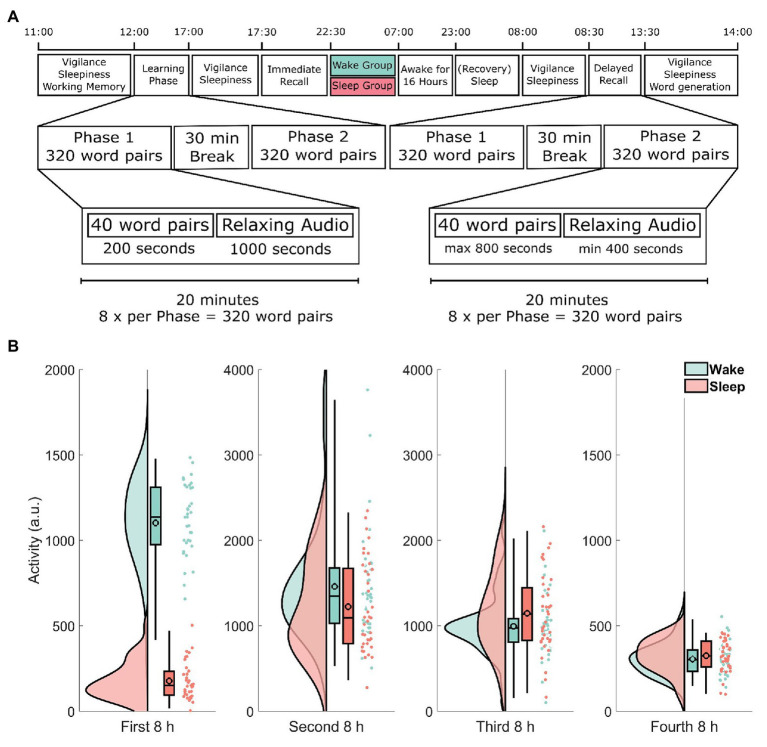
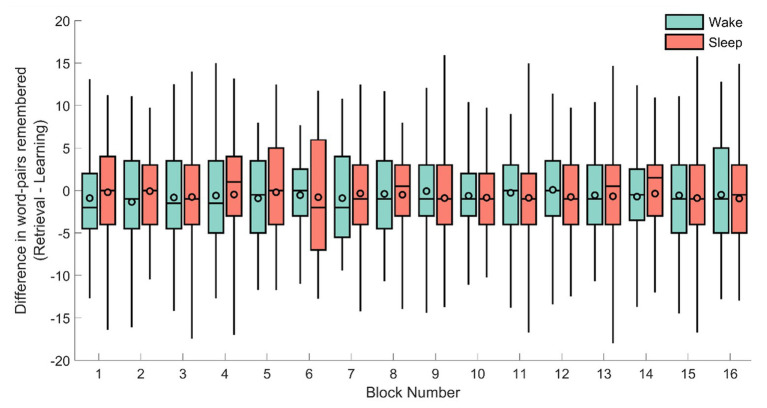
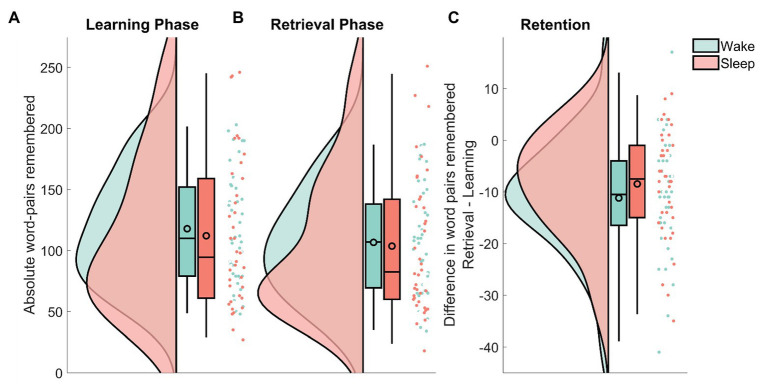
Sleep strengthens memories by repeatedly reactivating associated neuron ensembles. Our studies show that although long-term memory for a medium number of word-pairs (160) benefits from sleep, a large number (320) does not. This suggests an upper limit to the amount of information that has access to sleep-dependent declarative memory consolidation, which is possibly linked to the availability of reactivation opportunities. Due to competing processes of global forgetting that are active during sleep, we hypothesized that even larger amounts of information would enhance the proportion of information that is actively forgotten during sleep. In the present study, we aimed to induce such forgetting by challenging the sleeping brain with vast amounts of to be remembered information. For this, 78 participants learned a very large number of 640 word-pairs interspersed with periods of quiet awake rest over the course of an entire day and then either slept or stayed awake during the night. Recall was tested after another night of regular sleep. Results revealed comparable retention rates between the sleep and wake groups. Although this null-effect can be reconciled with the concept of limited capacities available for sleep-dependent consolidation, it contradicts our hypothesis that sleep would increase forgetting compared to the wake group. Additional exploratory analyses relying on equivalence testing and Bayesian statistics reveal that there is evidence against sleep having a detrimental effect on the retention of declarative memory at high information loads. We argue that forgetting occurs in both wake and sleep states through different mechanisms, i.e., through increased interference and through global synaptic downscaling, respectively. Both of these processes might scale similarly with information load.
睡眠通过反复重新激活相关的神经元群来强化记忆。我们的研究表明,虽然对于中等数量的单词对(160个)的长期记忆受益于睡眠,但大量(320个)单词对却并非如此。这表明可利用睡眠依赖的陈述性记忆巩固的信息量存在上限,这可能与重新激活机会的可用性有关。由于睡眠期间存在活跃的全局遗忘竞争过程,我们推测,更多的信息量会增加睡眠期间被主动遗忘的信息比例。在本研究中,我们旨在通过用大量待记忆信息挑战睡眠中的大脑来诱导这种遗忘。为此,78名参与者在一整天的时间里学习了大量640个单词对,并穿插着安静的清醒休息时间,然后在夜间要么睡觉要么保持清醒。在又经过一晚的正常睡眠后进行回忆测试。结果显示,睡眠组和清醒组的保持率相当。虽然这种零效应可以与睡眠依赖巩固的有限能力概念相协调,但它与我们的假设相矛盾,即与清醒组相比,睡眠会增加遗忘。依赖等效性测试和贝叶斯统计的额外探索性分析表明,有证据反对在高信息负荷下睡眠对陈述性记忆的保持有不利影响。我们认为,遗忘在清醒和睡眠状态下通过不同机制发生,即分别通过增加干扰和通过全局突触缩小。这两个过程可能都与信息负荷成相似比例变化。