Liu Yixiao, Jiang Quanbao
Institute for Population and Development Studies, School of Public Policy and Administration, Xi'an Jiaotong University, Xi'an, China.
Front Psychol. 2021 Jan 8;11:608995. doi: 10.3389/fpsyg.2020.608995. eCollection 2020.
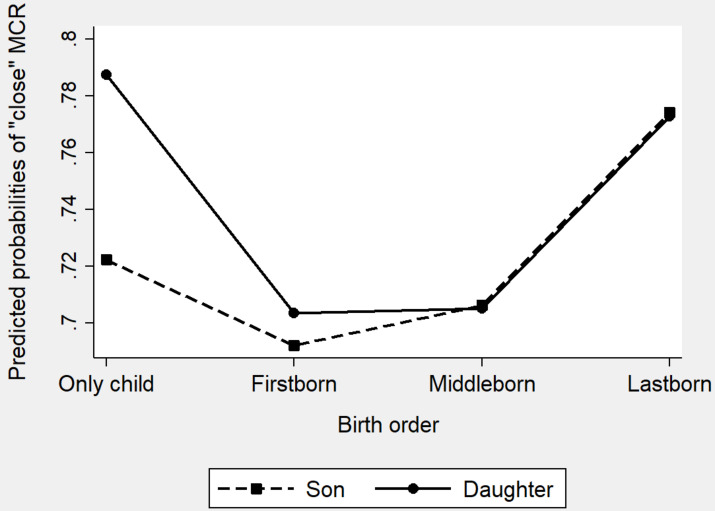
After more than three decades of implementation, China's one-child policy has generated a large number of only children. Although extensive research has documented the developmental outcomes of being an only child, research on the parent-child relational quality of the only child is somewhat limited. Using China Education Panel Survey (2014), this study examined whether the only child status was associated with parent-child relationships among Chinese junior high school students. It further explored whether children's gender moderated the association between the only child status and parent-child relationships. Two-level ordered logit models suggested that only children were more likely to report a close relationship with their mothers and fathers compared to children from multiple-child families (including two-child families). Taking birth order into consideration, we found that, only children were more likely to have close parent-child relationships than firstborns, whereas no significant differences were found between only children and lastborns. Interaction analyses further suggested that the only child advantages were gender-specific: the positive effects of the only child status were stronger for daughters than for sons, that is, daughters benefited more from being only children. Our findings highlight the importance of considering children's gender and birth order in exploring the only child effects in the Chinese context. Additional analyses about sibling-gender composition indicated female children were more likely to be disadvantaged with the presence of younger brothers, whereas male children benefited more from having older sisters. This reveals that the son preference culture is still deep-rooted in the Chinese multiple-child families.
经过三十多年的实施,中国的独生子女政策产生了大量独生子女。尽管广泛的研究记录了独生子女的发展结果,但对独生子女亲子关系质量的研究在一定程度上有限。本研究利用中国教育追踪调查(2014),考察了独生子女身份是否与中国初中生的亲子关系有关。它进一步探讨了孩子的性别是否调节了独生子女身份与亲子关系之间的关联。两级有序logit模型表明,与多子女家庭(包括二孩家庭)的孩子相比,独生子女更有可能报告与父母关系亲密。考虑到出生顺序,我们发现,独生子女比长子更有可能拥有亲密的亲子关系,而独生子女与幼子之间没有显著差异。交互分析进一步表明,独生子女优势具有性别特异性:独生子女身份对女儿的积极影响比对儿子更强,也就是说,女儿从独生子女身份中受益更多。我们的研究结果凸显了在中国背景下探索独生子女效应时考虑孩子性别和出生顺序的重要性。关于兄弟姐妹性别构成的额外分析表明,有弟弟时,女孩更有可能处于劣势,而男孩从有姐姐中受益更多。这表明重男轻女文化在中国多子女家庭中仍然根深蒂固。