Liu Ju-Chi, Chen Po-Yuan, Hao Wen-Rui, Liu Yi-Chung, Lyu Ping-Chiang, Hong Hong-Jye
Division of Cardiology, Department of Internal Medicine, Shuang Ho Hospital, Taipei Medical University, New Taipei, Taiwan.
Department of Biological Science and Technology, College of Biopharmaceutical and Food Sciences, China Medical University, Taichung, Taiwan.
Evid Based Complement Alternat Med. 2020 Dec 31;2020:4503747. doi: 10.1155/2020/4503747. eCollection 2020.
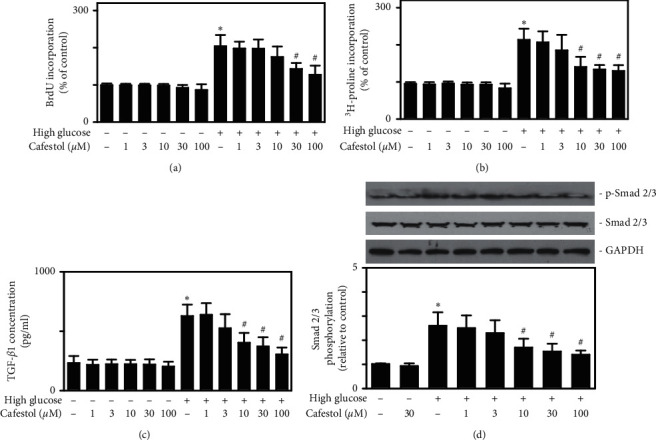
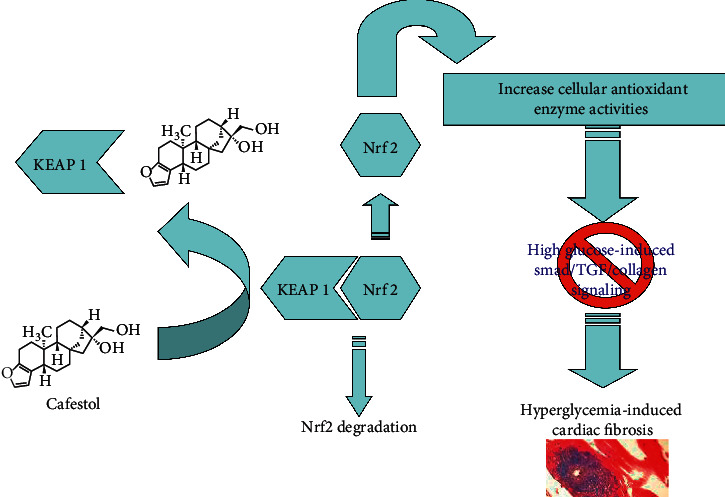
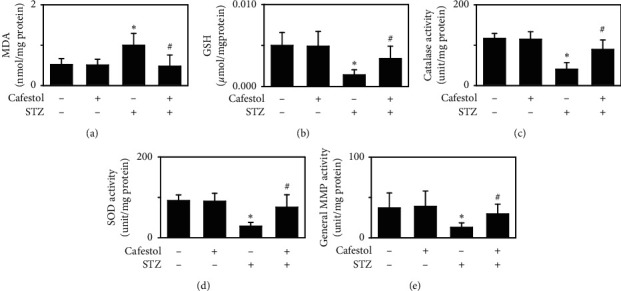
Diabetes is associated with the development of myocardial fibrosis, which is related to various cardiac diseases. Cafestol, one of the active ingredients in coffee, has been reported to exert biological effects. However, whether cafestol can ameliorate diabetes-induced cardiac fibrosis remains unknown. The aim of this study was to evaluate the effects of cafestol on cardiac fibrosis in high-glucose-treated cardiac fibroblasts and streptozocin- (STZ-) induced diabetic rats. Rat cardiac fibroblasts were cultured in high-glucose (25 mM) media in the absence or presence of cafestol, and the changes in collagen synthesis, transforming growth factor-1 (TGF-1) production, and related signaling molecules were assessed on the basis of H-proline incorporation, enzyme-linked immunosorbent assay, and western blotting. Cardiac fibroblasts exposed to high-glucose conditions exhibited increased collagen synthesis, TGF-1 production, and Smad2/3 phosphorylation, and these effects were mitigated by cafestol treatment. Furthermore, cafestol increased the translocation of nuclear factor erythroid 2-related factor 2 and increased the expression of heme oxygenase-1. The results of molecular docking analysis suggested a selective interaction of cafestol with Kelch-like ECH-associated protein 1. The rats with untreated STZ-induced diabetes exhibited considerable collagen accumulation, which was ameliorated by cafestol. Moreover, activities of catalase, superoxide dismutase, general matrix metalloproteinase, and reduced glutathione concentration were upregulated, whereas malondialdehyde level was downregulated by treatment with cafestol in rats with cardiac fibrosis. These findings highlight the effects of cafestol, which may be useful in treating diabetes-related cardiac fibrosis.
糖尿病与心肌纤维化的发生发展相关,而心肌纤维化与多种心脏疾病有关。咖啡醇是咖啡中的活性成分之一,已有报道称其具有生物学效应。然而,咖啡醇是否能改善糖尿病诱导的心脏纤维化尚不清楚。本研究的目的是评估咖啡醇对高糖处理的心脏成纤维细胞和链脲佐菌素(STZ)诱导的糖尿病大鼠心脏纤维化的影响。将大鼠心脏成纤维细胞在无糖或含有咖啡醇的高糖(25 mM)培养基中培养,并基于羟脯氨酸掺入、酶联免疫吸附测定和蛋白质印迹法评估胶原合成、转化生长因子 -1(TGF-1)产生及相关信号分子的变化。暴露于高糖条件下的心脏成纤维细胞表现出胶原合成增加、TGF-1产生增加以及Smad2/3磷酸化增加,而咖啡醇处理可减轻这些效应。此外,咖啡醇增加了核因子红细胞2相关因子2的易位并增加了血红素加氧酶-1的表达。分子对接分析结果表明咖啡醇与类 Kelch 样 ECH 相关蛋白1存在选择性相互作用。未治疗的 STZ 诱导糖尿病大鼠表现出大量胶原积累,而咖啡醇可改善这种情况。此外,在患有心脏纤维化的大鼠中,咖啡醇处理上调了过氧化氢酶、超氧化物歧化酶、总基质金属蛋白酶的活性以及还原型谷胱甘肽浓度,而下调了丙二醛水平。这些发现突出了咖啡醇的作用,其可能对治疗糖尿病相关的心脏纤维化有用。