Ozkan Aydin, Ozkan Gulcin, Yalaman Abdullah, Yildiz Yilmaz
University of Huddersfield, UK.
King's College London, UK.
World Dev. 2021 May;141:105412. doi: 10.1016/j.worlddev.2021.105412. Epub 2021 Jan 19.
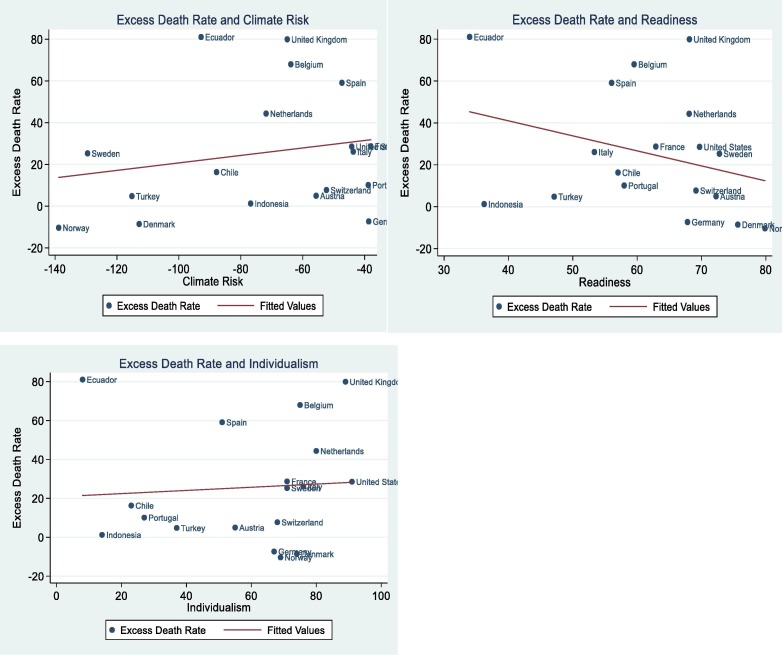
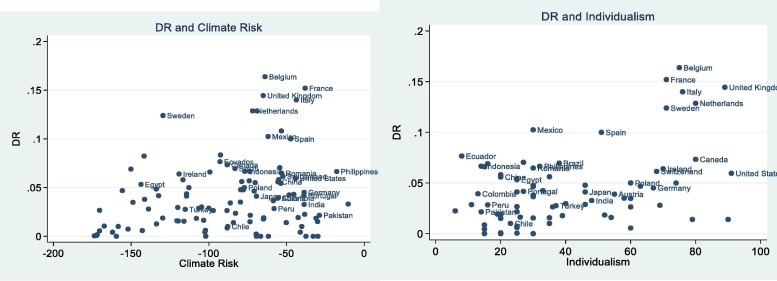
Why have some countries done significantly better than others in fighting the Covid-19 pandemic? Had some countries been better prepared than others? This paper attempts to shed light on these questions by examining the role of climate risk and culture in explaining the cross-country variation in the Covid-19 mortality, while controlling for other potential drivers. In our analysis, we consider climate risk, readiness to climate change and individualism as main indicators reflecting the climate and culture status of individual countries. Using data from 110 countries, we find that the greater the climate risk; the lower the readiness to climate change and the more individualistic the society, the higher the pandemic mortality rate. We also present a series of sensitivity checks and show that our findings are robust to different specifications, alternative definitions of the mortality rate; and different estimation methods. One policy implication arising from our results is that countries that were better prepared for the climate emergency were also better placed to fight the pandemic. Overall, countries in which individuals look after each other and the environment, creating sustainable societies, are better able to cope with climate and public health emergencies.
为什么在抗击新冠疫情方面,一些国家比其他国家表现得好得多?是一些国家比其他国家准备得更充分吗?本文试图通过考察气候风险和文化在解释新冠死亡率的跨国差异中的作用,同时控制其他潜在驱动因素,来阐明这些问题。在我们的分析中,我们将气候风险、应对气候变化的准备程度和个人主义视为反映各国气候和文化状况的主要指标。利用110个国家的数据,我们发现气候风险越大;应对气候变化的准备程度越低,社会越个人主义,大流行死亡率就越高。我们还进行了一系列敏感性检验,并表明我们的研究结果对不同的设定、死亡率的替代定义以及不同的估计方法都具有稳健性。我们的研究结果产生的一个政策含义是,那些为气候紧急情况做好更充分准备的国家,在抗击疫情方面也更有优势。总体而言,在个人相互照顾和保护环境、创造可持续社会的国家,更有能力应对气候和公共卫生紧急情况。