Fahy Lucine, Calvo Julien, Chabi Sara, Renou Laurent, Le Maout Charly, Poglio Sandrine, Leblanc Thierry, Petit Arnaud, Baruchel André, Ballerini Paola, Naguibneva Irina, Haddad Rima, Arcangeli Marie-Laure, Mazurier Frederic, Pflumio Francoise, Uzan Benjamin
Team Niche and Cancer in Hematopoiesis, Unité 1274, INSERM, Fontenay-aux-Roses, France.
Laboratoire des Cellules Souches Hématopoïétiques et des Leucémies, Service Cellules Souches et Radiations, Institut de Recherche en Cancérologie de Montpellier (IRCM), Commissariat a l'Energie Atomique et aux Energies Alternatives (CEA), Fontenay-aux-Roses, France.
Blood Adv. 2021 Jan 26;5(2):513-526. doi: 10.1182/bloodadvances.2020002832.
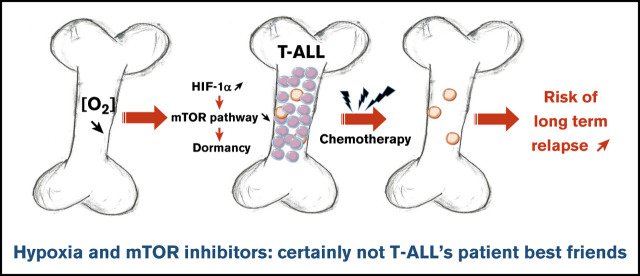
Resistance to chemotherapy, a major therapeutic challenge in the treatment of T-cell acute lymphoblastic leukemia (T-ALL), can be driven by interactions between leukemic cells and the microenvironment that promote survival of leukemic cells. The bone marrow, an important leukemia niche, has low oxygen partial pressures that highly participate in the regulation of normal hematopoiesis. Here we show that hypoxia inhibits T-ALL cell growth by slowing down cell cycle progression, decreasing mitochondria activity, and increasing glycolysis, making them less sensitive to antileukemic drugs and preserving their ability to initiate leukemia after treatment. Activation of the mammalian target of rapamycin (mTOR) was diminished in hypoxic leukemic cells, and treatment of T-ALL with the mTOR inhibitor rapamycin in normoxia mimicked the hypoxia effects, namely decreased cell growth and increased quiescence and drug resistance. Knocking down (KD) hypoxia-induced factor 1α (HIF-1α), a key regulator of the cellular response to hypoxia, antagonized the effects observed in hypoxic T-ALL and restored chemosensitivity. HIF-1α KD also restored mTOR activation in low O2 concentrations, and inhibiting mTOR in HIF1α KD T-ALL protected leukemic cells from chemotherapy. Thus, hypoxic niches play a protective role of T-ALL during treatments. Inhibition of HIF-1α and activation of the mTORC1 pathway may help suppress the drug resistance of T-ALL in hypoxic niches.
化疗耐药是T细胞急性淋巴细胞白血病(T-ALL)治疗中的一项重大挑战,白血病细胞与促进白血病细胞存活的微环境之间的相互作用可导致化疗耐药。骨髓作为一个重要的白血病龛位,其氧分压较低,在正常造血的调节中起重要作用。我们在此表明,缺氧通过减缓细胞周期进程、降低线粒体活性和增加糖酵解来抑制T-ALL细胞生长,使其对抗白血病药物的敏感性降低,并保留其在治疗后引发白血病的能力。缺氧白血病细胞中雷帕霉素哺乳动物靶蛋白(mTOR)的激活减弱,在常氧条件下用mTOR抑制剂雷帕霉素治疗T-ALL可模拟缺氧效应,即细胞生长减少、静止期增加和耐药性增强。敲低缺氧诱导因子1α(HIF-1α),这是细胞对缺氧反应的关键调节因子,可拮抗缺氧T-ALL中观察到的效应并恢复化学敏感性。HIF-1α敲低还可在低氧浓度下恢复mTOR激活,并且在HIF1α敲低的T-ALL中抑制mTOR可保护白血病细胞免受化疗影响。因此,缺氧龛位在治疗期间对T-ALL起保护作用。抑制HIF-1α和激活mTORC1途径可能有助于抑制缺氧龛位中T-ALL的耐药性。