Department of Computer Science, University of British Columbia, Vancouver, BC, Canada.
British Columbia Centre for Disease Control, Vancouver, BC, Canada.
J Med Internet Res. 2021 Feb 10;23(2):e25431. doi: 10.2196/25431.
Social media is a rich source where we can learn about people's reactions to social issues. As COVID-19 has impacted people's lives, it is essential to capture how people react to public health interventions and understand their concerns.
We aim to investigate people's reactions and concerns about COVID-19 in North America, especially in Canada.
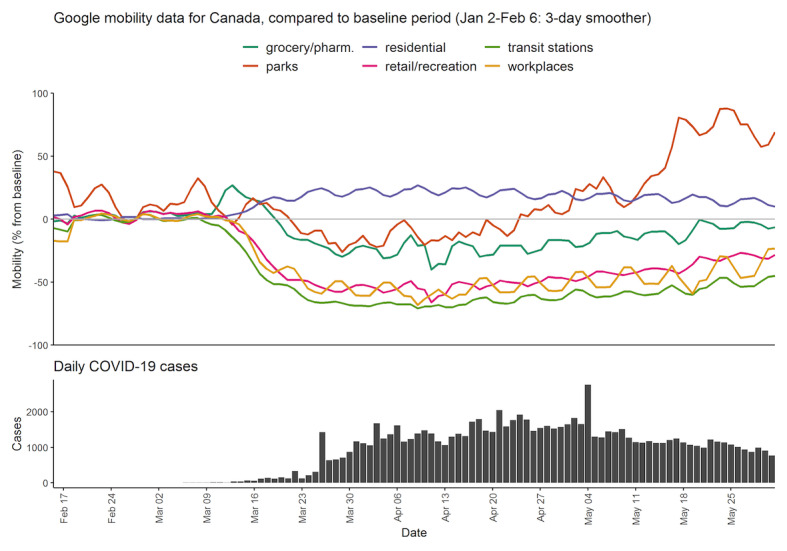
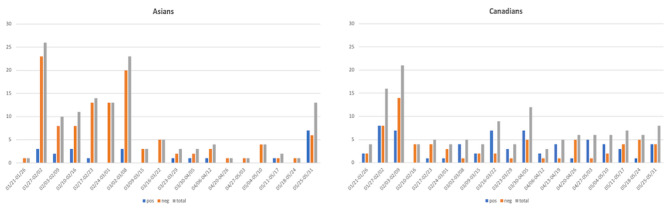
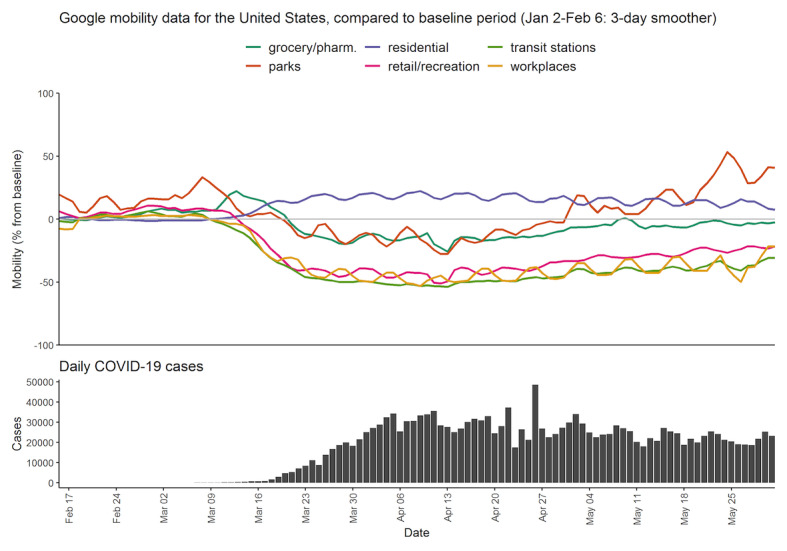
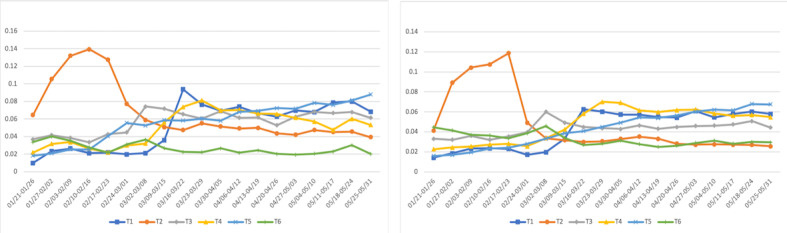
We analyzed COVID-19-related tweets using topic modeling and aspect-based sentiment analysis (ABSA), and interpreted the results with public health experts. To generate insights on the effectiveness of specific public health interventions for COVID-19, we compared timelines of topics discussed with the timing of implementation of interventions, synergistically including information on people's sentiment about COVID-19-related aspects in our analysis. In addition, to further investigate anti-Asian racism, we compared timelines of sentiments for Asians and Canadians.
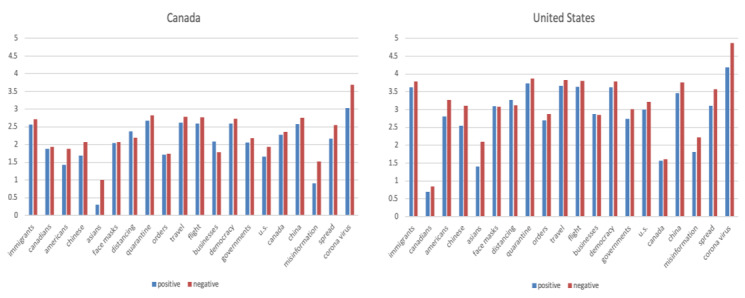
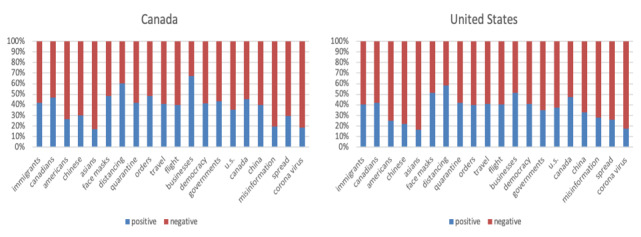
Topic modeling identified 20 topics, and public health experts provided interpretations of the topics based on top-ranked words and representative tweets for each topic. The interpretation and timeline analysis showed that the discovered topics and their trend are highly related to public health promotions and interventions such as physical distancing, border restrictions, handwashing, staying home, and face coverings. After training the data using ABSA with human-in-the-loop, we obtained 545 aspect terms (eg, "vaccines," "economy," and "masks") and 60 opinion terms such as "infectious" (negative) and "professional" (positive), which were used for inference of sentiments of 20 key aspects selected by public health experts. The results showed negative sentiments related to the overall outbreak, misinformation and Asians, and positive sentiments related to physical distancing.
Analyses using natural language processing techniques with domain expert involvement can produce useful information for public health. This study is the first to analyze COVID-19-related tweets in Canada in comparison with tweets in the United States by using topic modeling and human-in-the-loop domain-specific ABSA. This kind of information could help public health agencies to understand public concerns as well as what public health messages are resonating in our populations who use Twitter, which can be helpful for public health agencies when designing a policy for new interventions.
社交媒体是一个丰富的资源,从中我们可以了解人们对社会问题的反应。由于 COVID-19 对人们的生活产生了影响,因此必须捕捉人们对公共卫生干预措施的反应,并了解他们的关注点。
我们旨在调查北美(尤其是加拿大)人们对 COVID-19 的反应和关注点。
我们使用主题建模和基于方面的情感分析(ABSA)分析了与 COVID-19 相关的推文,并由公共卫生专家对结果进行解释。为了从人群中获取有关 COVID-19 特定公共卫生干预措施有效性的见解,我们将讨论的主题时间线与干预措施的实施时间进行了比较,在分析中协同纳入了人们对 COVID-19 相关方面的情感信息。此外,为了进一步调查反亚裔种族主义,我们比较了亚洲人和加拿大人的情感时间线。
主题建模确定了 20 个主题,公共卫生专家根据每个主题的最高排名词和代表性推文对主题进行了解释。解释和时间线分析表明,发现的主题及其趋势与物理隔离、边境限制、洗手、居家和戴口罩等公共卫生宣传和干预措施高度相关。使用带有人工干预的 ABSA 对数据进行训练后,我们获得了 545 个方面术语(例如“疫苗”、“经济”和“口罩”)和 60 个意见术语,例如“传染性”(负面)和“专业性”(正面),这些术语用于推断公共卫生专家选择的 20 个关键方面的情感。结果表明,与总体疫情、错误信息和亚洲人相关的负面情绪,以及与物理隔离相关的正面情绪。
使用自然语言处理技术并结合领域专家的参与,可以为公共卫生提供有用的信息。本研究首次使用主题建模和基于人工干预的特定领域的 ABSA 分析了加拿大与美国的 COVID-19 相关推文。这种信息可以帮助公共卫生机构了解公众的关注点,以及在使用 Twitter 的人群中哪些公共卫生信息能引起共鸣,这对于公共卫生机构在制定新干预措施的政策时很有帮助。