• 文献检索
  • 文档翻译
  • 深度研究
  • 学术资讯
  • Suppr Zotero 插件Zotero 插件
  • 邀请有礼
  • 套餐&价格
  • 历史记录
应用&插件
Suppr Zotero 插件Zotero 插件浏览器插件Mac 客户端Windows 客户端微信小程序
定价
高级版会员购买积分包购买API积分包
服务
文献检索文档翻译深度研究API 文档MCP 服务
关于我们
关于 Suppr公司介绍联系我们用户协议隐私条款
关注我们

Suppr 超能文献

核心技术专利:CN118964589B侵权必究
粤ICP备2023148730 号-1Suppr @ 2026

文献检索

告别复杂PubMed语法,用中文像聊天一样搜索,搜遍4000万医学文献。AI智能推荐,让科研检索更轻松。

立即免费搜索

文件翻译

保留排版,准确专业,支持PDF/Word/PPT等文件格式,支持 12+语言互译。

免费翻译文档

深度研究

AI帮你快速写综述,25分钟生成高质量综述,智能提取关键信息,辅助科研写作。

立即免费体验

人工智能分析英美两国民众在脸书和推特上对 COVID-19 疫苗的态度:观察性研究。

Artificial Intelligence-Enabled Analysis of Public Attitudes on Facebook and Twitter Toward COVID-19 Vaccines in the United Kingdom and the United States: Observational Study.

机构信息

School of Computing, Edinburgh Napier University, Edinburgh, United Kingdom.

Department of Electrical Engineering, University of Engineering and Technology, Lahore, Pakistan.

出版信息

J Med Internet Res. 2021 Apr 5;23(4):e26627. doi: 10.2196/26627.

DOI:10.2196/26627
PMID:33724919
原文链接:https://pmc.ncbi.nlm.nih.gov/articles/PMC8023383/
Abstract

BACKGROUND

Global efforts toward the development and deployment of a vaccine for COVID-19 are rapidly advancing. To achieve herd immunity, widespread administration of vaccines is required, which necessitates significant cooperation from the general public. As such, it is crucial that governments and public health agencies understand public sentiments toward vaccines, which can help guide educational campaigns and other targeted policy interventions.

OBJECTIVE

The aim of this study was to develop and apply an artificial intelligence-based approach to analyze public sentiments on social media in the United Kingdom and the United States toward COVID-19 vaccines to better understand the public attitude and concerns regarding COVID-19 vaccines.

METHODS

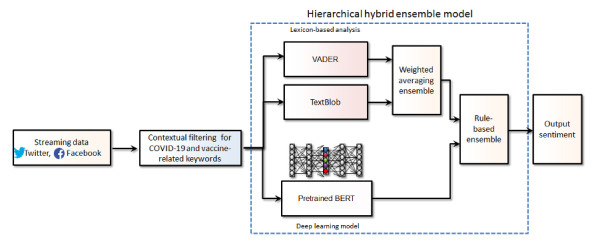
Over 300,000 social media posts related to COVID-19 vaccines were extracted, including 23,571 Facebook posts from the United Kingdom and 144,864 from the United States, along with 40,268 tweets from the United Kingdom and 98,385 from the United States from March 1 to November 22, 2020. We used natural language processing and deep learning-based techniques to predict average sentiments, sentiment trends, and topics of discussion. These factors were analyzed longitudinally and geospatially, and manual reading of randomly selected posts on points of interest helped identify underlying themes and validated insights from the analysis.

RESULTS

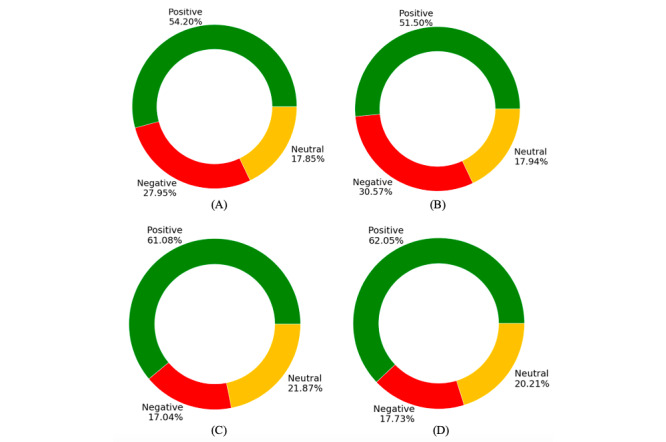
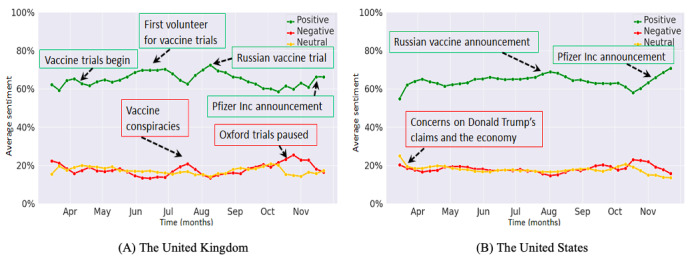
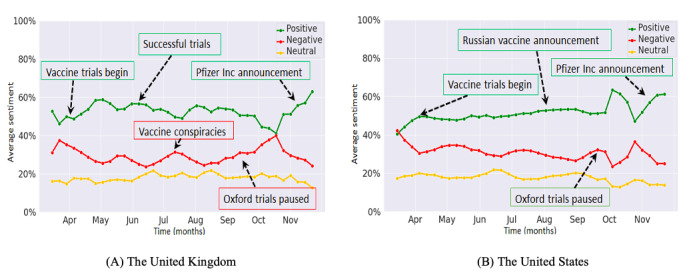
Overall averaged positive, negative, and neutral sentiments were at 58%, 22%, and 17% in the United Kingdom, compared to 56%, 24%, and 18% in the United States, respectively. Public optimism over vaccine development, effectiveness, and trials as well as concerns over their safety, economic viability, and corporation control were identified. We compared our findings to those of nationwide surveys in both countries and found them to correlate broadly.

CONCLUSIONS

Artificial intelligence-enabled social media analysis should be considered for adoption by institutions and governments alongside surveys and other conventional methods of assessing public attitude. Such analyses could enable real-time assessment, at scale, of public confidence and trust in COVID-19 vaccines, help address the concerns of vaccine sceptics, and help develop more effective policies and communication strategies to maximize uptake.

摘要

背景

全球在开发和部署 COVID-19 疫苗方面的努力正在迅速推进。为了实现群体免疫,需要广泛接种疫苗,这需要公众的大力合作。因此,政府和公共卫生机构了解公众对疫苗的看法至关重要,这有助于指导教育活动和其他有针对性的政策干预措施。

目的

本研究旨在开发并应用一种基于人工智能的方法,分析英国和美国社交媒体上公众对 COVID-19 疫苗的情绪,以更好地了解公众对 COVID-19 疫苗的态度和关注。

方法

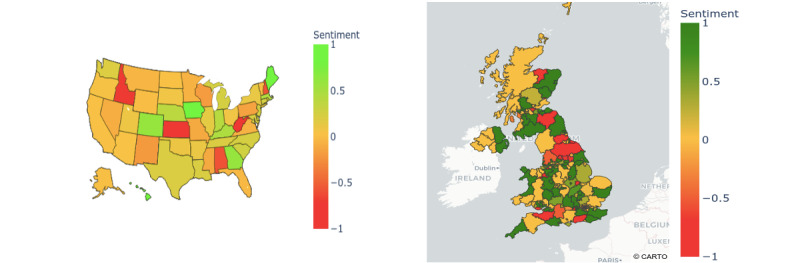
提取了 30 多万条与 COVID-19 疫苗相关的社交媒体帖子,包括英国的 23571 条 Facebook 帖子和美国的 144864 条,以及英国的 40268 条推文和美国的 98385 条推文,时间为 2020 年 3 月 1 日至 11 月 22 日。我们使用自然语言处理和基于深度学习的技术来预测平均情绪、情绪趋势和讨论主题。这些因素从纵向和地理空间上进行了分析,并且对感兴趣的点进行了随机选择的帖子进行人工阅读,以帮助识别潜在的主题并验证分析的结果。

结果

在英国,总体平均积极、消极和中性情绪分别为 58%、22%和 17%,而在美国则分别为 56%、24%和 18%。公众对疫苗开发、有效性和试验的乐观情绪,以及对安全性、经济可行性和公司控制的担忧情绪都有所体现。我们将我们的发现与两国的全国性调查进行了比较,发现它们大致相关。

结论

人工智能支持的社交媒体分析应该与调查和其他评估公众态度的传统方法一起被机构和政府采用。这种分析可以实时评估公众对 COVID-19 疫苗的信心和信任程度,帮助解决疫苗怀疑论者的担忧,并帮助制定更有效的政策和沟通策略,以最大限度地提高疫苗接种率。
https://cdn.ncbi.nlm.nih.gov/pmc/blobs/8d1e/8023383/2471cf8c7d79/jmir_v23i4e26627_fig5.jpg
https://cdn.ncbi.nlm.nih.gov/pmc/blobs/8d1e/8023383/2b5bed6534c9/jmir_v23i4e26627_fig1.jpg
https://cdn.ncbi.nlm.nih.gov/pmc/blobs/8d1e/8023383/1cb326ec6001/jmir_v23i4e26627_fig2.jpg
https://cdn.ncbi.nlm.nih.gov/pmc/blobs/8d1e/8023383/b38a423768a0/jmir_v23i4e26627_fig3.jpg
https://cdn.ncbi.nlm.nih.gov/pmc/blobs/8d1e/8023383/ebcd855159c4/jmir_v23i4e26627_fig4.jpg
https://cdn.ncbi.nlm.nih.gov/pmc/blobs/8d1e/8023383/2471cf8c7d79/jmir_v23i4e26627_fig5.jpg
https://cdn.ncbi.nlm.nih.gov/pmc/blobs/8d1e/8023383/2b5bed6534c9/jmir_v23i4e26627_fig1.jpg
https://cdn.ncbi.nlm.nih.gov/pmc/blobs/8d1e/8023383/1cb326ec6001/jmir_v23i4e26627_fig2.jpg
https://cdn.ncbi.nlm.nih.gov/pmc/blobs/8d1e/8023383/b38a423768a0/jmir_v23i4e26627_fig3.jpg
https://cdn.ncbi.nlm.nih.gov/pmc/blobs/8d1e/8023383/ebcd855159c4/jmir_v23i4e26627_fig4.jpg
https://cdn.ncbi.nlm.nih.gov/pmc/blobs/8d1e/8023383/2471cf8c7d79/jmir_v23i4e26627_fig5.jpg

相似文献

1
Artificial Intelligence-Enabled Analysis of Public Attitudes on Facebook and Twitter Toward COVID-19 Vaccines in the United Kingdom and the United States: Observational Study.人工智能分析英美两国民众在脸书和推特上对 COVID-19 疫苗的态度:观察性研究。
J Med Internet Res. 2021 Apr 5;23(4):e26627. doi: 10.2196/26627.
2
Artificial Intelligence-Enabled Social Media Analysis for Pharmacovigilance of COVID-19 Vaccinations in the United Kingdom: Observational Study.英国利用人工智能进行社交媒体分析以监测新冠疫苗接种的药物警戒:观察性研究
JMIR Public Health Surveill. 2022 May 27;8(5):e32543. doi: 10.2196/32543.
3
Tweet Topics and Sentiments Relating to COVID-19 Vaccination Among Australian Twitter Users: Machine Learning Analysis.澳大利亚推特用户与 COVID-19 疫苗接种相关的推文主题和情绪:机器学习分析。
J Med Internet Res. 2021 May 19;23(5):e26953. doi: 10.2196/26953.
4
COVID-19 Vaccine-Related Discussion on Twitter: Topic Modeling and Sentiment Analysis.新冠疫苗相关推文的讨论:主题建模和情感分析。
J Med Internet Res. 2021 Jun 29;23(6):e24435. doi: 10.2196/24435.
5
Tracking Public Attitudes Toward COVID-19 Vaccination on Tweets in Canada: Using Aspect-Based Sentiment Analysis.追踪加拿大推特上公众对 COVID-19 疫苗接种的态度:使用基于方面的情感分析。
J Med Internet Res. 2022 Mar 29;24(3):e35016. doi: 10.2196/35016.
6
Understanding Public Perceptions of COVID-19 Contact Tracing Apps: Artificial Intelligence-Enabled Social Media Analysis.理解公众对 COVID-19 接触者追踪应用的看法:人工智能支持的社交媒体分析。
J Med Internet Res. 2021 May 17;23(5):e26618. doi: 10.2196/26618.
7
Evolution of Public Attitudes and Opinions Regarding COVID-19 Vaccination During the Vaccine Campaign in China: Year-Long Infodemiology Study of Weibo Posts.中国疫苗接种运动期间公众对 COVID-19 疫苗接种的态度和看法的演变:对微博帖子进行的为期一年的信息流行病学研究。
J Med Internet Res. 2023 Feb 16;25:e42671. doi: 10.2196/42671.
8
Revealing Public Opinion Towards COVID-19 Vaccines With Twitter Data in the United States: Spatiotemporal Perspective.利用美国推特数据揭示公众对 COVID-19 疫苗的看法:时空透视。
J Med Internet Res. 2021 Sep 10;23(9):e30854. doi: 10.2196/30854.
9
Topics and Sentiments of Public Concerns Regarding COVID-19 Vaccines: Social Media Trend Analysis.公众对新冠疫苗关注的话题和情绪:社交媒体趋势分析。
J Med Internet Res. 2021 Oct 21;23(10):e30765. doi: 10.2196/30765.
10
Twitter sentiment analysis from Iran about COVID 19 vaccine.推特上关于新冠疫苗的伊朗民众情绪分析。
Diabetes Metab Syndr. 2022 Jan;16(1):102367. doi: 10.1016/j.dsx.2021.102367. Epub 2021 Dec 13.

引用本文的文献

1
Mapping Vaccine Sentiment by Analyzing Spanish-Language Social Media Posts and Survey-Based Public Opinion: Dual Methods Study.通过分析西班牙语社交媒体帖子和基于调查的公众舆论来绘制疫苗情绪:双方法研究
JMIR Infodemiology. 2025 Aug 29;5:e63223. doi: 10.2196/63223.
2
Harnessing Artificial Intelligence and Innovative Vaccines for Mpox Diagnosis and Control: A Comprehensive Narrative Review.利用人工智能和创新疫苗进行猴痘诊断与控制:一项全面的叙述性综述
J Prim Care Community Health. 2025 Jan-Dec;16:21501319251357701. doi: 10.1177/21501319251357701. Epub 2025 Jul 23.
3
How politics affect pandemic forecasting: spatio-temporal early warning capabilities of different geo-social media topics in the context of state-level political leaning.

本文引用的文献

1
A Large-Scale COVID-19 Twitter Chatter Dataset for Open Scientific Research-An International Collaboration.用于开放科学研究的大规模COVID-19推特聊天数据集——一项国际合作。
Epidemiologia (Basel). 2021 Aug 5;2(3):315-324. doi: 10.3390/epidemiologia2030024.
2
Assessing the risks of 'infodemics' in response to COVID-19 epidemics.评估应对 COVID-19 疫情“信息疫情”的风险。
Nat Hum Behav. 2020 Dec;4(12):1285-1293. doi: 10.1038/s41562-020-00994-6. Epub 2020 Oct 29.
3
A global survey of potential acceptance of a COVID-19 vaccine.
政治如何影响疫情预测:在州级政治倾向背景下不同地理社交媒体话题的时空预警能力
Front Public Health. 2025 Jul 1;13:1618347. doi: 10.3389/fpubh.2025.1618347. eCollection 2025.
4
Artificial intelligence in vaccine research and development: an umbrella review.疫苗研发中的人工智能:一项综合综述
Front Immunol. 2025 May 8;16:1567116. doi: 10.3389/fimmu.2025.1567116. eCollection 2025.
5
Exploring Topics, Emotions, and Sentiments in Health Organization Posts and Public Responses on Instagram: Content Analysis.探索健康组织在Instagram上发布的内容以及公众回应中的主题、情感和情绪:内容分析
JMIR Infodemiology. 2025 May 2;5:e70576. doi: 10.2196/70576.
6
Vaccine refusal and hesitancy in Spain: an online cross-sectional questionnaire.西班牙的疫苗接种拒绝与犹豫:一项在线横断面问卷调查
BMC Prim Care. 2025 Apr 28;26(1):132. doi: 10.1186/s12875-025-02820-2.
7
Vaccination, Public Health and Health Communication: A Network of Connections to Tackle Global Challenges.疫苗接种、公共卫生与健康传播:应对全球挑战的联系网络
Vaccines (Basel). 2025 Feb 27;13(3):245. doi: 10.3390/vaccines13030245.
8
TriLex: A fusion approach for unsupervised sentiment analysis of short texts.TriLex:一种用于短文本无监督情感分析的融合方法。
PLoS One. 2025 Apr 17;20(4):e0317100. doi: 10.1371/journal.pone.0317100. eCollection 2025.
9
COVID-19 Public Health Communication on X (Formerly Twitter): Cross-Sectional Study of Message Type, Sentiment, and Source.关于X(原推特)上的新冠疫情公共卫生传播:信息类型、情感倾向及来源的横断面研究
JMIR Form Res. 2025 Mar 19;9:e59687. doi: 10.2196/59687.
10
How People in Eight European Countries Felt About the Safety, Effectiveness, and Necessity of COVID-19 Vaccination: A Cross-Sectional Survey.八个欧洲国家的民众对新冠疫苗接种的安全性、有效性和必要性的看法:一项横断面调查。
Healthcare (Basel). 2025 Feb 6;13(3):344. doi: 10.3390/healthcare13030344.
一项针对 COVID-19 疫苗潜在接受度的全球调查。
Nat Med. 2021 Feb;27(2):225-228. doi: 10.1038/s41591-020-1124-9. Epub 2020 Oct 20.
4
Mapping global trends in vaccine confidence and investigating barriers to vaccine uptake: a large-scale retrospective temporal modelling study.绘制全球疫苗信心趋势图并调查疫苗接种障碍:一项大规模回顾性时间建模研究。
Lancet. 2020 Sep 26;396(10255):898-908. doi: 10.1016/S0140-6736(20)31558-0. Epub 2020 Sep 10.
5
COVID-19 herd immunity: where are we?COVID-19 群体免疫:我们在哪里?
Nat Rev Immunol. 2020 Oct;20(10):583-584. doi: 10.1038/s41577-020-00451-5.
6
Covid-19: Oxford researchers halt vaccine trial while adverse reaction is investigated.新冠疫情:牛津大学研究人员暂停疫苗试验,同时对不良反应展开调查。
BMJ. 2020 Sep 9;370:m3525. doi: 10.1136/bmj.m3525.
7
"When Will Have a Vaccine?" - Understanding Questions and Answers about Covid-19 Vaccination.“何时会有疫苗?”——解读关于新冠疫苗接种的问答
N Engl J Med. 2020 Dec 3;383(23):2202-2204. doi: 10.1056/NEJMp2025331. Epub 2020 Sep 8.
8
Determinants of COVID-19 vaccine acceptance in the US.美国新冠疫苗接种意愿的影响因素
EClinicalMedicine. 2020 Sep;26:100495. doi: 10.1016/j.eclinm.2020.100495. Epub 2020 Aug 12.
9
Social Network Analysis of COVID-19 Sentiments: Application of Artificial Intelligence.COVID-19 舆情的社会网络分析:人工智能的应用
J Med Internet Res. 2020 Aug 18;22(8):e22590. doi: 10.2196/22590.
10
A Novel Fuzzy Multilayer Perceptron (F-MLP) for the Detection of Irregularity in Skin Lesion Border Using Dermoscopic Images.一种用于使用皮肤镜图像检测皮肤病变边界不规则性的新型模糊多层感知器(F-MLP)。
Front Med (Lausanne). 2020 Jul 7;7:297. doi: 10.3389/fmed.2020.00297. eCollection 2020.