Cominelli Lorenzo, Mazzei Daniele, De Rossi Danilo Emilio
E. Piaggio Research Center, Information Engineering Department, University of Pisa, Pisa, Italy.
Computer Science Department, University of Pisa, Pisa, Italy.
Front Robot AI. 2018 Feb 7;5:6. doi: 10.3389/frobt.2018.00006. eCollection 2018.
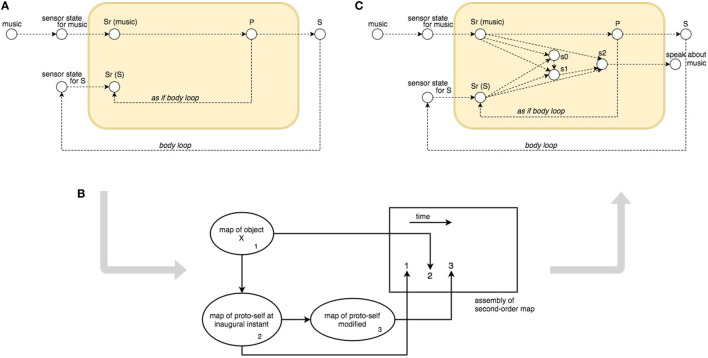
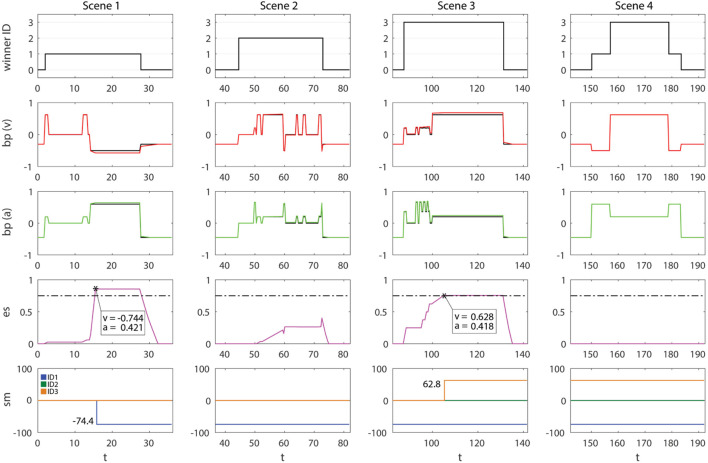
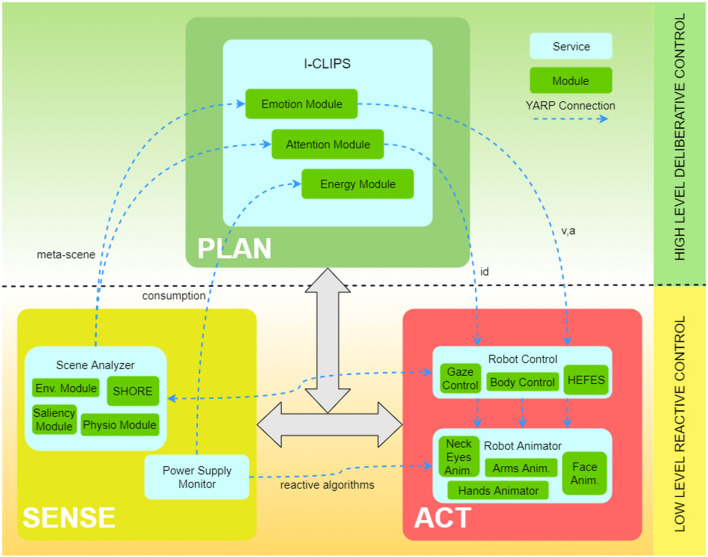
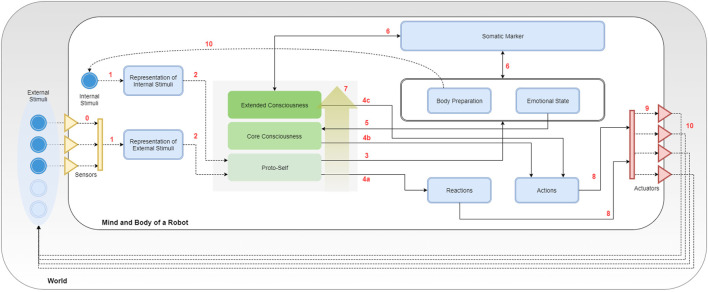
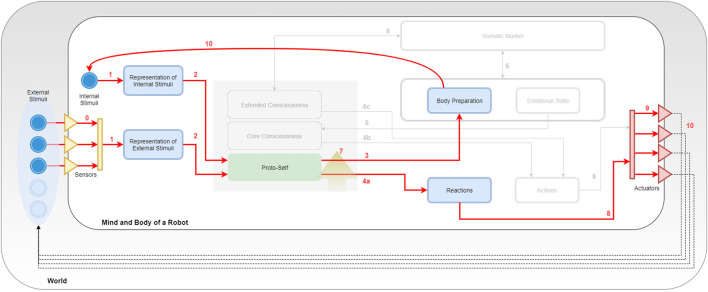
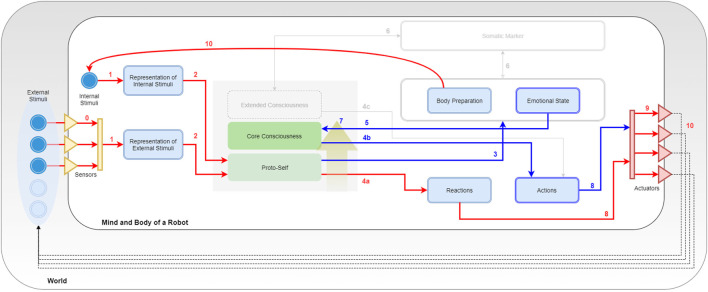
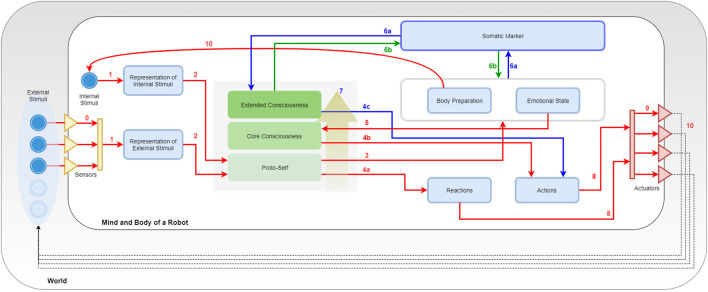
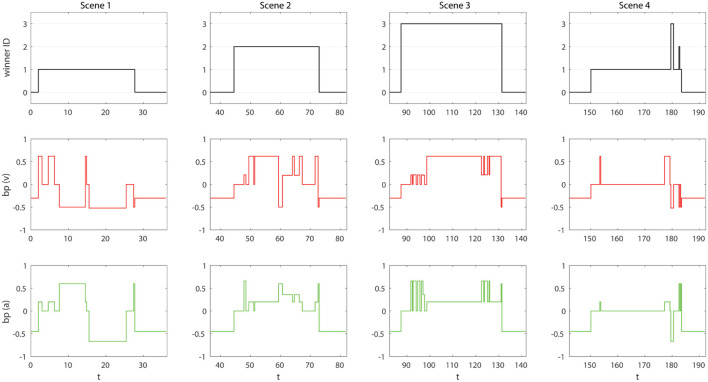
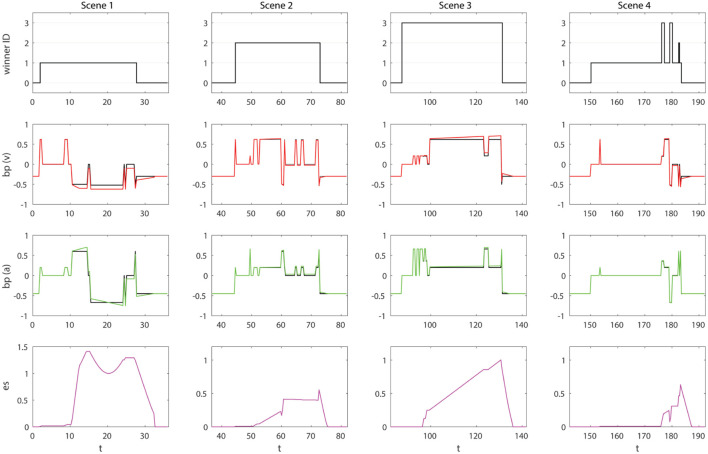
A socially intelligent robot must be capable to extract meaningful information in real time from the social environment and react accordingly with coherent human-like behavior. Moreover, it should be able to internalize this information, to reason on it at a higher level, build its own opinions independently, and then automatically bias the decision-making according to its unique experience. In the last decades, neuroscience research highlighted the link between the evolution of such complex behavior and the evolution of a certain level of consciousness, which cannot leave out of a body that feels emotions as discriminants and prompters. In order to develop cognitive systems for social robotics with greater human-likeliness, we used an "understanding by building" approach to model and implement a well-known theory of mind in the form of an artificial intelligence, and we tested it on a sophisticated robotic platform. The name of the presented system is SEAI (Social Emotional Artificial Intelligence), a cognitive system specifically conceived for social and emotional robots. It is designed as a bio-inspired, highly modular, hybrid system with emotion modeling and high-level reasoning capabilities. It follows the deliberative/reactive paradigm where a knowledge-based expert system is aimed at dealing with the high-level symbolic reasoning, while a more conventional reactive paradigm is deputed to the low-level processing and control. The SEAI system is also enriched by a model that simulates the Damasio's theory of consciousness and the theory of Somatic Markers. After a review of similar bio-inspired cognitive systems, we present the scientific foundations and their computational formalization at the basis of the SEAI framework. Then, a deeper technical description of the architecture is disclosed underlining the numerous parallelisms with the human cognitive system. Finally, the influence of artificial emotions and feelings, and their link with the robot's beliefs and decisions have been tested in a physical humanoid involved in Human-Robot Interaction (HRI).
一个具备社交智能的机器人必须能够实时从社交环境中提取有意义的信息,并以连贯的类人行为做出相应反应。此外,它应该能够将这些信息内化,在更高层次上对其进行推理,独立形成自己的观点,然后根据其独特的经验自动影响决策。在过去几十年中,神经科学研究突出了这种复杂行为的进化与一定程度意识进化之间的联系,而这种意识离不开一个能感受情感并将其作为判别和推动者的身体。为了开发更具人类特征的社交机器人认知系统,我们采用了一种“通过构建来理解”的方法,以人工智能的形式对一种著名的心理理论进行建模和实现,并在一个复杂的机器人平台上对其进行测试。所展示系统的名称是SEAI(社交情感人工智能),这是一个专门为社交和情感机器人设计的认知系统。它被设计为一个受生物启发的、高度模块化的混合系统,具有情感建模和高级推理能力。它遵循审议/反应范式,其中基于知识的专家系统旨在处理高级符号推理,而更传统的反应范式则负责低级处理和控制。SEAI系统还通过一个模拟达马西奥意识理论和躯体标记理论的模型得到了丰富。在回顾了类似的受生物启发的认知系统之后,我们介绍了SEAI框架的科学基础及其计算形式化。然后,对该架构进行了更深入的技术描述,强调了与人类认知系统的众多并行之处。最后,在一个参与人机交互(HRI)的实体人形机器人中测试了人工情感和感觉的影响及其与机器人信念和决策的联系。