• 文献检索
  • 文档翻译
  • 深度研究
  • 学术资讯
  • Suppr Zotero 插件Zotero 插件
  • 邀请有礼
  • 套餐&价格
  • 历史记录
应用&插件
Suppr Zotero 插件Zotero 插件浏览器插件Mac 客户端Windows 客户端微信小程序
定价
高级版会员购买积分包购买API积分包
服务
文献检索文档翻译深度研究API 文档MCP 服务
关于我们
关于 Suppr公司介绍联系我们用户协议隐私条款
关注我们

Suppr 超能文献

核心技术专利:CN118964589B侵权必究
粤ICP备2023148730 号-1Suppr @ 2026

文献检索

告别复杂PubMed语法,用中文像聊天一样搜索,搜遍4000万医学文献。AI智能推荐,让科研检索更轻松。

立即免费搜索

文件翻译

保留排版,准确专业,支持PDF/Word/PPT等文件格式,支持 12+语言互译。

免费翻译文档

深度研究

AI帮你快速写综述,25分钟生成高质量综述,智能提取关键信息,辅助科研写作。

立即免费体验

人机交互中的承诺与信任。

Promises and trust in human-robot interaction.

机构信息

Department of Information Engineering and Center E. Piaggio, University of Pisa, Pisa, Italy.

Department of Economics, Royal Holloway University of London, London, UK.

出版信息

Sci Rep. 2021 May 6;11(1):9687. doi: 10.1038/s41598-021-88622-9.

DOI:10.1038/s41598-021-88622-9
PMID:33958624
原文链接:https://pmc.ncbi.nlm.nih.gov/articles/PMC8102555/
Abstract

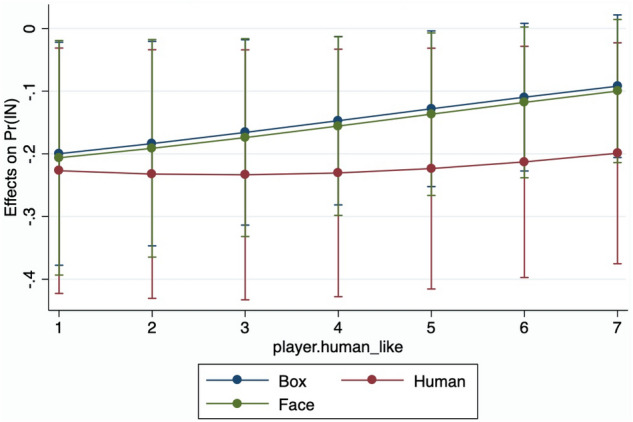
Understanding human trust in machine partners has become imperative due to the widespread use of intelligent machines in a variety of applications and contexts. The aim of this paper is to investigate whether human-beings trust a social robot-i.e. a human-like robot that embodies emotional states, empathy, and non-verbal communication-differently than other types of agents. To do so, we adapt the well-known economic trust-game proposed by Charness and Dufwenberg (2006) to assess whether receiving a promise from a robot increases human-trust in it. We find that receiving a promise from the robot increases the trust of the human in it, but only for individuals who perceive the robot very similar to a human-being. Importantly, we observe a similar pattern in choices when we replace the humanoid counterpart with a real human but not when it is replaced by a computer-box. Additionally, we investigate participants' psychophysiological reaction in terms of cardiovascular and electrodermal activity. Our results highlight an increased psychophysiological arousal when the game is played with the social robot compared to the computer-box. Taken all together, these results strongly support the development of technologies enhancing the humanity of robots.

摘要

由于智能机器在各种应用和场景中的广泛使用,理解人类对机器伙伴的信任变得至关重要。本文旨在研究人类是否会以不同于其他类型代理的方式信任社交机器人——即具有情感状态、同理心和非言语交流的类人机器人。为此,我们改编了 Charness 和 Dufwenberg(2006)提出的著名经济信任游戏,以评估从机器人那里收到承诺是否会增加人类对其的信任。我们发现,收到机器人的承诺会增加人类对其的信任,但前提是个人将机器人感知得非常像人类。重要的是,当我们用人代替类人机器人时,我们会观察到类似的选择模式,但当用计算机箱代替时则不会。此外,我们还研究了参与者在心血管和皮肤电活动方面的心理生理反应。我们的研究结果表明,与计算机箱相比,当与人形机器人玩游戏时,参与者的心理生理唤醒会增加。综上所述,这些结果强烈支持开发增强机器人人性化的技术。

https://cdn.ncbi.nlm.nih.gov/pmc/blobs/8107/8102555/d51e1d998f5e/41598_2021_88622_Fig6_HTML.jpg
https://cdn.ncbi.nlm.nih.gov/pmc/blobs/8107/8102555/e8bf682514ea/41598_2021_88622_Fig1_HTML.jpg
https://cdn.ncbi.nlm.nih.gov/pmc/blobs/8107/8102555/6227fe9d9fd4/41598_2021_88622_Fig2_HTML.jpg
https://cdn.ncbi.nlm.nih.gov/pmc/blobs/8107/8102555/f6df1c3830c1/41598_2021_88622_Fig3_HTML.jpg
https://cdn.ncbi.nlm.nih.gov/pmc/blobs/8107/8102555/be765b3402f0/41598_2021_88622_Fig4_HTML.jpg
https://cdn.ncbi.nlm.nih.gov/pmc/blobs/8107/8102555/65e97343ad5e/41598_2021_88622_Fig5_HTML.jpg
https://cdn.ncbi.nlm.nih.gov/pmc/blobs/8107/8102555/d51e1d998f5e/41598_2021_88622_Fig6_HTML.jpg
https://cdn.ncbi.nlm.nih.gov/pmc/blobs/8107/8102555/e8bf682514ea/41598_2021_88622_Fig1_HTML.jpg
https://cdn.ncbi.nlm.nih.gov/pmc/blobs/8107/8102555/6227fe9d9fd4/41598_2021_88622_Fig2_HTML.jpg
https://cdn.ncbi.nlm.nih.gov/pmc/blobs/8107/8102555/f6df1c3830c1/41598_2021_88622_Fig3_HTML.jpg
https://cdn.ncbi.nlm.nih.gov/pmc/blobs/8107/8102555/be765b3402f0/41598_2021_88622_Fig4_HTML.jpg
https://cdn.ncbi.nlm.nih.gov/pmc/blobs/8107/8102555/65e97343ad5e/41598_2021_88622_Fig5_HTML.jpg
https://cdn.ncbi.nlm.nih.gov/pmc/blobs/8107/8102555/d51e1d998f5e/41598_2021_88622_Fig6_HTML.jpg

相似文献

1
Promises and trust in human-robot interaction.人机交互中的承诺与信任。
Sci Rep. 2021 May 6;11(1):9687. doi: 10.1038/s41598-021-88622-9.
2
Factors affecting trust in high-vulnerability human-robot interaction contexts: A structural equation modelling approach.影响高脆弱性人机交互情境中信任的因素:结构方程建模方法。
Appl Ergon. 2020 May;85:103056. doi: 10.1016/j.apergo.2020.103056. Epub 2020 Jan 20.
3
A Literature Review on Safety Perception and Trust during Human-Robot Interaction with Autonomous Mobile Robots That Apply to Industrial Environments.关于在适用于工业环境的自主移动机器人的人机交互中,安全感知和信任的文献综述。
IISE Trans Occup Ergon Hum Factors. 2024 Jan-Jun;12(1-2):6-27. doi: 10.1080/24725838.2023.2283537. Epub 2024 Jan 8.
4
Persuasive robots should avoid authority: The effects of formal and real authority on persuasion in human-robot interaction.有说服力的机器人应避免权威:正式和真实权威对人机交互中说服的影响。
Sci Robot. 2021 Sep 22;6(58):eabd5186. doi: 10.1126/scirobotics.abd5186.
5
Relationship Development with Humanoid Social Robots: Applying Interpersonal Theories to Human-Robot Interaction.人形社交机器人的关系发展:将人际关系理论应用于人机交互。
Cyberpsychol Behav Soc Netw. 2021 May;24(5):294-299. doi: 10.1089/cyber.2020.0181. Epub 2021 Jan 11.
6
Human-Robot Confluence: Toward a Humane Robotics.人机融合:迈向有人情味的机器人技术。
Cyberpsychol Behav Soc Netw. 2021 May;24(5):291-293. doi: 10.1089/cyber.2021.29215.gri.
7
An Immersive Investment Game to Study Human-Robot Trust.一款用于研究人机信任的沉浸式投资游戏。
Front Robot AI. 2021 Jun 4;8:644529. doi: 10.3389/frobt.2021.644529. eCollection 2021.
8
The Relationship Between Trust and Use Choice in Human-Robot Interaction.人机交互中的信任与使用选择的关系。
Hum Factors. 2019 Jun;61(4):614-626. doi: 10.1177/0018720818816838. Epub 2019 Jan 2.
9
Intelligent humanoid robots expressing artificial humanlike empathy in nursing situations.在护理情境中表现出类人般同理心的智能人形机器人。
Nurs Philos. 2020 Oct;21(4):e12318. doi: 10.1111/nup.12318. Epub 2020 Jul 20.
10
: An investigation of public trust in South Korea.公众对韩国的信任度调查。
J Commun Healthc. 2022 Dec;15(4):276-285. doi: 10.1080/17538068.2021.1994825. Epub 2021 Nov 2.

引用本文的文献

1
Rewards and punishments help humans overcome biases against cooperation partners assumed to be machines.奖励和惩罚有助于人类克服对被假定为机器的合作伙伴的偏见。
iScience. 2025 Jun 6;28(7):112833. doi: 10.1016/j.isci.2025.112833. eCollection 2025 Jul 18.
2
Interactivity, humanness, and trust: a psychological approach to AI chatbot adoption in e-commerce.互动性、人性化和信任:电子商务中人工智能聊天机器人采用的心理学方法。
BMC Psychol. 2024 Oct 28;12(1):595. doi: 10.1186/s40359-024-02083-z.
3
Developing trustworthy artificial intelligence: insights from research on interpersonal, human-automation, and human-AI trust.

本文引用的文献

1
SEAI: Social Emotional Artificial Intelligence Based on Damasio's Theory of Mind.SEAI:基于达马西奥心智理论的社会情感人工智能。
Front Robot AI. 2018 Feb 7;5:6. doi: 10.3389/frobt.2018.00006. eCollection 2018.
2
Assessing Autonomic Function from Electrodermal Activity and Heart Rate Variability During Cold-Pressor Test and Emotional Challenge.评估冷压试验和情绪挑战期间皮肤电活动和心率变异性的自主功能。
Sci Rep. 2020 Mar 25;10(1):5406. doi: 10.1038/s41598-020-62225-2.
3
Neural Correlates of Variations in Human Trust in Human-like Machines during Non-reciprocal Interactions.
开发值得信赖的人工智能:来自人际信任、人机自动化信任和人类与人工智能信任研究的见解。
Front Psychol. 2024 Apr 17;15:1382693. doi: 10.3389/fpsyg.2024.1382693. eCollection 2024.
4
A Generative Model to Embed Human Expressivity into Robot Motions.生成模型将人类表现力嵌入机器人运动中。
Sensors (Basel). 2024 Jan 16;24(2):569. doi: 10.3390/s24020569.
5
Real-time emotion generation in human-robot dialogue using large language models.使用大语言模型在人机对话中进行实时情感生成
Front Robot AI. 2023 Dec 1;10:1271610. doi: 10.3389/frobt.2023.1271610. eCollection 2023.
6
Robot occupations affect the categorization border between human and robot faces.机器人职业影响人类和机器人面孔的分类边界。
Sci Rep. 2023 Nov 7;13(1):19250. doi: 10.1038/s41598-023-46425-0.
7
The theory of mind and human-robot trust repair.心理理论与人际机器人信任修复。
Sci Rep. 2023 Jun 19;13(1):9877. doi: 10.1038/s41598-023-37032-0.
8
Possibilities and ethical issues of entrusting nursing tasks to robots and artificial intelligence.将护理任务委托给机器人和人工智能的可能性和伦理问题。
Nurs Ethics. 2024 Sep;31(6):1010-1020. doi: 10.1177/09697330221149094. Epub 2023 Jun 12.
9
Heterogeneous human-robot task allocation based on artificial trust.基于人工信任的异构人机任务分配。
Sci Rep. 2022 Sep 12;12(1):15304. doi: 10.1038/s41598-022-19140-5.
人类在非互惠互动中对类人机器的信任变化的神经相关因素。
Sci Rep. 2019 Jul 10;9(1):9975. doi: 10.1038/s41598-019-46098-8.
4
The neural circuitry of affect-induced distortions of trust.情感诱发信任扭曲的神经回路。
Sci Adv. 2019 Mar 13;5(3):eaau3413. doi: 10.1126/sciadv.aau3413. eCollection 2019 Mar.
5
A New Sympathovagal Balance Index from Electrodermal Activity and Instantaneous Vagal Dynamics: A Preliminary Cold Pressor Study.一种基于皮肤电活动和瞬时迷走神经动力学的新交感-迷走神经平衡指数:一项冷加压试验的初步研究
Annu Int Conf IEEE Eng Med Biol Soc. 2018 Jul;2018:3068-3071. doi: 10.1109/EMBC.2018.8512932.
6
Cooperating with machines.与机器协作。
Nat Commun. 2018 Jan 16;9(1):233. doi: 10.1038/s41467-017-02597-8.
7
Interoception, homeostatic emotions and sympathovagal balance.内感受、稳态情绪与交感迷走神经平衡。
Philos Trans R Soc Lond B Biol Sci. 2016 Nov 19;371(1708). doi: 10.1098/rstb.2016.0010. Epub 2016 Oct 10.
8
Power Spectral Density Analysis of Electrodermal Activity for Sympathetic Function Assessment.用于交感神经功能评估的皮肤电活动功率谱密度分析
Ann Biomed Eng. 2016 Oct;44(10):3124-3135. doi: 10.1007/s10439-016-1606-6. Epub 2016 Apr 8.
9
cvxEDA: A Convex Optimization Approach to Electrodermal Activity Processing.cvxEDA:一种用于皮肤电活动处理的凸优化方法。
IEEE Trans Biomed Eng. 2016 Apr;63(4):797-804. doi: 10.1109/TBME.2015.2474131. Epub 2015 Aug 28.
10
Can a Humanoid Face be Expressive? A Psychophysiological Investigation.类人面孔是否具有表现力?一项心理生理学研究。
Front Bioeng Biotechnol. 2015 May 26;3:64. doi: 10.3389/fbioe.2015.00064. eCollection 2015.