Kondo Ryota, Tani Yamato, Sugimoto Maki, Minamizawa Kouta, Inami Masahiko, Kitazaki Michiteru
Department of Computer Science and Engineering, Toyohashi University of Technology, Toyohashi, Japan.
Department of Information and Computer Science, Keio University, Yokohama, Japan.
Front Robot AI. 2020 Mar 19;7:26. doi: 10.3389/frobt.2020.00026. eCollection 2020.
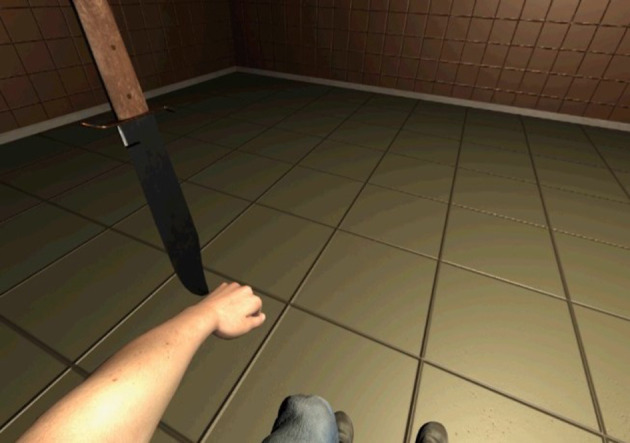
Illusory ownership can be induced in a virtual body by visuo-motor synchrony. Our aim was to test the possibility of a re-association of the right thumb with a virtual left arm and express the illusory body ownership of the re-associated arm through a synchronous or asynchronous movement of the body parts through action and vision. Participants felt that their right thumb was the virtual left arm more strongly in the synchronous condition than in the asynchronous one, and the feeling of ownership of the virtual arm was also stronger in the synchronous condition. We did not find a significant difference in the startle responses to a sudden knife appearance to the virtual arm between the two synchrony conditions, as there was no proprioceptive drift of the thumb. These results suggest that a re-association of the right thumb with the virtual left arm could be induced by visuo-motor synchronization; however, it may be weaker than the natural association.
通过视觉运动同步可以在虚拟身体中诱发错觉性所有权。我们的目的是测试右手拇指与虚拟左臂重新关联的可能性,并通过身体部位的同步或异步运动,经动作和视觉来表达重新关联手臂的错觉性身体所有权。与异步条件相比,参与者在同步条件下更强烈地感觉他们的右手拇指是虚拟左臂,并且在同步条件下对虚拟手臂的所有权感觉也更强。在两种同步条件下,对于虚拟手臂突然出现一把刀的惊吓反应,我们没有发现显著差异,因为拇指没有本体感觉漂移。这些结果表明,右手拇指与虚拟左臂的重新关联可以通过视觉运动同步诱发;然而,它可能比自然关联更弱。