Bessler Jule, Prange-Lasonder Gerdienke B, Schulte Robert V, Schaake Leendert, Prinsen Erik C, Buurke Jaap H
Roessingh Research and Development, Enschede, Netherlands.
Department of Biomedical Signals and Systems, University of Twente, Enschede, Netherlands.
Front Robot AI. 2020 Nov 16;7:557606. doi: 10.3389/frobt.2020.557606. eCollection 2020.
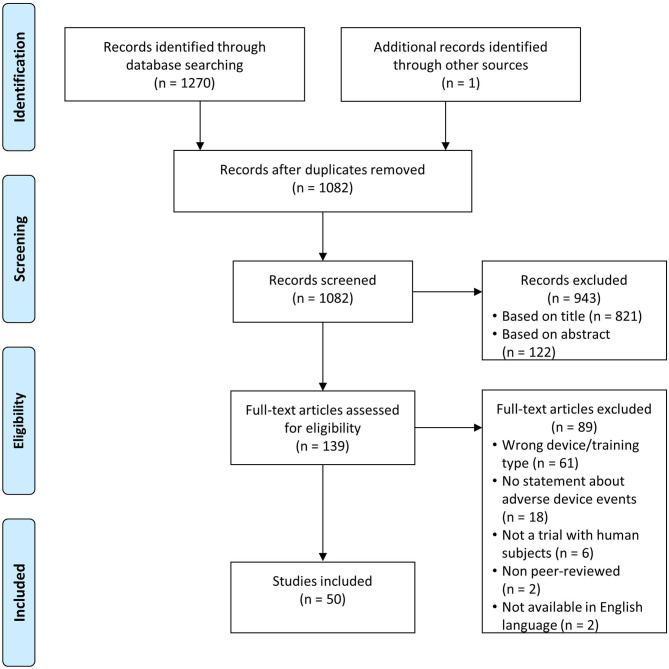
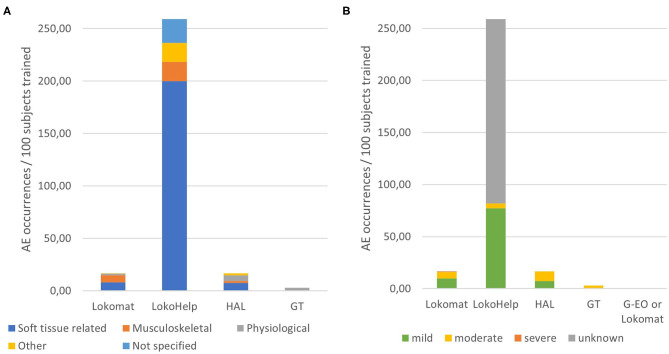
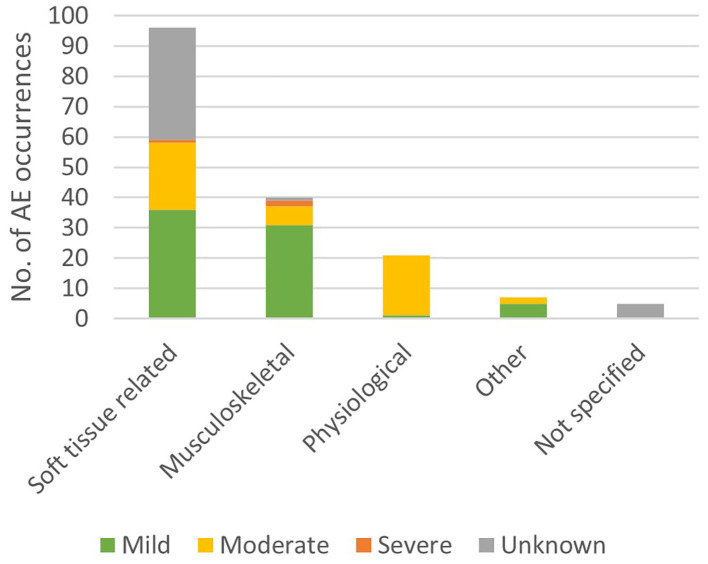
Robot-assisted gait training (RAGT) devices are used in rehabilitation to improve patients' walking function. While there are some reports on the adverse events (AEs) and associated risks in overground exoskeletons, the risks of stationary gait trainers cannot be accurately assessed. We therefore aimed to collect information on AEs occurring during the use of stationary gait robots and identify associated risks, as well as gaps and needs, for safe use of these devices. We searched both bibliographic and full-text literature databases for peer-reviewed articles describing the outcomes of stationary RAGT and specifically mentioning AEs. We then compiled information on the occurrence and types of AEs and on the quality of AE reporting. Based on this, we analyzed the risks of RAGT in stationary gait robots. We included 50 studies involving 985 subjects and found reports of AEs in 18 of those studies. Many of the AE reports were incomplete or did not include sufficient detail on different aspects, such as severity or patient characteristics, which hinders the precise counts of AE-related information. Over 169 device-related AEs experienced by between 79 and 124 patients were reported. Soft tissue-related AEs occurred most frequently and were mostly reported in end-effector-type devices. Musculoskeletal AEs had the second highest prevalence and occurred mainly in exoskeleton-type devices. We further identified physiological AEs including blood pressure changes that occurred in both exoskeleton-type and end-effector-type devices. Training in stationary gait robots can cause injuries or discomfort to the skin, underlying tissue, and musculoskeletal system, as well as unwanted blood pressure changes. The underlying risks for the most prevalent injury types include excessive pressure and shear at the interface between robot and human (cuffs/harness), as well as increased moments and forces applied to the musculoskeletal system likely caused by misalignments (between joint axes of robot and human). There is a need for more structured and complete recording and dissemination of AEs related to robotic gait training to increase knowledge on risks. With this information, appropriate mitigation strategies can and should be developed and implemented in RAGT devices to increase their safety.
机器人辅助步态训练(RAGT)设备用于康复治疗,以改善患者的行走功能。虽然有一些关于地面外骨骼的不良事件(AE)及相关风险的报告,但固定步态训练器的风险尚无法准确评估。因此,我们旨在收集有关使用固定步态机器人期间发生的AE的信息,识别相关风险以及安全使用这些设备的差距和需求。我们检索了书目和全文文献数据库,以查找描述固定RAGT结果并特别提及AE的同行评审文章。然后,我们汇总了有关AE的发生情况、类型以及AE报告质量的信息。在此基础上,我们分析了固定步态机器人中RAGT的风险。我们纳入了50项涉及985名受试者的研究,其中18项研究报告了AE。许多AE报告不完整,或者在不同方面(如严重程度或患者特征)没有包含足够的细节,这妨碍了对AE相关信息的精确统计。报告了79至124名患者经历的169起以上与设备相关的AE。软组织相关的AE最常发生,主要报告于末端执行器型设备。肌肉骨骼AE的发生率次之,主要发生在外骨骼型设备中。我们还识别出了生理AE,包括外骨骼型和末端执行器型设备中均出现的血压变化。固定步态机器人训练可能会对皮肤、深层组织和肌肉骨骼系统造成损伤或不适,以及不必要的血压变化。最常见损伤类型的潜在风险包括机器人与人体(袖口/背带)界面处的压力和剪切力过大,以及可能由机器人与人体关节轴之间的不对准导致的施加于肌肉骨骼系统的力矩和力增加。需要更结构化和完整地记录及传播与机器人步态训练相关的AE,以增加对风险的认识。有了这些信息,就可以而且应该在RAGT设备中制定并实施适当的缓解策略,以提高其安全性。