Xiao Xiao, Poon Howard, Lim Chwee Ming, Meng Max Q-H, Ren Hongliang
Department of Electrical and Electronic Engineering, Southern University of Science and Technology, Shenzhen, China.
Department of Biomedical Engineering, National University of Singapore, Singapore, Singapore.
Front Robot AI. 2020 Nov 27;7:575445. doi: 10.3389/frobt.2020.575445. eCollection 2020.
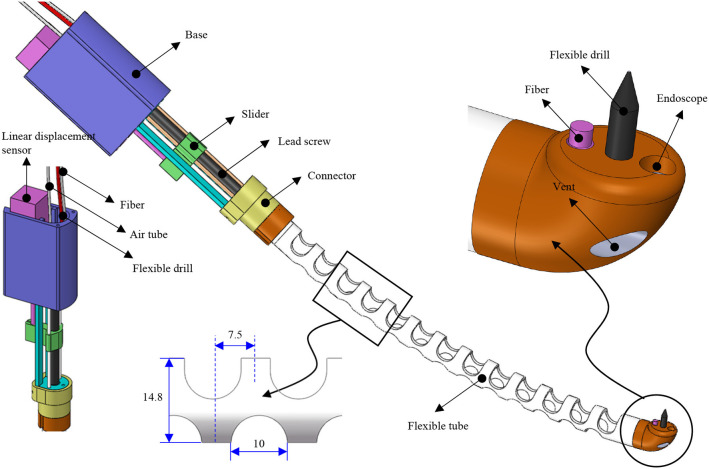
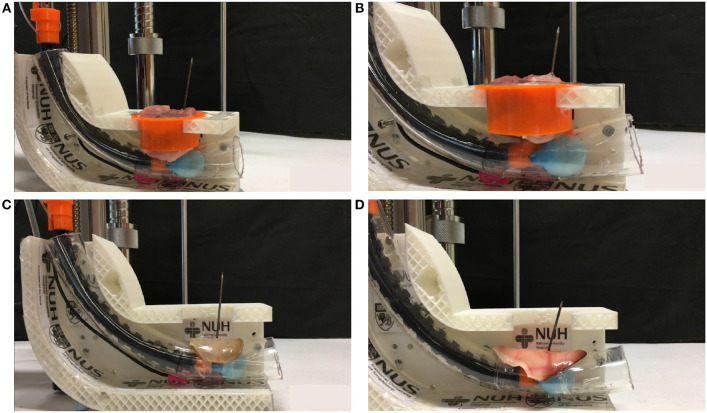
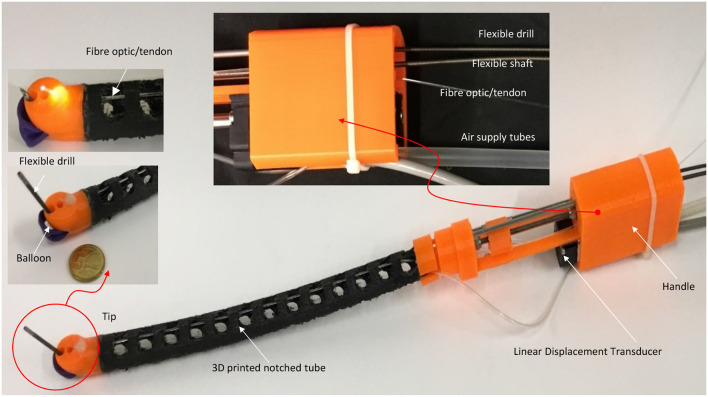
COVID-19 can induce severe respiratory problems that need prolonged mechanical ventilation in the intensive care unit. While Open Tracheostomy (OT) is the preferred technique due to the excellent visualization of the surgical field and structures, Percutaneous Tracheostomy (PT) has proven to be a feasible minimally invasive alternative. However, PT's limitation relates to the inability to precisely enter the cervical trachea at the exact spot since the puncture is often performed based on crude estimation from anatomical laryngeal surface landmarks. Besides, there is no absolute control of the trajectory and force required to make the percutaneous puncture into the trachea, resulting in inadvertent injury to the cricoid ring, cervical esophagus, and vessels in the neck. Therefore, we hypothesize that a flexible mini-robotic system, incorporating the robotic needling technology, can overcome these challenges by allowing the trans-oral robotic instrument of the cervical trachea. This approach promises to improve current PT technology by making the initial trachea puncture from an "inside-out" approach, rather than an "outside-in" manner, fraught with several technical uncertainties.
新型冠状病毒肺炎(COVID-19)可引发严重的呼吸问题,在重症监护病房需要长时间进行机械通气。虽然开放式气管切开术(OT)因手术视野和结构的良好可视化而成为首选技术,但经皮气管切开术(PT)已被证明是一种可行的微创替代方法。然而,PT的局限性在于无法精确地在确切位置进入颈段气管,因为穿刺通常是基于从喉部表面解剖标志进行的粗略估计。此外,对于经皮穿刺进入气管所需的轨迹和力量没有绝对的控制,导致环状软骨、颈段食管和颈部血管受到意外损伤。因此,我们假设一种结合机器人针刺技术的柔性微型机器人系统可以通过允许经口进入颈段气管的机器人器械来克服这些挑战。这种方法有望通过采用“由内向外”的方式进行初始气管穿刺,而不是充满若干技术不确定性的“由外向内”方式,来改进当前的PT技术。